If you live in Islamabad, Rawalpindi, or the surrounding areas, chances are your electricity comes from IESCO – Islamabad Electric Supply Company, one of Pakistan’s key power distribution companies under WAPDA. Every month, your electricity bill is shaped not just by how many units you consume, but also when you use them. That’s where peak hours and off-peak hours come into play.
In simple terms, peak hours are the time slots when electricity demand is at its highest—think evenings when everyone’s home, lights are on, air conditioners are running, and kitchens are busy. Because the load on the grid is greater, IESCO’s peak hour unit rates are higher. On the flip side, off-peak hours are the quieter periods, usually late at night or early morning, when demand is low and the electricity per unit cost is cheaper.
The National Electric Power Regulatory Authority (NEPRA) sets these time-of-use (TOU) tariff rates for all distribution companies, including IESCO, ensuring a structured approach to electricity pricing. By knowing these time slots, you can plan your energy usage more efficiently and keep your monthly bill in check.
That’s exactly where the IESCO Peak Hour Usage Cost Calculator becomes a game changer. This easy-to-use tool helps you estimate your electricity cost during peak and off-peak hours, compare rates, and see exactly how much you could save just by shifting appliance usage to cheaper time slots. In other words, it’s like having a personal energy-saving assistant right at your fingertips—helping you cut costs without cutting comfort.
IESCO Peak Hour Usage Cost Calculator 2026
IESCO Peak Hour Cost Calculator
Using the IESCO Peak Hour Usage Cost Calculator
We’ve made saving on your electricity bill easier than ever with our custom-built IESCO Peak Hour Usage Cost Calculator—a simple yet powerful tool designed right into this website. No more guessing how much those evening appliance runs are costing you; now you can see the numbers instantly.
-
Enter Units Consumed
– Add the total number of units (kWh) you expect to use. This could be for a single appliance or your entire household usage during a specific period. -
Select Time of Day
– Choose whether you’re calculating for peak hours or off-peak hours. The calculator uses the official IESCO TOU (Time of Use) schedule to determine the correct rate. -
Enter Appliance Wattage
– If you want a more precise calculation, add the wattage of the appliance you’re running. For example, a 1,500-watt heater or a 750-watt washing machine. -
Hit Calculate
– Instantly, the tool will process your inputs and apply NEPRA’s approved IESCO tariff rates for peak or off-peak hours.
How the Tool Works Behind the Scenes
Our calculator is programmed with the latest IESCO electricity tariff structure and TOU billing method. It multiplies your units or wattage by the applicable per unit rate—higher for peak hours, lower for off-peak—and then totals it for both monthly and annual cost estimates.
✅ Use the IESCO Bill Calculator to plan your energy expenses
Understanding Your Results
Once you hit calculate, you’ll see:
-
Cost for the selected time slot (peak or off-peak)
-
Monthly total if you maintain the same usage pattern
-
Annual total so you can see long-term savings potential
-
A side-by-side comparison of peak vs off-peak costs if you try both options
Why It’s Useful
By visualizing the difference, you’ll instantly know if shifting appliance usage to off-peak hours could save you hundreds—or even thousands—of rupees over the year.
So go ahead—try it out right now, test different scenarios, and see how much you can save. With this calculator, cutting your electricity costs is no longer a guessing game—it’s a smart, data-backed decision.
Understanding IESCO Peak and Off-Peak Hours 2026
When it comes to electricity billing in Islamabad and nearby regions, knowing your IESCO peak and off-peak hours isn’t just helpful—it’s the secret to lowering your monthly energy costs.
Current Peak Time Schedule
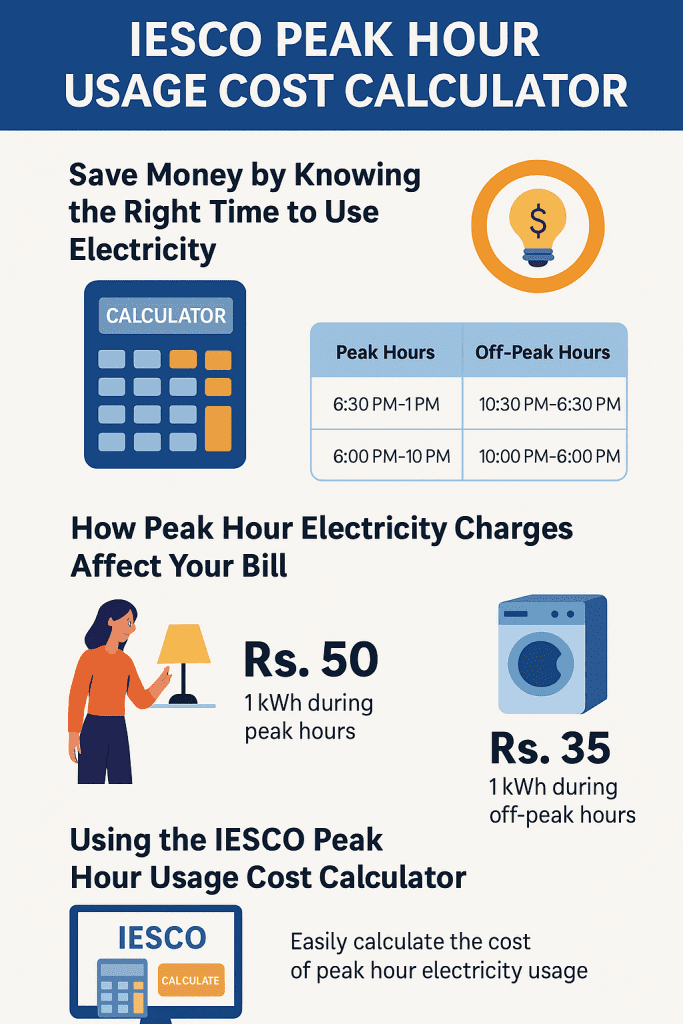
For domestic consumers, IESCO peak hours typically run during the evening when electricity demand soars—usually between 6:30 PM and 10:30 PM. For commercial and industrial consumers, the peak hours may vary slightly, but they follow the same principle: higher rates when the grid is busiest. Outside of these slots are your off-peak hours, when demand is low and per unit electricity rates drop.
Peak vs Off-Peak Rates
The difference between peak hour rates and off-peak unit rates can be substantial. For example, if the peak rate is several rupees higher per kWh than the off-peak rate, running heavy appliances like air conditioners, electric heaters, or water pumps during off-peak hours could mean significant monthly savings. The idea is simple: use more power when it’s cheaper, less when it’s expensive.
Also Check: IESCO Solar Saving Calculator
What is a kWh and How is it Measured?
Electricity usage is measured in kilowatt-hours (kWh)—essentially the amount of energy used to run a 1,000-watt appliance for one hour. So, if you run a 2,000-watt heater for two hours during peak time, you’re using 4 kWh at the higher rate. Understanding this unit is key to managing both your energy consumption and your electricity bill.
Official Tariff References
If you want to see the latest IESCO electricity tariff structure, including peak and off-peak rates, these are set and updated by the National Electric Power Regulatory Authority (NEPRA). You can check the official updates on:
Knowing this schedule and the rate difference isn’t just about information—it’s about empowerment. With the right timing, you can make every kilowatt-hour work in your favor.
How Peak Hour Electricity Charges Affect Your Bill 2026
One of the biggest shifts in modern electricity billing is time-based billing—also called Time of Use (TOU). Instead of charging a flat rate for every unit you consume, IESCO bills you differently depending on when you use that electricity.
How Time-Based Billing Works
In this system, the per unit rate during peak hours is higher because the demand on the power grid is at its maximum. Conversely, the off-peak rate is lower, encouraging consumers to shift their usage to these quieter hours. This not only saves you money but also helps reduce pressure on the grid during high-demand periods.
Example: 1 kWh in Peak vs Off-Peak Hours
Let’s say the peak hour rate is Rs. 50 per kWh and the off-peak rate is Rs. 35 per kWh (for illustration only). If you run a 1,000-watt appliance for one hour:
-
During peak hours, it costs: 1 kWh × Rs. 50 = Rs. 50
-
During off-peak hours, it costs: 1 kWh × Rs. 35 = Rs. 35
That’s a 30% saving just by shifting your usage to a different time of day. Now imagine this difference applied to all your high-consumption appliances—air conditioners, water pumps, washing machines—over an entire month.
Factors That Affect Your Cost
Your total bill impact depends on:
-
Appliance type – High-wattage appliances (ACs, geysers, heaters) consume more units per hour.
-
Duration of usage – The longer you run them during peak hours, the more it costs.
-
Load in kW – A 2 kW appliance will double your consumption compared to a 1 kW device.
Residential vs Commercial Impact
For residential users, shifting a few key appliances to off-peak hours can make a noticeable dent in the bill. For commercial users, where machinery or heavy equipment is running, the impact is even greater—sometimes saving thousands of rupees a month.
In short, understanding and adjusting to IESCO’s peak hour charges isn’t just smart—it’s one of the most effective cost-cutting strategies available to you.
➡️ Find your accurate electrical load needs with this tool
Tips to Save Electricity During Peak Hours
Paying high IESCO peak hour rates isn’t inevitable—you have more control over your electricity bill than you think. With a few smart changes in your usage habits, you can cut costs without sacrificing comfort or productivity.
1. Shift Appliance Use to Off-Peak Hours
The simplest (and most effective) tip is to run heavy appliances when electricity is cheaper. Washing machines, water pumps, geysers, and air conditioners are best operated during off-peak hours, when per unit rates drop. Even shifting just two hours of high-load appliance use out of peak time can translate into noticeable monthly savings.
2. Use Energy-Efficient Appliances
Switch to energy-efficient devices like inverter ACs, LED lights, and high-efficiency refrigerators. These consume fewer kilowatt-hours (kWh), which means you’ll pay less—regardless of whether it’s peak or off-peak time.
3. Take Advantage of Smart Meters
If you have a TOU (Time of Use) smart meter, use it to track your real-time consumption. Many smart meters display peak vs off-peak usage, helping you adjust habits instantly. Over time, you’ll get a clear picture of your energy patterns and where you can save.
4. Load Management for Commercial Consumers
For businesses and commercial setups, strategic load management can significantly reduce operating costs. Stagger machinery usage, run non-essential equipment during off-peak hours, and consider backup systems like solar power to reduce grid reliance during costly time slots.
Why These Tips Work
Reducing electricity use during IESCO’s peak hours not only helps your budget but also supports the power grid by easing demand during high-load periods. It’s a win-win—lower bills for you, and a more stable supply for everyone.
Start small, track your results with the IESCO Peak Hour Usage Cost Calculator, and you’ll quickly see how these adjustments can add up to major annual savings.
✅ Access old IESCO bills by entering your reference number
IESCO Peak Hour Tariff & NEPRA Notifications
Electricity rates in Pakistan—especially IESCO’s peak hour charges—aren’t fixed forever. They are regulated and periodically updated by the National Electric Power Regulatory Authority (NEPRA) to reflect changes in generation costs, fuel prices, and government policies.
Recent NEPRA Tariff Updates
In recent tariff adjustments, peak hour rates have increased more than off-peak rates, making it even more important for consumers to be mindful of their time-of-use (TOU) patterns. NEPRA reviews these rates regularly, meaning the per unit cost you pay during peak hours today may be different a few months from now.
Official IESCO Tariff Schedule
For the most accurate and up-to-date information, always refer to the official tariff documents:
These resources detail domestic, commercial, and industrial tariff slabs, including peak and off-peak unit rates for both single-phase and three-phase connections.
Impact on Domestic & Industrial Users
-
Domestic Users: Even small appliances can significantly impact bills if run during peak hours. For households, understanding these rates allows you to plan your daily routine—such as ironing clothes, running washing machines, or heating water—when electricity is cheaper.
-
Industrial Users: In manufacturing or service industries, where heavy machinery runs for hours, peak rates can make a substantial difference in operating costs. Many businesses now schedule production cycles around off-peak hours to stay competitive.
Keeping track of NEPRA tariff notifications and IESCO’s official rates ensures you’re never caught off guard by a sudden spike in your bill. Combine this awareness with the IESCO Peak Hour Usage Cost Calculator, and you have a powerful strategy to control energy expenses year-round.
✅ Check your expected solar savings with our solar calculator
Frequently Asked Questions (FAQs)
Q1: What are IESCO peak and off-peak hours?
IESCO peak hours are specific time slots—usually in the evening—when electricity demand is highest and per unit rates are higher. Off-peak hours are the low-demand periods, often late at night or early morning, when electricity is cheaper. These timings are set according to NEPRA’s time-of-use (TOU) tariff schedule.
Q2: How can I save money on my IESCO electricity bill?
You can save by shifting heavy appliance usage to off-peak hours, using energy-efficient devices, and tracking your consumption through a TOU smart meter. Our IESCO Peak Hour Usage Cost Calculator helps you see exactly how much you could save by changing your usage habits.
Q3: Are peak hours the same for residential and commercial consumers?
The basic principle is the same—peak hours have higher rates for both residential and commercial users—but the exact timings and tariff rates can vary depending on the consumer category and connection type. Always check the latest IESCO tariff schedule for details.
Q4: Does IESCO have different rates for summer and winter?
Yes. In some cases, NEPRA-approved tariffs can differ between seasons due to changes in fuel costs and demand patterns. This can affect both peak and off-peak unit rates, so it’s worth reviewing the updated tariff notifications regularly.
Q5: What is TOU billing and how does it work?
TOU (Time of Use) billing means your electricity cost depends on when you use it. Peak hours have higher per unit rates, while off-peak hours are cheaper. This encourages consumers to shift non-essential usage to low-demand times, benefiting both their wallet and the power grid.
Q6: How do I know if I’m being charged peak rates?
If you have a TOU smart meter, it automatically records peak and off-peak consumption separately on your bill. You can also check your IESCO bill breakdown to see units charged at different rates, or use our Peak Hour Usage Cost Calculator to compare costs yourself.
✅ Forgot your reference number? Use this tool to recover it instantly
Conclusion & Call to Action
Understanding the difference between IESCO peak and off-peak hours is more than just an energy-saving tip—it’s a direct way to put money back in your pocket. By knowing when to use your high-consumption appliances, you can cut down your electricity costs without sacrificing comfort or productivity.
Our IESCO Peak Hour Usage Cost Calculator makes this easier than ever. With just a few clicks, you can see exactly how your usage patterns affect your bill, compare monthly vs. annual costs, and find the best times to run your appliances.
For an even clearer picture of your electricity usage, you can also use the IESCO Online Bill Check Tool to track your monthly consumption and verify peak/off-peak unit charges.
Pro Tip: Bookmark this calculator and share it with friends, family, or even your workplace. The more people use it, the more we all save—both in terms of money and energy.
Start today. Open the calculator, adjust your habits, and watch your savings grow month after month.
Also Check: