Tips to Reduce Your IESCO Bill – Proven Ways to Save on Electricity Costs
Electricity bills giving you a headache? You’re not alone. The Islamabad Electric Supply Company (IESCO) plays a crucial role in powering daily life across regions like Islamabad, Rawalpindi, Attock, Jhelum, Chakwal, and nearby areas of Kashmir, serving around 3.2 million consumers and touching the lives of over 25 million people.
Lately, the sting of rising electricity costs has been felt by every household—from city flats to suburban homes. Whether it’s soaring summer demand, changing tariff slabs, or unexpected peak charges, it’s more important than ever to make every rupee count. By lowering your electricity consumption, you not only save money but also contribute to a greener, more sustainable home.
➡️ Track your IESCO bill status and due date online
In this guide, we’ll help you master three key concepts that can make a real difference:
-
The peak hours when electricity use costs more,
-
Understanding IESCO’s tariff categories (like “Life-line” vs “Un-protected,” and how Time-of-Use (TOU) billing works),
-
And simple, energy-efficient habits that feel natural, not forced.
Stick with me—this will feel less like a lecture and more like handy, everyday wisdom you wish someone had shared earlier.
➡️ Easily calculate estimated electricity charges for your household
Understand Your IESCO Bill
Understanding your electricity bill can feel like decoding hieroglyphs—but let’s unpack it together in everyday terms, using familiar LSI keywords like IESCO tariff slabs, lifeline vs unprotected, Time-of-Use (TOU) meters, and the handy IESCO Bill Calculator.
1. IESCO Tariff Slabs & Unit-Based Billing
IESCO divides your electricity bill into slabs, meaning the more units you use, the higher the rate per unit. Here’s a snapshot for residential users (sanctioned load up to 5 kW):
-
Lifeline (up to 50 units): just ₨3.95/kWh
-
Protected (51–100 units): ₨7.74/kWh
-
Protected (101–200 units): around ₨10–14/kWh, depending on the notifications.
-
Once you go beyond 200 units, you’re treated as unprotected, paying much higher rates per unit.
2. Lifeline vs Protected vs Unprotected: What’s the Difference?
-
Lifeline consumers enjoy the most affordable rates—only if their usage stays under 50 (sometimes 100) units per month.
-
Protected consumers can use up to 200 units and still benefit from lower rates. If you exceed 200 units in a month, you’re labeled unprotected, meaning no slab benefits and noticeably steeper prices.
3. Time-of-Use (TOU) Meters—Peak & Off-Peak Savings
If you have a TOU meter (typically for higher loads), your bill differentiates between peak and off-peak hours. For example, commercial and TOU residential users might get charged around ₨45/kWh at peak times, but only ₨36–₨41/kWh in off-peak hours.
Even for regular households, understanding peak times—seasonally defined—can help you shift appliance use and save big on your bill.
4. Use the IESCO Bill Calculator — Estimate Before You Pay
The IESCO Bill Calculator on IESCO-Online-Bill.pk is your digital ally. You simply:
-
Enter your monthly electricity usage,
-
Select your tariff category (lifeline, protected, unprotected, TOU, etc.),
-
Get an instant bill estimate with taxes, surcharges, and any peak-hour effects included
Why It Matters:
When you know which slab you fall into, how TOU pricing works, and how to estimate your bill, you’re not just reading a statement—you’re taking control. You’ll know when you’re creeping into a higher slab (and raising your cost), and you’ll find the best ways to reduce usage—especially during peak times.
➡️ View all your previous month IESCO bills here
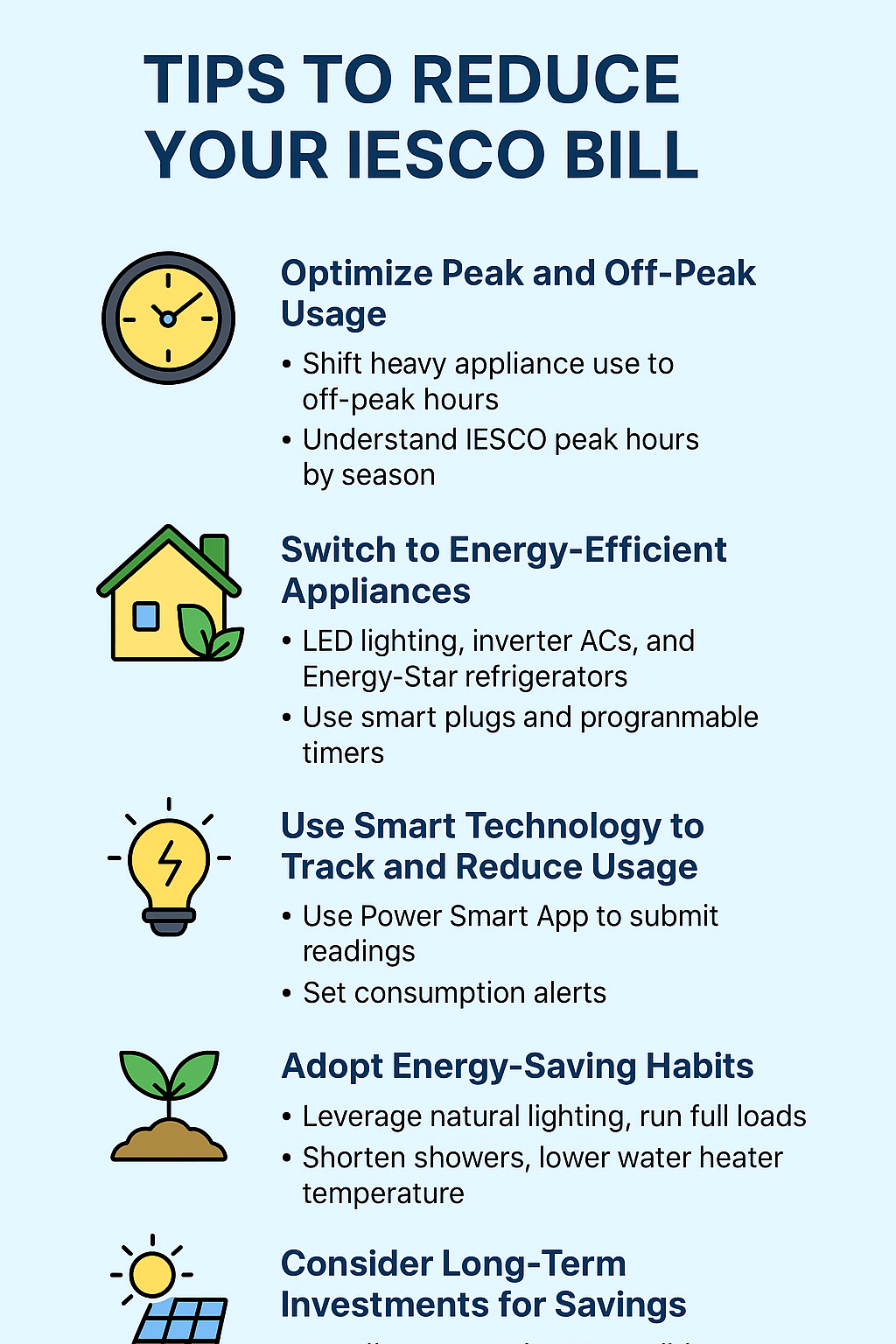
Optimize Usage Based on Peak and Off-Peak Hours
Ready to take control of your electricity bill? Understanding IESCO peak hours and Time-of-Use (TOU) billing can be your secret weapon to smart savings.
IESCO Peak Hours by Season
IESCO’s peak electricity times shift gently through the year. Here’s a clear snapshot to help you plan:
| Season | Peak Hours |
|---|---|
| December – February | 5 PM – 9 PM |
| March – May | 6 PM – 10 PM |
| June – August | 7 PM – 11 PM |
| September – November | 6 PM – 10 PM |
These timings are based on reliable local insights.
Why Shift Your Heavy Usage to Off-Peak Hours?
Here’s why timing your appliance use matters:
-
Cost Savings: Electricity during peak hours is in high demand—and often more expensive, especially if you’re billed under TOU. Running appliances like air conditioners or water heaters during off-peak hours can reduce your bill.
-
Grid Relief: Spreading out electricity usage helps ease pressure on the grid, reducing the chance of load-shedding during peak.
-
Better Efficiency: Appliances run more efficiently during off-peak times when grid voltage tends to be more stable.
✅ Forecast peak time electricity spending easily
Smart Usage Shifts You Can Start Now
Here’s how everyday routines can become money-savers:
-
Run the washing machine or dryer after dinner—say, between 10 PM and 6 AM—when electricity demand dips and cost may drop.
-
Iron clothes or charge devices during the same off-peak window to take advantage of stable rates.
-
Water pumps, especially for gardens or storage tanks, work better and cost less when operated late at night or early morning.
-
Air conditioners? Set them to run during off-peak hours or at least avoid starting heavy cooling cycles right at 7–9 PM when the demand surges.
In Short: By mastering the IESCO peak hours (seasonal) and making a few smart shifts—like scheduling high-consumption tasks during off-peak times—you turn your electricity bill from a constant worry into something you can manage with ease.
✅ Access the IESCO old bill archive for reference
Switch to Energy-Efficient Appliances
One of the easiest—and most impactful—ways to cut down your IESCO electricity bill is by upgrading to energy-efficient appliances. Think of it as giving your home a smarter, leaner energy diet that works 24/7 without you lifting a finger.
LED Bulbs: Small Change, Big Savings
Still using old incandescent or CFL bulbs? Switching to LED lighting can slash your lighting costs by up to 80%. LEDs don’t just use less electricity—they also last years longer, meaning fewer replacements and less hassle. Bright, efficient, and easy on the wallet—that’s a win-win.
Inverter ACs & Energy-Star Refrigerators
Appliances like inverter air conditioners and Energy-Star-rated refrigerators are designed to adjust their power usage according to need, instead of running at full throttle all the time.
-
Inverter ACs cool your space without the wild temperature swings that waste energy.
-
Energy-Star refrigerators maintain steady cooling with far less electricity, and many modern models are optimized for our hot climate.
Smart Plugs & Programmable Timers
Ever heard of “phantom load”? It’s the electricity appliances that use electricity even when they’re switched off but still plugged in. Smart plugs and programmable timers solve this by cutting off the power supply when you’re not using a device. Imagine your water dispenser, TV, or gaming console actually resting when you do.
Keep Appliances in Top Shape
Efficiency isn’t just about buying new—it’s also about maintaining what you have.
-
Clean refrigerator coils every few months to help the compressor work less.
-
Change AC filters regularly for better airflow and lower energy draw.
-
Make sure washing machines and dryers aren’t overloaded, which forces them to work harder.
Use Smart Technology to Track and Reduce Usage
Want a smarter way to manage your electricity usage and keep your IESCO bill in check? Enter the Power Smart App — your digital ally for energy control.
The Power Smart App: Your Control Hub
The Power Smart App, launched as part of the “Apna Meter, Apni Reading” campaign, empowers you to submit your own meter readings each month—reducing errors from traditional meter readers and helping you avoid inflated or estimated bills. If you upload your reading on the designated day, IESCO will prioritize it over the conventional reading—protecting you from unnecessary costs.
Plus, the smart app gives you insights that go beyond the bill:
-
It shows your daily, weekly, and monthly consumption trends, helping you spot usage spikes.
-
You get alerts for meter submission dates, bill due notices, and even load-shedding updates.
-
Features like complaint lodging, bill payment, and history lookup make it an all-in-one energy manager.
Smart Meters & Real-Time Monitoring
IESCO is rolling out smart meters in phases, equipping some users with devices that provide real-time energy usage monitoring. This gives you access to hourly, daily, or monthly usage data, making it easy to identify where energy is being wasted—and act on it.
Apps like IESCO Smart bring a Smart Energy Advisor feature to the table—letting you set usage thresholds and get notified when you’re nearing them. It’s like having a personal energy coach right on your phone.
Why This Matters (And Sounds Cool)
-
Avoid Billing Surprises: Don’t be stuck with an estimated bill—submit your reading and see exactly what you owe.
-
Take Control: Trend charts expose energy-guzzling habits instantly—so you can cut back where it counts.
-
Stay On Track: Alerts and reminders mean you neither miss a submission nor get hit with late fees.
-
Full-Service, At Your Fingertips: Whether it’s paying bills, raising a complaint, or tracking usage—you get it all in one smart, mobile interface.
➡️ Calculate your solar energy savings for budgeting accuracy
Adopt Energy-Saving Habits for a Lower IESCO Bill
Sometimes, the simplest changes in your daily routine can make the biggest difference to your electricity bill. By adopting smart energy-saving habits, you not only save money but also help conserve resources for a greener Pakistan. Here’s how you can get started.
Make the Most of Natural Lighting
Why keep your lights on when the sun is offering free brightness? Open your curtains and blinds during the day to let in natural light. It’s a simple yet effective way to reduce your reliance on artificial lighting and cut down your IESCO bill.
Dress for the Weather, Not the Thermostat
Instead of cranking up the AC in summer or the heater in winter, adjust your clothing to match the season. Light, breathable fabrics in summer and warm layers in winter can keep you comfortable without high energy use.
Run Full Loads in Appliances
Whether it’s your washing machine or dishwasher, always wait until you have a full load before running them. This maximizes efficiency, saves water, and reduces electricity consumption.
Shorter Showers & Lower Water Heater Temperature
By cutting just a few minutes off your shower time and lowering your water heater temperature, you can significantly reduce your monthly energy usage. Plus, it’s better for your skin and saves water.
Unplug Idle Electronics to Avoid Phantom Loads
Many electronics like TVs, chargers, and microwaves still consume electricity even when not in use. Unplugging them—or using a power strip you can switch off—helps eliminate this “phantom load” and saves you money over time.
Small behavioral adjustments, when practiced consistently, can bring noticeable savings on your IESCO bill. Think of it as creating an energy-conscious lifestyle—one that rewards you with lower costs and a lighter environmental footprint.
Consider Long-Term Investments for Savings
If you’re serious about reducing your IESCO bill for good, it’s time to think beyond short-term fixes and invest in sustainable energy solutions. One of the most impactful choices is installing solar panels at your home or business. By generating your own solar energy, you significantly cut down on your reliance on the national grid—meaning lower bills month after month.
With net metering programs, any extra electricity your solar panels produce can be sent back to the grid, and you’ll receive credits on your future bills. This not only maximizes your savings but also ensures your investment works for you year-round.
If solar panel installation feels too big of a step right now, explore community solar projects. These allow multiple households to share the benefits of a single solar installation, reducing costs and making renewable energy more accessible.
It’s also worth checking if the government or IESCO offers any renewable energy incentives, such as subsidies or financing plans. These can make adopting clean energy more affordable and speed up your return on investment.
By shifting toward renewable energy sources today, you’re not just reducing your IESCO bill—you’re also securing energy independence and contributing to a cleaner, greener Pakistan.
Conduct a Home Energy Audit to Cut Wastage and Save More
If your electricity bill keeps climbing and you’re unsure why, it might be time for a home energy audit. This simple yet powerful step helps you identify where your energy is going—and how you can stop the wastage. Whether you choose a DIY energy audit or hire a professional, the goal is the same: pinpoint problem areas and take immediate action.
A DIY energy audit can be as straightforward as walking through your home and checking for drafts, inspecting appliances, and reviewing lighting usage. Look out for energy-hungry appliances running unnecessarily, air leaks around windows and doors, and outdated bulbs or electronics that consume more power than needed.
Professional energy audits go a step further by using specialized tools like thermal cameras, blower door tests, and load monitoring equipment to find hidden inefficiencies. While they may come at a cost, the long-term energy savings can far outweigh the initial expense.
Once you’ve identified areas of high consumption—like poor insulation, leaky ductwork, or inefficient lighting—implement corrective actions immediately. Seal gaps, upgrade to energy-efficient appliances, switch to LED lighting, and adjust thermostat settings to match your actual needs.
By conducting a thorough energy audit and making the right adjustments, you can reduce your overall consumption, lower your IESCO bill, and make your home more eco-friendly. Think of it as giving your home a full health check-up—only this one saves money and energy at the same time.
➡️ Retrieve IESCO bill reference numbers without hassle
Seasonal Adjustment Strategies to Save Energy and Lower Your IESCO Bill
Seasons change — and so should your energy habits. By making small, smart adjustments to how and when you use electricity, you can significantly lower your IESCO bill and reduce your environmental impact. Understanding seasonal peak hours and adopting the right behavioral changes for each season is the key to maximizing savings.
Summer Energy-Saving Tips
When temperatures rise, so does your electricity consumption, especially from air conditioners. Set your AC temperature between 24°C and 26°C for optimal efficiency. Use ceiling fans to circulate cool air and reduce reliance on air conditioning. Avoid running heavy appliances like washing machines, irons, or microwaves during peak hours, as electricity rates can be higher.
Winter Energy-Saving Tips
During colder months, focus on efficient heating. Use a room heater instead of heating the whole house, and insulate windows and doors to prevent heat loss. Take advantage of natural sunlight during the day by opening curtains to warm your home naturally.
Spring & Autumn Opportunities
These mid-season months are perfect for reducing appliance use altogether. The weather is often mild, so you can skip the AC or heater entirely. Open windows for ventilation, and use natural lighting as much as possible to minimize artificial light usage.
By aligning your habits with the season, you not only stay comfortable but also enjoy noticeable savings on your electricity bill. Small seasonal energy adjustments can lead to big results over the year.
FAQs
1. How can I reduce my monthly IESCO bill quickly?
You can lower your bill by using appliances during off-peak hours, replacing old bulbs with LED lights, turning off devices when not in use, and avoiding high-consumption appliances during peak times.
2. What are IESCO’s peak and off-peak hours?
IESCO peak hours are when electricity demand is highest, usually in the evening, and off-peak hours are during low demand, typically at night or early morning. Using power in off-peak hours can reduce your tariff charges.
3. Does using energy-efficient appliances really make a difference?
Yes, appliances like inverter ACs, LED lights, and energy-efficient refrigerators consume less electricity, which significantly lowers your IESCO bill over time.
4. Can solar panels help reduce my IESCO bill?
Absolutely. Installing solar panels allows you to generate your own electricity, offsetting your grid usage and even enabling net-metering benefits if approved by IESCO.
5. How can I track my daily electricity usage?
You can use smart meters, energy-monitoring apps, or your IESCO online bill portal to track usage patterns and adjust habits accordingly.
6. Is it cheaper to use heavy appliances at night?
Yes, running high-load appliances like washing machines, water motors, or irons during off-peak hours usually costs less because of reduced tariff rates.
7. Does regular bill checking help in saving electricity?
Yes, reviewing your IESCO bill monthly helps you identify usage trends, spot unnecessary consumption, and take corrective actions before costs rise.
Conclusion
Saving on your electricity bill isn’t just about one big change – it’s about smart, consistent habits that add up over time. From understanding IESCO tariffs, shifting usage to off-peak hours, investing in energy-efficient appliances, and tracking consumption with smart meters, to adopting everyday energy-saving practices – each step you take puts more control (and savings) in your hands.
Make it a habit to check your IESCO bill online every month. This helps you spot unusual spikes in consumption, measure the impact of your energy-saving strategies, and adjust quickly if needed. Even small tweaks – like switching off unused lights, adjusting AC temperatures, or using ceiling fans – can bring noticeable results in your next billing cycle.
We’d love to hear from you! What’s your favorite IESCO bill-saving tip? Drop your ideas, tricks, or personal success stories in the comments below so our community can benefit from your experience.
Start today – make one change right now, track your next bill, and see the difference for yourself. Lower bills, more savings, and a greener footprint are just a few smart choices away!