WAPDA vs IESCO – Key Differences, Roles & Impact on Pakistan’s Power Sector
Welcome to the heart of Pakistan’s electricity world—built on dams, wires, and millions of lights—yet often hidden behind confusing names like WAPDA and IESCO.
Pakistan’s electric sector is vast and layered, with WAPDA (Water and Power Development Authority) handling big-picture tasks like hydropower generation and water management, while IESCO (Islamabad Electric Supply Company) takes care of delivering that electricity—right to your home.
Understanding the difference between these two is more than just a fun fact—it’s your ticket to clearer electricity bills, knowing who’s responsible for generation vs. distribution, and making smarter decisions about your energy usage.
✅ WAPDA IESCO bill checking system for all customers
Here’s what’s happening:
-
WAPDA acts as the backbone of Pakistan’s energy infrastructure—building and managing major hydroelectric power projects, such as the impressive Tarbela and Mangla dams.
-
IESCO, spun off from WAPDA in 1998, is your local utility—responsible for electricity distribution, serving areas like Islamabad, Rawalpindi, Attock, Jhelum, and Chakwal. It ensures that the power generated by WAPDA (and other producers) actually reaches your home or office, and manages everything from billing to customer support.
In short, think of WAPDA as the generator and IESCO as your friendly neighborhood power deliverer. Ready to explore how this “hand-off” works and why it matters for your bills, services, and daily life? Let’s light it up!
What is WAPDA?
Imagine a giant puzzle that powers our farms, lights up cities, and keeps water flowing — that’s WAPDA, short for the Water and Power Development Authority.
A Legacy Forged in 1958
WAPDA was established in February 1958 as a federal authority to bring together Pakistan’s water and power plans under one roof. Its mission? To investigate, plan, and build projects spanning from hydropower generation to irrigation, drainage, flood control, and even inland navigation.
Hydropower & Dams: The Engine of Energy
Think of WAPDA as the backbone of Pakistan’s energy infrastructure and electricity generation. It’s behind iconic projects like the Mangla Dam, Tarbela Dam, Ghazi Barotha, Chashma Hydropower, and many more.
Some of its landmark hydropower projects include:
-
Allai Khwar Hydropower Plant (121 MW)
-
Duber Khwar Hydropower Plant (130 MW)
-
Golen Gol Hydropower Plant (106 MW)
Looking ahead, WAPDA’s Water Vision 2025 maps out a mega-plan with projects like Neelum Jhelum, Dasu Stage I, and Tarbela 4th Extension—all designed to boost hydel capacity and strengthen Pakistan’s power generation.
✅ Check estimated electricity charges for multiple units
More Than Just Power
WAPDA’s responsibilities don’t stop at dams and turbines. Its Water Wing plays a pivotal role in managing irrigation, reclaiming saline land, and preventing floods. It has:
-
Reclaimed over 18 million acres from waterlogging and salinity
-
Installed 15,000+ tube wells and built 12,000 km of surface drains and 13,000 km of pipe drains
-
Completed major irrigation projects like the Indus Basin barrages, the Mangla Watershed, and the Chashma Canal systems
Why It Matters to You
In short, WAPDA is the backbone of our water and energy infrastructure, stepping in where the soil needs saving, rivers need control, and electricity needs generating. Knowing WAPDA’s role helps you appreciate where your electricity starts—long before it reaches your meter under IESCO’s care.
What is IESCO?
Ever wonder who delivers that power to your light switch? That’s IESCO, short for the Islamabad Electric Supply Company—the regional utility making sure your lights stay on.
A Utility Born in 1998
IESCO was established in 1998, when the Islamabad Area Electricity Board was transformed into a focused regional power distributor. Today, IESCO is a key DISCO (distribution company) under Pakistan Electric Power Company (PEPCO). Its role is to deliver electricity, manage billing, and provide connections to homes and businesses in its service regions.
The Regions IESCO Lights Up
IESCO’s network covers several important districts: Islamabad, Rawalpindi, Attock, Jhelum, Chakwal, and parts of Azad Jammu & Kashmir. Altogether, it serves around 3.2 million customers, impacting over 25 million people who depend on its electricity every day.
What IESCO Does for You
IESCO plays a vital role in everyday life, handling:
-
Electricity Distribution & Supply: From the power grid to your home or office, IESCO ensures reliable electricity delivery.
-
Billing & Payments: It generates your monthly bills, applies tariffs set by NEPRA, and offers flexible payment options.
-
New Connections: Whether for a house, shop, or office, IESCO processes applications, conducts inspections, and approves new electricity connections.
-
Customer Support & Centers: With a 24/7 helpline and customer service centers, IESCO resolves billing issues, complaints, and meter-related queries.
-
Network Infrastructure: It operates 108 grid stations and nearly 1,000 feeders, organized into circles, divisions, and subdivisions for efficient management.
➡️ Access your complete IESCO billing history quickly
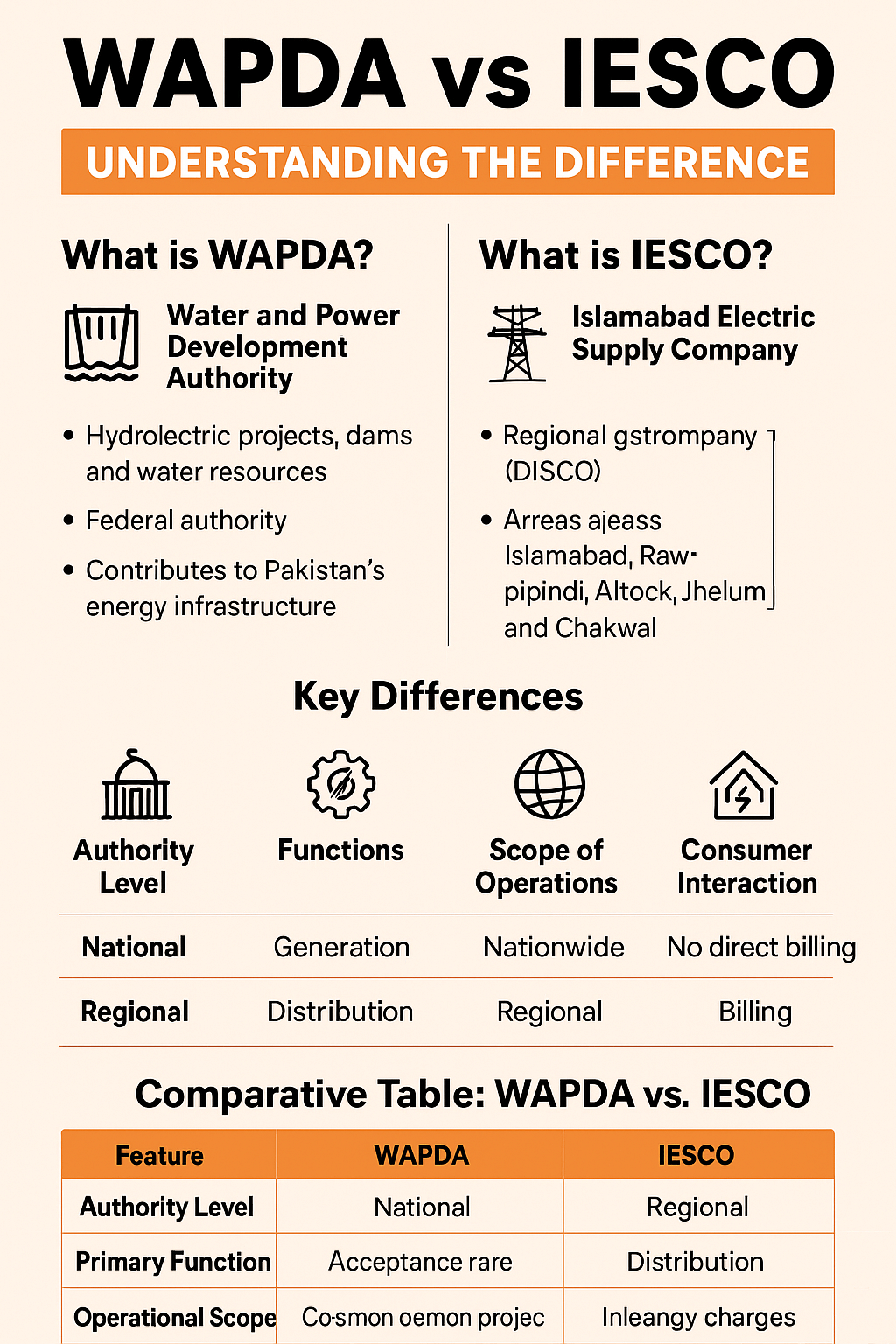
WAPDA vs. IESCO – Key Differences
Think of Pakistan’s electricity system as a relay race—WAPDA kicks things off, and IESCO carries the baton right to your doorstep.
Authority Level: National vs Regional
WAPDA (Water and Power Development Authority) is a national, federal authority established in 1958, responsible for powering the country with hydroelectric infrastructure and water resources across the nation.
On the other hand, IESCO (Islamabad Electric Supply Company) is a regional distribution company (DISCO) set up in 1998 to serve areas like Islamabad, Rawalpindi, Attock, Jhelum, and Chakwal.
Functions: Generation vs Distribution
WAPDA focuses on generation, building, and managing dams, hydropower stations, and water infrastructure that form the backbone of Pakistan’s energy infrastructure.
IESCO, by contrast, handles distribution. It buys electricity from entities like WAPDA and delivers it to homes, businesses, and public institutions within its service region.
✅ Get solar savings estimates tailored to your consumption
Scope of Operations
-
WAPDA has a nationwide reach, with responsibilities spanning dams, rivers, and national power generation schemes.
-
IESCO serves the Islamabad Capital Territory and surrounding districts, with a focused operational scope that includes local grid maintenance and consumer services.
Consumer Interaction: Who Bills You?
-
WAPDA does not issue bills to consumers; it’s focused on upstream infrastructure and generation.
-
IESCO is the company that issues your monthly electricity bill, manages payments, and provides customer assistance within its region.
Comparative Table: WAPDA vs IESCO
| Feature | WAPDA (National Authority) | IESCO (Regional DISCO) |
|---|---|---|
| Authority Level | Federal government agency | Regional distribution company under PEPCO |
| Primary Function | Hydropower generation & water management | Electricity distribution, billing, and customer service |
| Operational Scope | Nationwide energy & water projects | Islamabad, Rawalpindi, Attock, Jhelum, Chakwal |
| Consumer Billing | Does not bill consumers | Responsible for issuing electricity bills |
| Customer Services | Not directly involved with consumers | Handles new connections, complaints, and bill inquiries |
Consumer Impact and Services
When it comes to electricity, IESCO isn’t just about wires, grids, and bills—it’s about how power actually reaches your home, how much you pay for it, and the quality of service you experience every day. Let’s break down how IESCO impacts you as a consumer.
How IESCO Manages the Electricity Billing System
Your monthly IESCO bill is more than just numbers on paper—it reflects your actual electricity usage, meter readings, government taxes, and tariff adjustments. IESCO has introduced digital billing services like online bill checking, SMS alerts, and multiple payment channels so you can stay updated and pay conveniently. This not only saves time but also ensures billing transparency.
Subsidy Allocation and Government Support
One of the biggest consumer benefits comes from government subsidies. Many households—especially those with low consumption—receive relief through electricity subsidies applied directly on their IESCO bills. This helps keep power affordable for middle-class and low-income families, reducing the burden of rising energy prices.
✅ Track the impact of peak hour electricity usage on costs
Importance of NEPRA Regulations in Tariff Setting
Ever wonder who decides electricity rates? That’s where NEPRA (National Electric Power Regulatory Authority) comes in. NEPRA regulates tariff structures, fuel cost adjustments, and billing transparency to make sure IESCO consumers are charged fairly. With these regulations, consumers are protected from sudden price hikes and benefit from a regulated and standardized billing process.
Role of IESCO in Load Management & Reducing Line Losses
Like any utility company, IESCO faces challenges such as line losses and power theft, which increase costs for everyone. To tackle this, IESCO invests in grid modernization, advanced meters, and monitoring systems. It also implements load management strategies to ensure fair distribution of electricity during high-demand periods, keeping outages shorter and more predictable.
Consumer Connection Process under IESCO
Need a new electricity connection? IESCO has streamlined the process to make it more consumer-friendly. From online application forms to document verification and site inspections, the whole process is designed to be transparent and efficient. Whether it’s for your home, shop, or business, IESCO ensures you get connected without unnecessary delays.
✅ Use the calculator to verify home load capacity safety
Importance of WAPDA in Pakistan’s Energy Sector
When we talk about electricity in Pakistan, one name always stands out—WAPDA (Water and Power Development Authority). It’s not just an organization; it’s the backbone of Pakistan’s energy system, playing a vital role in keeping our homes bright, our industries running, and our fields irrigated.
Role in Hydroelectric Dams and Power Projects
WAPDA is best known for building and operating hydropower dams like Tarbela, Mangla, and Warsak, which generate thousands of megawatts of clean and affordable electricity. These dams don’t just provide power—they also help in flood control, irrigation, and water storage, making them essential for Pakistan’s long-term energy stability. With projects like Diamer-Bhasha Dam and Dasu Hydropower Project, WAPDA continues to expand Pakistan’s hydroelectric capacity.
Ensuring Water Management for Agriculture and Industry
Pakistan’s economy depends heavily on agriculture, and WAPDA ensures that farmers get the water they need for crops like wheat, rice, and cotton. By managing rivers, canals, and reservoirs, WAPDA supports irrigation systems that sustain millions of livelihoods. At the same time, industries benefit from reliable water supply for their operations, showing how WAPDA is equally crucial for both food security and industrial growth.
Contribution to Renewable Energy and Energy Security
In addition to hydropower, WAPDA contributes to Pakistan’s renewable energy future by promoting sustainable, low-cost electricity generation. Unlike imported fuel-based power plants, hydropower is locally sourced, eco-friendly, and cost-effective, which makes it a key solution for reducing energy imports and ensuring energy security. By increasing renewable capacity, WAPDA is helping Pakistan move toward a cleaner and more self-reliant energy future.
Why WAPDA Matters to Every Pakistani
Whether it’s the electricity powering your fan, the water irrigating crops, or the clean energy reducing our reliance on expensive fuel, WAPDA is at the center of it all. Its projects shape not only our electricity bills but also the economic and environmental health of the country. In short, WAPDA is more than just a power authority—it’s a national lifeline for Pakistan’s growth and sustainability.
Common Misconceptions About WAPDA and IESCO
When it comes to electricity in Pakistan, there’s often confusion between WAPDA and IESCO. Many people mix up their roles, which leads to misunderstandings about who does what. Let’s clear the air once and for all.
Does WAPDA send electricity bills? – Not True!
One of the biggest misconceptions is that WAPDA issues electricity bills. In reality, WAPDA doesn’t deal directly with consumers at all. Its primary role is in power generation (mainly through hydropower dams) and water management projects.
The electricity bills you receive at home come from distribution companies (DISCOs)—and if you live in Islamabad, Rawalpindi, or surrounding districts, that company is IESCO (Islamabad Electric Supply Company).
WAPDA Builds Dams, IESCO Delivers Power
Another common mix-up is thinking that IESCO builds dams like Tarbela or Mangla. That’s completely WAPDA’s domain. IESCO’s job starts after electricity is generated—it distributes electricity to homes, businesses, and industries, manages billing systems, and handles customer complaints or new connections.
So, while WAPDA focuses on national-level energy and water projects, IESCO operates regionally to ensure you get electricity at your doorstep.
➡️ Never lose your bill details—retrieve your reference number online
Future Outlook of Pakistan’s Power Sector
Pakistan’s power sector is at a turning point. With rising electricity demand, frequent challenges in supply, and the global push toward clean energy, both WAPDA and IESCO are gearing up for a smarter, more sustainable future.
Power Sector Reforms in Progress
The government has been introducing ongoing reforms to reduce line losses, improve transparency, and bring efficiency to the energy sector. These reforms aim to ensure affordable electricity tariffs, minimize circular debt, and encourage private investment in renewable energy.
WAPDA’s Hydropower Expansion
WAPDA continues to play a crucial role by focusing on new hydropower projects such as Dasu, Diamer-Bhasha, and Mohmand dams. These projects not only promise clean and reliable energy but also ensure better water management for agriculture and industry. With hydropower being one of Pakistan’s most sustainable energy sources, WAPDA’s efforts are central to the country’s long-term energy security.
IESCO’s Modernization Journey
On the consumer side, IESCO is modernizing its services to provide a smoother experience for its 3.2 million customers. From digital billing systems and online bill payments to smart metering initiatives and enhanced customer support centers, IESCO is working to make electricity management easier, faster, and more transparent for users.
Government & NEPRA’s Role
The role of NEPRA (National Electric Power Regulatory Authority) and the government cannot be overstated. Together, they regulate tariff structures, ensure fair pricing, and promote policies that support renewable energy adoption. By encouraging solar, wind, and hydro projects, they are laying the foundation for a sustainable and reliable energy mix.
Looking Ahead
The future of Pakistan’s power sector lies in a balance between generation and distribution. While WAPDA focuses on building energy resources, IESCO and other DISCOs are ensuring that electricity reaches consumers efficiently. With reforms, technology, and renewable projects, the goal is clear: affordable, clean, and uninterrupted electricity for every household and business in Pakistan.
➡️ Use IESCO online bill payment to save time and energy
FAQs
Q1. Does WAPDA send electricity bills?
No, WAPDA does not send bills. WAPDA is responsible for power generation and water management. Electricity bills are issued by regional distribution companies (DISCOs) like IESCO, LESCO, MEPCO, and others.
Q2. What is the main difference between WAPDA and IESCO?
The biggest difference is their role and scope. WAPDA manages hydropower projects, dams, and water resources, while IESCO handles electricity distribution, billing, and customer service in the Islamabad region.
Q3. Is IESCO part of WAPDA?
Not exactly. IESCO was originally part of WAPDA but became a separate distribution company (DISCO) in 1998. It now operates under PEPCO and NEPRA’s regulations.
Q4. Which areas does IESCO cover?
IESCO provides electricity to Islamabad, Rawalpindi, Attock, Jhelum, Chakwal, and parts of Azad Jammu & Kashmir, serving around 3.2 million customers.
Q5. Who controls electricity tariffs in Pakistan?
Tariffs are regulated by NEPRA (National Electric Power Regulatory Authority), not directly by WAPDA or IESCO. NEPRA ensures fair pricing based on generation costs, subsidies, and government policies.
Q6. Can I apply for a new electricity connection through WAPDA?
No, WAPDA does not handle new connections. You must apply through your local distribution company (like IESCO) for new connections, billing, or complaint resolution.
Q7. What role does WAPDA play in Pakistan’s future energy needs?
WAPDA is focusing on renewable energy projects, especially hydropower dams, to reduce dependence on costly imported fuels and ensure long-term energy security for Pakistan.
Q8. How is IESCO improving customer service?
IESCO is adopting digital billing, smart metering, online bill payment systems, and 24/7 helplines to make electricity management easier and more transparent for consumers.
✅ Lost your reference number? Retrieve it quickly with this tool
Conclusion
When it comes to Pakistan’s electricity system, it’s easy to get confused between WAPDA and IESCO—but their roles are very different. WAPDA works at the national level, focusing on hydropower projects, dams, and water management, while IESCO is your regional utility in charge of delivering electricity, sending bills, and handling consumer services in Islamabad and surrounding districts.
Both play a crucial role in keeping the power sector running—WAPDA by generating energy and ensuring the availability of water resources, and IESCO by distributing electricity to millions of homes and businesses.
For consumers, the key takeaway is simple: stay informed about your electricity bills, subsidy allocations, and ongoing power sector reforms. This awareness helps you not only manage your household budget but also understand how national policies and regional utilities work together to keep the lights on.