Why Load Requirement Calculation Matters
If you’re planning to apply for a new electricity connection with IESCO or any WAPDA-affiliated company, the very first thing they’ll ask you for is your load requirement. In simple words, a load requirement calculator is a tool that helps you figure out exactly how much electrical power your home needs based on all the appliances you use—fans, lights, ACs, refrigerators, and more.
This is more than just a formality. Accurate domestic load calculation ensures your home’s electrical system is safe, efficient, and compliant with IESCO’s connection rules. If your declared load is too low, your wiring may overload, leading to tripped breakers, damaged appliances, or even fire hazards. If it’s too high, you might end up paying for capacity you don’t actually use.
For IESCO and WAPDA customers, knowing your exact connected load is also crucial when choosing between a single-phase or three-phase connection, planning for peak load hours, and estimating your monthly electricity bill. Whether you’re moving into a new home or upgrading your current setup, using a home electrical load calculator before applying for a meter can save you time, money, and a lot of unnecessary headaches.
Think of it as creating a “power blueprint” for your home—so your connection is approved faster, your appliances run smoothly, and you avoid costly mistakes from day one.
1️⃣ Appliance – This is where you type the name of the electrical device you’re adding, like Fan, LED Bulb, Fridge, AC, etc.
2️⃣ Wattage (W) – How much electricity that appliance uses per hour, in watts. You can usually find this on the appliance label or in its manual. Example: Fan = 75W, LED Bulb = 12W.
3️⃣ Qty – Short for Quantity. How many of that appliance you have in your home. Example: if you have 3 fans, type 3.
4️⃣ Hours/day – How many hours per day you normally use that appliance. Example: Fan = 8 hours/day, Bulb = 5 hours/day.
5️⃣ X – This is a delete button. Click it to remove that appliance row from the list if you no longer want to include it in the calculation
IESCO Load Requirement Calculator
Notes & Tips
- Values are estimates. Confirm with a certified electrician for final wiring & permits.
- If recommended main breaker > 63A, consider three-phase supply.
- Motor loads (pumps, AC) may require higher start currents — sizing includes a safety factor.
Results
Backup & Wiring Recommendations
Interface Guide — IESCO Load Calculator
1. Appliance
-
What it means: The name of the electrical device you want to include in your load calculation.
-
Examples:
-
Fan
-
LED Bulb
-
Refrigerator
-
Washing Machine
-
-
Why it’s needed: Helps you organize and identify which devices are included in your total load.
2. Wattage (W)
-
What it means: The amount of electrical power the appliance consumes, measured in watts.
-
Where to find it: Usually printed on the device label, user manual, or online product description.
-
Examples:
-
Fan: 75 W
-
LED Bulb: 12 W
-
Refrigerator: 200 W
-
-
Tip for users: If unsure, you can use a common approximate value, but accurate wattage gives better results.
3. Qty (Quantity)
-
What it means: The number of identical appliances you have.
-
Examples:
-
If you have 3 fans, enter
3. -
If only 1 washing machine, enter
1.
-
4. Hours/day
-
What it means: Average number of hours per day the appliance is used.
-
Why it matters: More usage time increases daily energy consumption and affects the load calculation.
-
Examples:
-
Fan in summer: 8 hours/day
-
LED bulb in hall: 5 hours/day
-
Refrigerator: 24 hours/day
-
5. Diversity Factor (%)
-
What it means: An adjustment percentage to reflect that not all appliances run at full load at the same time.
-
Default: 75% (meaning you assume that at most 75% of total load is used at once)
-
Why it’s important: This is part of IESCO’s practical load calculation method, avoiding overestimation.
6. Safety Margin (%)
-
What it means: An extra percentage added to the calculated load to account for future expansion or unexpected usage.
-
Default: 25%
-
Example: If your design load is 4.0 kW, adding 25% margin results in 5.0 kW.
-
Tip: Keep some margin to avoid undersizing your wiring or main breaker.
7. Results Section
-
Total Load:
-
The sum of all appliances’ power consumption, converted to kilowatts (kW).
-
Formula:
Total Wh ÷ 1000 = kW
-
-
Design Load:
-
Total load adjusted with Diversity Factor and Safety Margin.
-
Formula:
-
Design Load = Total kW × (Diversity Factor %) × (1 + Safety Margin %)
-
Pie Chart:
-
A visual chart showing how much each appliance contributes to the total load.
-
Helps identify big power consumers.
-
. + Add Appliance Button
-
What it does: Adds a new blank row to the table so you can enter another appliance’s data.
-
User tip: Add one row for each different appliance type.
9. X Button (Remove)
-
What it does: Deletes that row from the list.
-
When to use: If you entered something by mistake or no longer want to include an appliance.
10. Download PDF
-
What it does: Creates a PDF report of your results for saving or printing.
-
User tip: Useful for electricians, engineers, or IESCO submission.
➡️ Find your estimated IESCO bill in seconds using our calculator
Understanding Electrical Load Basics
Before you start punching numbers into a load requirement calculator, it’s important to understand the basic terms used in electrical load calculation. Think of this as learning the language of electricity—once you get it, everything about IESCO or WAPDA load requirements will make a lot more sense.
1. Watts (W), Kilowatts (kW), Volts (V), and Amperes (A)
-
Watt (W) is the basic unit of power—it tells you how much energy an appliance uses. For example, an LED bulb might be 10 watts, while an iron could be 1,000 watts.
-
Kilowatt (kW) is simply 1,000 watts. This is the unit used for bigger appliances and for your total home load.
-
Volt (V) measures the electrical “pressure” that pushes current through wires. In Pakistan, most homes run at 230 volts.
-
Ampere (A) measures the flow of electricity, or how much current is moving. High-amp appliances draw more electricity and require thicker wires for safety.
2. Single-phase vs Three-phase Power
-
Single-phase power is standard for most small to medium-sized homes. It’s cost-effective and perfect for running lights, fans, TVs, and a few AC units.
-
Three-phase power is designed for higher loads—ideal if you have multiple air conditioners, heavy machinery, or plan to run a large home or commercial setup. With three-phase, electricity flows more evenly, reducing voltage drops and improving efficiency.
3. Key Load Concepts
-
Peak Load – The highest amount of electricity you use at one time, like on a hot summer afternoon when all the fans, ACs, and appliances are running.
-
Average Load – Your normal day-to-day usage spread across 24 hours.
-
Diversity Factor – A calculation that assumes not all appliances run at the same time. For example, you don’t run the iron, oven, and water pump all together every hour.
-
Demand Factor – The ratio between your maximum possible load and the actual load you’re likely to use. This helps avoid overestimating your needs.
By understanding these terms, you’ll be better equipped to calculate connected load for your home, choose the right single-phase or three-phase connection, and ensure you meet IESCO’s domestic load requirements without wasting money on unused capacity.
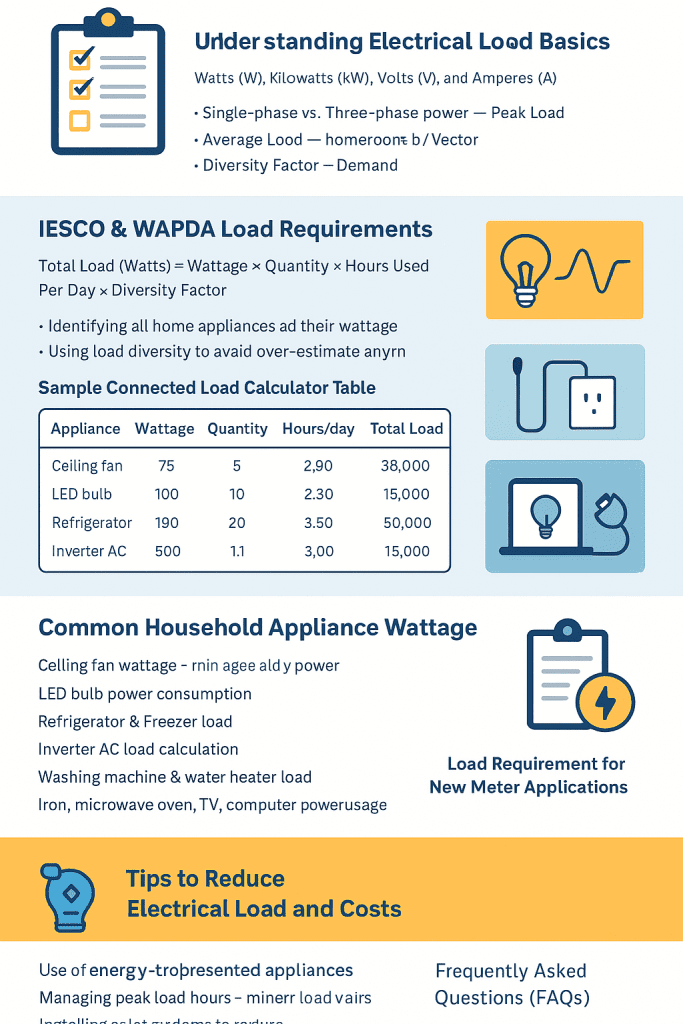
IESCO & WAPDA Load Requirements
When you apply for a new electricity connection with IESCO or any WAPDA-affiliated company, one of the first things they’ll ask for is your declared load. This isn’t just paperwork—it’s the official measure of how much electrical power your home will consume at peak usage. Declaring the right load ensures your meter capacity, wiring, and safety measures are all suitable for your actual needs.
1. IESCO Domestic Load Chart
IESCO uses a standardized load chart to guide residential customers:
-
Up to 1 kW – Suitable for small setups: lights, fans, and a few basic appliances.
-
Up to 3 kW – Ideal for average homes with multiple fans, lights, TV, fridge, and perhaps one air conditioner.
-
Up to 5 kW – For larger homes with multiple ACs, water heaters, and higher appliance usage.
-
Above 5 kW – Usually requires a three-phase connection for heavy loads.
Knowing where your home fits on this chart can speed up IESCO meter approval and help you choose the right single-phase or three-phase connection.
2. WAPDA Load Requirement Rules for Residential Users
WAPDA requires every household to declare its connected load before installation. If your actual usage exceeds your declared capacity, you could face penalties or be required to upgrade your connection. This is why using a home electrical load calculator before applying is so important—you’ll have accurate numbers to submit, avoiding both underestimation and overestimation.
3. NEPRA’s Role in Defining Load Guidelines
The National Electric Power Regulatory Authority (NEPRA) sets the overarching rules for load calculations, tariffs, and safety standards in Pakistan’s power sector. IESCO and other WAPDA distribution companies follow NEPRA’s guidelines to ensure fair billing, efficient grid management, and safety compliance for all customers.
By following the IESCO domestic load chart, adhering to WAPDA’s residential load requirements, and keeping NEPRA’s standards in mind, you can make sure your connection is sized perfectly for your home’s needs—saving you money, avoiding delays, and keeping your household safe.
➡️ Use the Solar Savings Calculator to forecast your electricity cost cut
How to Calculate Your Home’s Connected Load
Calculating your home’s connected load might sound technical, but it’s actually straightforward once you break it down. Think of it as creating a “power profile” of your home—listing every appliance you own, how much electricity it uses, and how often you use it. This is exactly what IESCO and WAPDA want to see before approving your new electricity connection.
Common Household Appliance Wattage
When calculating your home’s connected load, having a quick reference for appliance wattage makes the process much easier. While actual power consumption can vary by brand and model, the following values give you a reliable average for IESCO and WAPDA load calculations.
Ceiling Fan Wattage
A typical ceiling fan in Pakistan consumes between 60–80 watts on medium speed. High-speed fans can draw closer to 90 watts, especially older models. Energy-efficient fans can reduce this by up to 30%, saving both load capacity and electricity bills.
LED Bulb Power Consumption
Modern LED bulbs are extremely energy efficient. A 10-watt LED bulb produces about the same brightness as a 60-watt incandescent bulb, making them a must-have for reducing both connected load and monthly electricity costs.
Refrigerator & Freezer Load
Standard single-door refrigerators consume around 200–300 watts, while larger double-door or inverter models range from 250–350 watts. Chest freezers typically require 300–400 watts. Since these appliances run 24/7, they have a significant impact on your total load.
Inverter AC Load Calculation
A 1-ton inverter AC consumes approximately 1,200–1,500 watts at full load, but may operate at lower wattages once the desired temperature is reached. A 1.5-ton inverter AC typically ranges from 1,800–2,200 watts. These are among the largest contributors to household peak load.
Washing Machine & Water Heater Load
A fully automatic washing machine usually draws 400–600 watts, while semi-automatic models are slightly lower. Electric water heaters (geysers) are heavy load appliances, often consuming 1,500–3,000 watts depending on size and heating speed.
✅ Learn which Pakistan-based portals let you check all utility bills online
Iron, Microwave Oven, TV, and Computer Power Usage
-
Electric Iron – 1,000–1,500 watts (varies with temperature setting)
-
Microwave Oven – 800–1,200 watts for home models
-
LED TV – 50–150 watts depending on size and brightness settings
-
Desktop Computer – 200–400 watts (higher if used for gaming or design work)
-
Laptop – 50–100 watts on average
Using an Online Load Requirement Calculator
Manually calculating your home’s connected load can be time-consuming, especially if you have a long list of appliances. That’s where an online IESCO WAPDA Load Calculator Tool comes in—it does all the heavy lifting for you in just a few clicks.
How the IESCO WAPDA Load Calculator Tool Works
This digital tool allows you to enter each household appliance, its wattage, how many you own, and the average hours of use per day. Once you hit calculate, the tool instantly applies the electrical load calculation formula and even factors in a diversity factor so your final result is realistic, not overestimated.
Step-by-Step Usage Guide
-
Open the Load Requirement Calculator on your preferred device.
-
Select or enter the appliance name (fan, LED bulb, refrigerator, inverter AC, etc.).
-
Input the wattage of each appliance (use the appliance label or an average from a wattage chart).
-
Enter the quantity of that appliance in your home.
-
Add the hours/day you typically use it.
-
Repeat for all your household appliances.
-
Click the “Calculate” button to see your total connected load in watts and kilowatts.
-
Review the result and note if your load falls under single-phase or requires a three-phase connection.
Benefits of Calculating Before Meter Application
-
Faster IESCO Approval – Submitting an accurate load calculation speeds up the new meter process.
-
Avoids Penalties – Prevents under-declaring your load, which can lead to fines or forced connection upgrades.
-
Better Connection Choice – Helps you decide between single-phase and three-phase power.
-
Accurate Budgeting – Knowing your load can help predict monthly electricity bills based on your usage.
-
Energy Efficiency Planning – Highlights which appliances consume the most electricity, so you can reduce wastage.
Load Requirement for IESCO New Meter Applications
Applying for a new electricity connection with IESCO or any WAPDA distribution company isn’t just about filling out forms—it’s about making sure your declared electrical load matches your actual home usage. Get this wrong, and you might face delays, penalties, or even a forced connection upgrade later.
Choosing Between Single-Phase and Three-Phase Connections
Your declared load determines whether you get a single-phase or three-phase supply.
-
Single-phase connection – Best for small to medium homes with total loads under 5 kW. It’s simpler, cheaper, and perfectly fine if you only run a few heavy appliances at a time.
-
Three-phase connection – Required for loads above 5 kW or homes with multiple ACs, large water heaters, or heavy machinery. It offers better voltage stability and can handle higher peak demand without tripping.
Getting this choice right ensures your home runs smoothly without frequent voltage drops or circuit overloads.
Required Load for Different Home Sizes
While every household is unique, here’s a general guide for IESCO and WAPDA load requirement planning:
-
Small apartment or 2-room house – Around 1–2 kW
-
Medium home (3–4 rooms) – Around 3–5 kW
-
Large home (5+ rooms with multiple ACs) – 6–10 kW or more, requiring three-phase supply
These estimates are based on common appliance wattages and typical usage patterns in Pakistani households.
Avoiding Penalties for Under-Declared Load
Declaring a lower load than you actually use may seem tempting to save on connection fees, but IESCO/WAPDA inspections can detect this. If they find your actual usage exceeds your declared load, you could face:
-
Financial penalties
-
Forced load upgrade (with higher connection fees)
-
Possible disconnection until compliance
The safest route is to use a home load requirement calculator or consult the IESCO domestic load chart before submitting your application. This way, your load declaration is accurate, your meter capacity is correct, and your home stays compliant with NEPRA guidelines from day one.
Tips to Reduce Electrical Load and Costs
Cutting down your electrical load doesn’t just save money—it also extends the life of your appliances and helps you stay within your declared load limit for IESCO or WAPDA. Whether you’re trying to lower your monthly electricity bill or avoid the need for a costly three-phase connection, here are practical, proven tips.
1. Use Energy-Efficient Appliances
Switching to energy-saving appliances can drastically reduce your connected load.
-
LED bulbs use up to 80% less power than old incandescent bulbs.
-
Inverter ACs adjust their compressor speed, consuming far less electricity than standard ACs.
-
Energy Star–rated refrigerators and washing machines use optimized motors and insulation to reduce wattage.
This not only lowers your kWh usage but also helps you stay within your declared load bracket.
2. Manage Peak Load Hours
In Pakistan, peak load hours often occur in the evening when electricity demand is at its highest. By shifting heavy appliance use to off-peak times, you can:
-
Reduce your chance of overloading circuits.
-
Enjoy better voltage stability.
-
Potentially save money if you’re on a time-of-use tariff.
For example, running your washing machine at night instead of during peak hours can significantly lower stress on your home’s electrical system.
3. Install Solar Systems to Reduce Grid Dependency
Adding a solar power system—even a small one—can offset part of your grid electricity consumption.
-
A 3–5 kW solar setup can run lights, fans, and small appliances during the day.
-
Net-metering with IESCO allows you to sell excess power back to the grid, lowering your bill.
-
It reduces reliance on WAPDA supply and minimizes peak load demand.
Not only does this lower your connected load, but it also makes your home more energy-independent and eco-friendly.
✅ Check your estimated peak time IESCO charges online
Frequently Asked Questions (FAQs)
1. What is the load requirement for a 5 kW IESCO connection?
A 5 kW load in IESCO’s domestic load chart usually suits a medium-to-large household with multiple fans, LED lights, refrigerators, and one or two air conditioners. If your total connected load reaches 5 kW, you may still qualify for a single-phase connection, but anything above this will generally require a three-phase supply.
2. How do I calculate connected load for my home in Pakistan?
To calculate your connected electrical load:
-
List all home appliances (fans, lights, ACs, fridge, washing machine, etc.).
-
Note each item’s wattage rating (printed on the appliance or in its manual).
-
Multiply wattage by the quantity of each appliance.
-
Add up the totals to get your overall connected load in watts.
-
Divide by 1,000 to get kilowatts (kW).
For accurate results, use an online IESCO/WAPDA load requirement calculator and apply a diversity factor to avoid overestimation.
3. What is the difference between peak load and continuous load?
-
Peak Load is the maximum electricity demand your home places on the system at one time—for example, when you run the AC, water heater, and microwave all together.
-
Continuous Load refers to the steady, ongoing electricity consumption over time, such as fans, lights, and refrigerators running throughout the day.
Understanding this difference helps in correct load declaration for WAPDA and NEPRA compliance.
4. Does WAPDA require load calculation for a new meter?
Yes. WAPDA distribution companies, including IESCO, require you to declare your connected load when applying for a new electricity connection. This ensures:
-
Your meter capacity matches your actual usage.
-
The electrical infrastructure can handle your load safely.
-
Compliance with NEPRA load regulations to avoid penalties or forced upgrades.
➡️ Find your missing IESCO bill reference number with one click
Conclusion
Accurately calculating your home’s electrical load requirement is more than just a step in the application process—it’s the foundation for a safe, efficient, and cost-effective electricity connection with IESCO or WAPDA. By understanding your actual power needs and using a reliable load requirement calculator, you avoid costly mistakes like overloads, penalties, or unnecessary upgrades.
Before you apply for a new meter, take a few minutes to list your appliances, calculate your connected load, and use an online IESCO WAPDA load calculator tool. This simple step ensures your connection is correctly sized, your bills are fair, and your home’s electrical system runs smoothly for years to come.
Empower yourself with the right knowledge today, and make your electricity connection process faster, easier, and hassle-free.
➡️ IESCO Bill Online Payment – Pay your electricity charges from home