
Why Does FPA Change Each Month? | Simple Explanation of Fuel Price Adjustment
Electricity bills can sometimes feel like a mystery, especially when you notice extra charges that seem to change every month. One of the key components behind these fluctuations is the Fuel Price Adjustment (FPA). Simply put, FPA is a variable charge added to your monthly electricity bill to reflect the changing costs of fuel that power plants use to generate electricity.
Understanding FPA is important because it directly affects your monthly electricity charges. Whether you’re a household consumer or a business, knowing how FPA works can help you anticipate fluctuations in your bill and manage your electricity usage more effectively.
FPA is closely tied to electricity billing components and the power generation costs of your local distribution company. These costs vary based on fuel prices, economic conditions, and energy policies, which is why the FPA amount can differ from month to month. By learning about FPA, you’ll gain a clearer picture of your consumer electricity charges and why your bill may increase or decrease unexpectedly.
✅ Check your IESCO bill instantly to know your current usage
What is FPA in an Electricity Bill?
Fuel Price Adjustment (FPA) is a component of your electricity bill that reflects the changing cost of fuel used to generate electricity. Unlike your fixed electricity tariff, FPA is variable—it can increase or decrease each month depending on fuel prices, import costs, and other economic factors.
Power Distribution Companies, commonly known as DISCOs, such as FESCO, MEPCO, LESCO, PESCO, GEPCO, and IESCO, include FPA in the billing system to pass on the actual fuel cost to consumers. This ensures that electricity pricing remains fair and transparent while covering the power generation costs incurred by these companies.
The National Electric Power Regulatory Authority (NEPRA) oversees the calculation and approval of FPA rates. By monitoring fuel costs and other economic conditions, NEPRA ensures that FPA adjustments are accurate and reflect real-time market changes.
In short, FPA helps bridge the gap between fixed electricity tariffs and the fluctuating costs of fuel. Understanding its role in electricity billing components can help you better interpret your consumer electricity charges and plan your monthly energy budget wisely.
Why FPA Changes Every Month
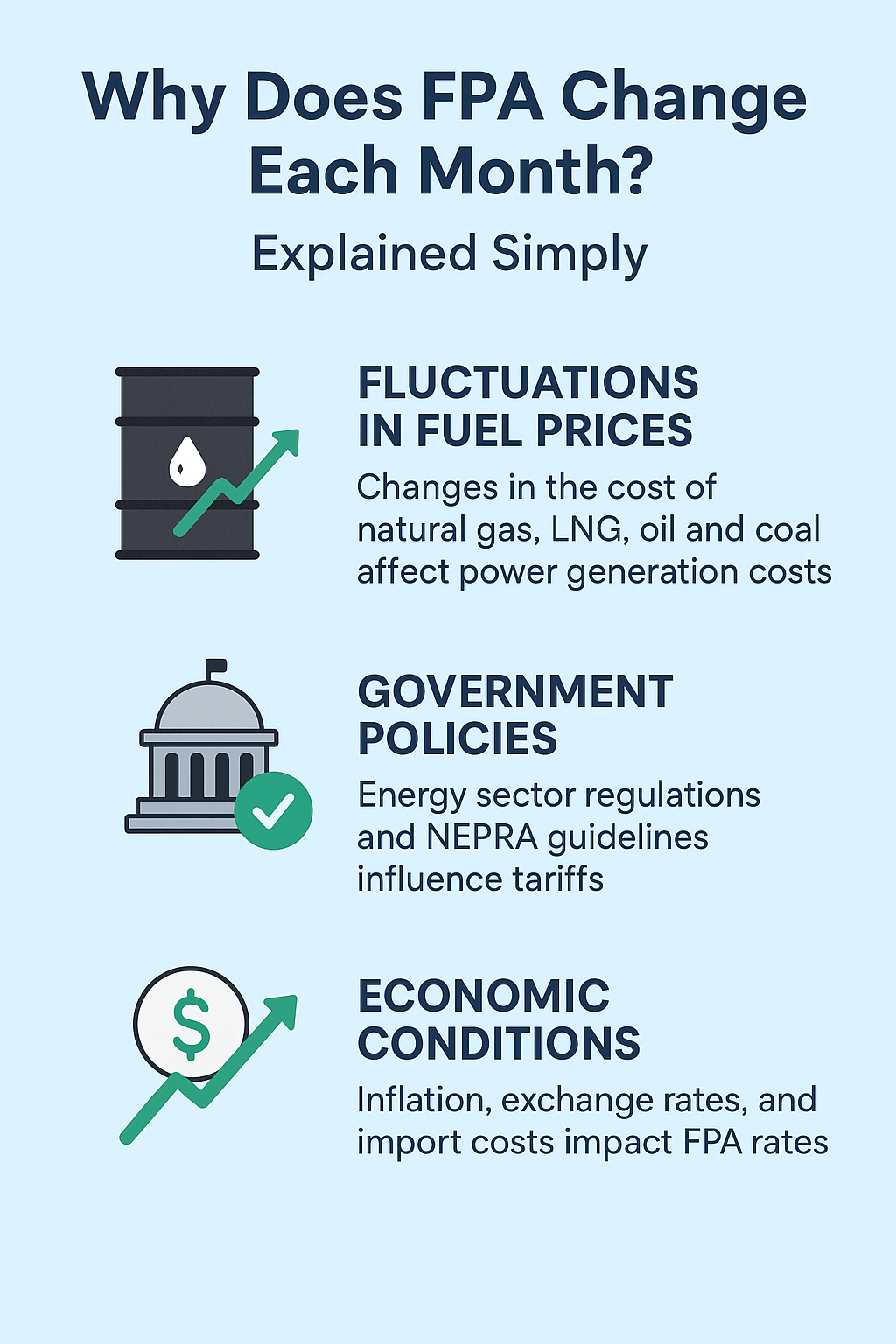
The Fuel Price Adjustment (FPA) on your electricity bill isn’t fixed because the cost of fuel used for power generation is constantly changing. Factors like natural gas, LNG, oil, and coal prices directly influence how much it costs for DISCOs to generate electricity. When fuel prices rise, the FPA increases; when they drop, your FPA decreases, reflecting these real-time power generation costs.
But it’s not just fuel prices that matter. Currency exchange rates and broader economic conditions also play a significant role. Pakistan relies heavily on imported fuel, so fluctuations in the exchange rate can make imported fuel more expensive or cheaper. This imported fuel dependency means your monthly electricity bill can change even if local fuel prices remain stable.
These variations are part of energy tariff fluctuations, a mechanism that ensures electricity pricing remains fair while covering the actual costs incurred by DISCOs like FESCO, MEPCO, LESCO, PESCO, GEPCO, and IESCO. Understanding why FPA changes helps you anticipate your consumer electricity charges and manage your monthly electricity expenses more effectively.
➡️ IESCO Bill Calculator helps plan your electricity budget
How FPA is Calculated
Calculating Fuel Price Adjustment (FPA) is simpler than it may seem. Essentially, your FPA charge depends on the FPA rate set for the month and the total electricity you consume. The formula is straightforward:
FPA Charge = FPA Rate × Total Electricity Units (EUs) Consumed
For example, if the FPA rate for the month is 2 PKR per unit and your household consumes 500 electricity units (EUs), your FPA charge would be:
- 2 PKR × 500 EUs = 1,000 PKR
This calculation is applied to your bill along with other unit rate charges and tariff revisions approved by NEPRA. It ensures that the electricity bill reflects the actual power generation costs for the month while remaining transparent to consumers.
Understanding how FPA is calculated helps you predict changes in your consumer electricity charges and gives you better control over your monthly electricity expenses.
Factors Affecting Monthly FPA
Several key factors influence why the Fuel Price Adjustment (FPA) changes from month to month. Understanding these can help you make sense of your electricity tariffs and consumer charges.
1. Fuel Costs
The primary driver of FPA is the cost of fuel used to generate electricity. Prices of natural gas, LNG, coal, and oil fluctuate regularly based on global and local markets. When fuel prices rise, DISCOs adjust the FPA accordingly, which can increase your monthly electricity bill.
2. Government Policies
Energy sector regulations and NEPRA guidelines also play a crucial role. Policies regarding subsidies, tariffs, or fuel imports directly affect how FPA is calculated. These regulations ensure that power generation costs remain transparent while keeping electricity affordable for consumers.
3. Alternative Energy Sources
The integration of solar, wind, and hydroelectric energy in the national grid can influence FPA. Renewable energy sources are less dependent on imported fuels, which can stabilize electricity prices and help manage energy efficiency for consumers.
4. Economic Conditions
Macroeconomic factors like inflation, currency exchange rates, and import costs impact FPA. Since Pakistan imports a significant portion of its fuel, any increase in import costs or a weaker currency can result in a higher FPA.
By understanding these factors, you can better anticipate changes in your monthly FPA and take steps to manage your consumer electricity charges more effectively.
➡️ Track your electricity usage by viewing older IESCO bills
Impact of FPA on Consumers
The Fuel Price Adjustment (FPA) has a direct effect on your monthly electricity bill. When fuel prices rise, your FPA charge increases, which can make your bill noticeably higher. Conversely, if fuel prices drop, your FPA may decrease, giving some relief to consumers.
Understanding your electricity billing components, including the FPA, fixed tariffs, and unit rate charges, is essential. This knowledge helps you see exactly why your bill changes each month and allows you to plan your household or business energy budget more effectively.
Here are some simple tips to manage or reduce electricity bills:
-
Monitor Electricity Usage: Track your daily or monthly consumption to identify peak usage times and unnecessary energy drains.
-
Adopt Energy-Efficient Appliances: Switching to energy-saving appliances can reduce total electricity consumption, which lowers FPA charges.
-
Practice Energy Efficiency: Turn off lights, fans, and devices when not in use. Small habits can have a big impact over time.
-
Stay Informed: Keep an eye on FPA rates announced by your DISCO. Being aware of fluctuations allows you to adjust usage accordingly.
By taking these steps, you can better manage the impact of FPA on your consumer electricity charges and avoid surprises on your monthly bill.
✅ Estimate total wattage requirement for all plugged-in devices
Strategies to Manage FPA Charges
While Fuel Price Adjustment (FPA) is a variable charge that you cannot control directly, there are practical strategies to manage your monthly electricity bills and minimize its impact.
1. Energy-Saving Techniques
Simple changes in daily habits can make a significant difference. Switching off lights, fans, and electrical appliances when not in use, using natural light during the day, and optimizing air conditioning can reduce overall electricity consumption, which in turn lowers your FPA charges.
2. Adoption of Energy-Efficient Appliances
Investing in energy-efficient appliances like LED lights, inverter ACs, and energy-saving refrigerators can help reduce the number of electricity units consumed. Lower consumption means your unit rate charges and FPA component will also be more manageable.
3. Monitoring Monthly Electricity Consumption
Keeping track of your monthly electricity units (EUs) allows you to identify high-usage patterns and make adjustments. Many DISCOs provide online billing portals or mobile apps that make it easy to monitor consumption in real-time. Staying informed helps you plan and reduce consumer electricity charges over time.
By applying these strategies, households and businesses can better manage the effect of FPA, making monthly electricity bills more predictable and budget-friendly.
✅ Check and pay all types of utility bills via trusted portals in Pakistan
FAQs
Q1: What does FPA stand for in my electricity bill?
FPA stands for Fuel Price Adjustment. It’s a variable charge added to your electricity bill to account for changes in the cost of fuel used to generate electricity, such as natural gas, LNG, oil, and coal.
Q2: Why does FPA change every month?
FPA changes due to fluctuations in fuel costs, economic conditions, currency exchange rates, and government energy policies. These factors affect power generation costs, which are reflected in your monthly electricity bill.
Q3: How is FPA calculated?
The calculation is simple: FPA rate × total electricity units (EUs) consumed. For example, if your FPA rate is 2 PKR per unit and you consume 500 units, your FPA charge will be 1,000 PKR. This ensures your consumer electricity charges reflect actual energy costs.
Q4: Can I reduce the FPA on my electricity bill?
Yes! While FPA itself is set by DISCOs, you can manage your bill by reducing electricity consumption, using energy-efficient appliances, and practicing energy-saving techniques at home or in your business.
Q5: Which authorities regulate FPA in Pakistan?
The National Electric Power Regulatory Authority (NEPRA) monitors and approves FPA rates, ensuring transparency in electricity billing and fair adjustments based on energy tariff fluctuations.
Q6: How can I stay updated on monthly FPA rates?
You can monitor FPA rates by checking your DISCO’s billing portal or mobile app. Keeping track of your unit rate charges and monthly electricity usage helps you anticipate changes and plan your budget more effectively.
Conclusion
The Fuel Price Adjustment (FPA) is a key component of your electricity bill that reflects the changing fuel costs, government policies, and broader economic conditions. These factors make FPA a variable charge that can rise or fall each month, directly impacting your consumer electricity charges.
Staying informed about FPA rates is essential for better budget planning and managing your monthly electricity expenses effectively. By understanding how FPA works and monitoring your electricity consumption units (EUs), you can take proactive steps to control your energy usage and reduce unnecessary costs.
Make it a habit to check the monthly FPA rates from your DISCO or official portals. Being aware of these changes empowers you to plan ahead, adopt energy-efficient practices, and keep your electricity bills under control.