How to Apply for an IESCO Special Connection (Tube Well & Agriculture)
In Pakistan, agriculture is the backbone of our economy, and reliable electricity plays a vital role in keeping this sector alive. From running tube wells for irrigation to powering essential farming equipment, a steady electricity supply ensures that crops get the water they need on time. Without it, farmers struggle with delayed irrigation, lower crop yields, and increased costs.
To support the farming community, IESCO (Islamabad Electric Supply Company) offers a special electricity connection for tube wells and agriculture users. This initiative is designed to make electricity more affordable and accessible for landowners and farmers who depend on irrigation for their livelihood. By providing subsidized electricity tariffs and a streamlined new agriculture connection process, IESCO helps farmers reduce costs while improving productivity.
These special agriculture connections also fall under the regulations of NEPRA (National Electric Power Regulatory Authority) and align with the Government of Pakistan’s subsidy programs. The aim is simple: to ease the financial burden on farmers and ensure they have uninterrupted power to support their crops and irrigation needs.
Whether you are a small-scale farmer or managing large agricultural land, applying for an IESCO special tube well connection can make a big difference in both efficiency and savings.
What is an IESCO Special Connection (Tube Well / Agriculture Category)?
An IESCO special agriculture connection is a dedicated electricity supply designed specifically for tube wells, irrigation systems, and farming needs. Unlike regular household or business connections, this category is meant to support farmers in efficiently running their water pumps and irrigation setups.
Through this connection, farmers benefit from subsidized electricity tariffs and priority in service, ensuring that water reaches their fields without unnecessary delays. The goal is to empower the agricultural sector with affordable and continuous electricity.
Difference Between Domestic, Commercial, and Agriculture Connections
-
Domestic Connection: Meant for households, covering lighting, fans, appliances, and everyday use.
-
Commercial Connection: Designed for shops, offices, and businesses where electricity consumption supports income-generating activities.
-
Agriculture Connection: Exclusively for farmers and landowners, this connection powers tube wells, irrigation systems, and agricultural equipment. It comes with special tariffs and government subsidies, making it distinct from domestic or commercial categories.
This clear distinction ensures that farmers are not burdened with higher commercial rates and can get electricity under a category tailored for agricultural purposes.
Benefits of IESCO Agriculture Connection for Farmers
Applying for an IESCO tube well connection brings several advantages for the farming community:
-
Subsidized Electricity Tariffs – Farmers pay less per unit compared to commercial users, reducing overall irrigation costs.
-
Reliable Irrigation Support – With dedicated agriculture connections, farmers get consistent power supply to run tube wells, ensuring crops receive timely water.
-
Improved Crop Yield – Affordable and uninterrupted electricity allows farmers to irrigate efficiently, resulting in better harvests and increased productivity.
-
Government-Backed Support – These connections are aligned with NEPRA regulations and government subsidy schemes, ensuring long-term relief for the agriculture sector.
By securing an IESCO agriculture electricity connection, farmers not only save money but also strengthen their farming operations, contributing to a more sustainable agricultural economy.
Eligibility Criteria for Tube Well / Agriculture Connection
Before applying for an IESCO special agriculture connection, it’s important to understand who is eligible and what documents are required. Since this category is designed to support the farming community, IESCO follows specific NEPRA and WAPDA guidelines to ensure that only genuine farmers and agricultural users can apply.
Who Can Apply for an Agriculture Connection?
Not everyone qualifies for an IESCO tube well or agriculture connection. The following groups are eligible:
-
Landowners – Individuals who own agricultural land and use tube wells for irrigation.
-
Registered Farmers – Farmers who are officially registered with local authorities or agricultural bodies.
-
Agricultural Societies / Cooperatives – Groups or communities managing shared agricultural land and irrigation systems.
This ensures that the special subsidized tariffs are provided only to those who are genuinely involved in farming and agricultural activities.
Required Agricultural Land Proof
To verify eligibility, applicants must provide proof of agricultural land ownership or usage rights. This may include:
-
Land ownership documents or registry papers.
-
Fard / Khasra Khatooni (land record papers) issued by local revenue departments.
-
Lease agreements (if the applicant is a tenant farmer with rights to cultivate the land).
-
Any supporting certificates that prove the land is being used for agricultural purposes.
Submitting proper documents not only speeds up the application process but also ensures that your case falls under the correct agriculture connection category.
NEPRA & WAPDA Guidelines for Agriculture Users
Since electricity distribution is regulated at a national level, all agriculture electricity connections must follow the rules set by:
-
NEPRA (National Electric Power Regulatory Authority) – Defines electricity tariff structures and approves subsidized rates for agriculture users.
-
WAPDA (Water and Power Development Authority) – Oversees water and power policies, ensuring that farmers receive fair and affordable access to electricity.
IESCO implements these regulations to provide farmers with a reliable, subsidized, and farmer-friendly electricity connection. By following these guidelines, farmers can benefit from lower electricity costs, timely irrigation, and improved crop output.
Documents Required for IESCO Agriculture Connection
When applying for an IESCO special tube well or agriculture electricity connection, preparing the correct documents in advance can save you time and prevent delays. Since this category comes with subsidized tariffs and special benefits for farmers, IESCO requires applicants to provide proof of identity, land ownership, and farming activity.
Here’s a detailed look at the documents you’ll need to submit with your application:
Copy of CNIC (Applicant & Witness)
A valid Computerized National Identity Card (CNIC) is mandatory for both the applicant and a witness. This step ensures the authenticity of the request and prevents misuse of the agriculture connection facility. Make sure your CNIC copy is clear and up to date.
Land Ownership Documents
Since the connection is meant for genuine farmers, applicants must submit land ownership papers. Accepted documents include:
-
Fard / Khasra Khatooni (land record papers).
-
Registry or lease documents in case of rented farmland.
-
Any official proof from the local revenue department confirming agricultural use.
This ensures that only those actively cultivating land benefit from the subsidized agriculture electricity tariffs.
Water Pumping Machine / Tube Well Details
Details of the tube well, bore system, or water pumping machine must be provided. This helps IESCO verify the load requirement and electricity usage under the agriculture category. Proper details ensure that you are billed under the correct tariff plan.
Undertaking for Agriculture Use Only
Applicants must sign an undertaking declaring that the connection will be used exclusively for agriculture and irrigation purposes. Using the connection for commercial or domestic needs can lead to disconnection or penalties.
Affidavit, Photographs, and Other Subdivision Office Requirements
Along with the main documents, IESCO may require:
-
Affidavit confirming lawful usage.
-
Recent passport-size photographs of the applicant.
-
Any additional forms or verifications requested by the local subdivision office.
These extra requirements help IESCO maintain transparency and confirm that the special agriculture connection is being issued under genuine circumstances.
Preparing these documents in advance makes the IESCO tube well connection application process smoother and faster, ensuring that farmers can quickly benefit from reliable and subsidized electricity for their irrigation needs.
Step-by-Step Process to Apply for IESCO Special Connection
Applying for an IESCO agriculture or tube well electricity connection is a simple process if you follow the required steps carefully. To make it easier for farmers and landowners, IESCO has designed a clear procedure that ensures transparency and timely installation of the connection. Here’s a complete breakdown of the process you need to follow.
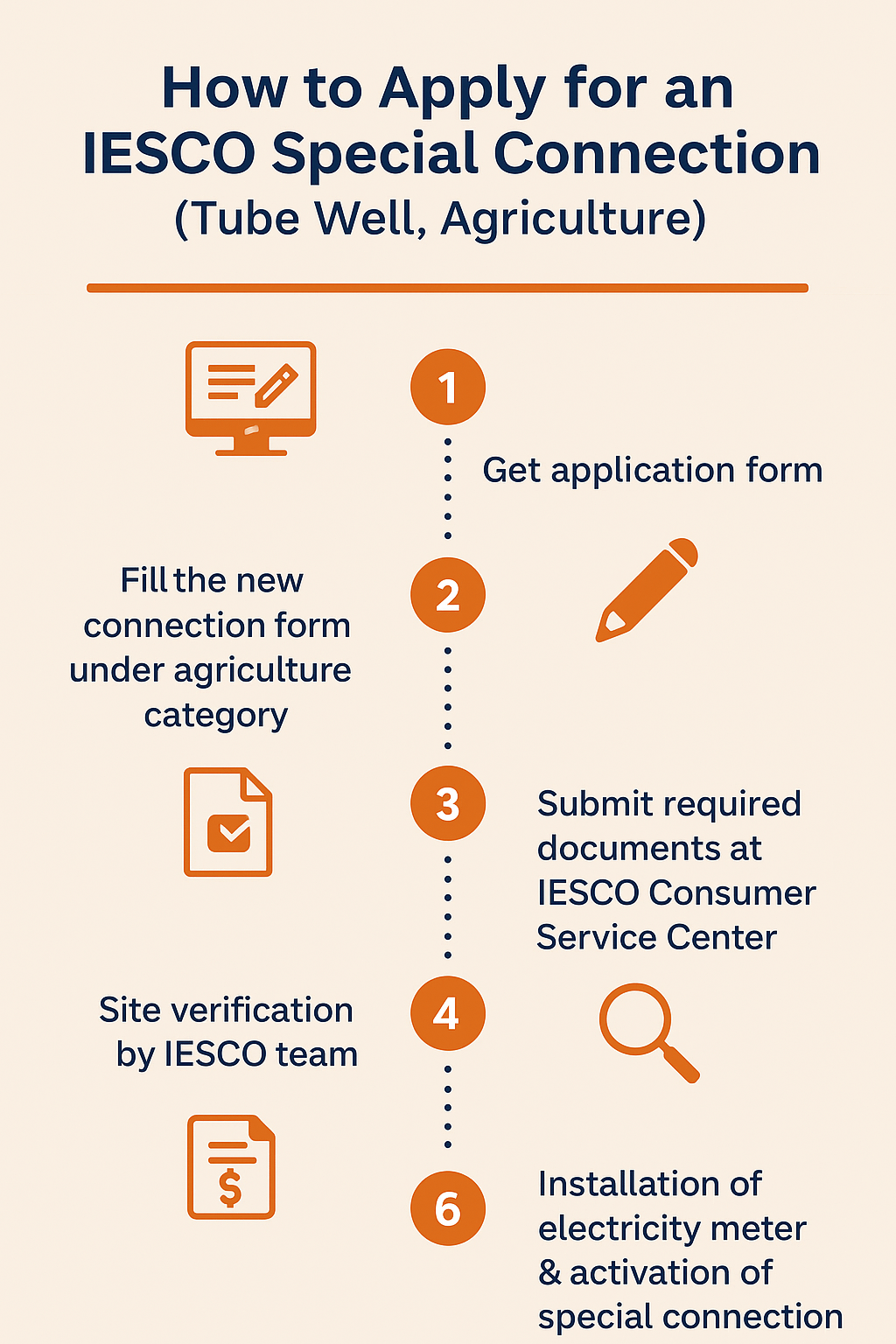
Step 1: Get Application Form (IESCO Online Portal / Subdivision Office)
The first step is to obtain the new connection application form. You can either download it from the IESCO online portal or collect it from your nearest IESCO subdivision office.
Step 2: Fill New Connection Form Under Agriculture Category
After getting the form, carefully fill it out under the agriculture category. Be sure to provide accurate information such as your CNIC details, land ownership proof, and tube well requirements to avoid delays.
Step 3: Submit Required Documents at IESCO Consumer Service Center
Once the form is complete, submit it along with all the required documents (CNIC, land papers, affidavit, photographs, and tube well details) to the IESCO Consumer Service Center or subdivision office.
Step 4: Site Verification by IESCO Team
After submission, the IESCO team will visit your agricultural land to verify the site, tube well location, and usage requirements. This ensures that the connection request falls under the agriculture category and meets the eligibility criteria.
Step 5: Receive Demand Notice (DN) and Pay at Designated Bank
If your application is approved, IESCO will issue a Demand Notice (DN). You must pay this fee at the designated bank within the given timeframe. Payment of the demand notice confirms your request for a new agriculture connection.
Step 6: Submit Paid Demand Notice Copy
After making the payment, submit the paid demand notice copy back to the IESCO office as proof of payment. Without this step, your connection cannot move forward for installation.
Step 7: Installation of Electricity Meter & Activation of Special Connection
Finally, once the demand notice is verified, IESCO will proceed with the installation of your electricity meter. After the meter is installed, your special agriculture connection for tube well or irrigation will be activated, allowing you to benefit from subsidized electricity tariffs and reliable power for farming.
Cost and Tariff for Agriculture Electricity
One of the biggest concerns for farmers when applying for a new tube well connection is the electricity cost and tariff structure. IESCO, under NEPRA regulations and government subsidy programs, offers special rates for agriculture consumers to reduce the financial burden on the farming community. Let’s look at how the tariff works for tube wells and agriculture users.
Tube Well Electricity Tariff in IESCO
The IESCO agriculture tariff is lower compared to domestic and commercial categories. This special rate is applied to tube wells and irrigation systems to ensure farmers can access electricity at affordable prices. By paying a reduced per-unit cost, farmers are able to keep irrigation expenses under control while maintaining productivity.
Seasonal Usage Charges
Electricity consumption in agriculture is not constant throughout the year. During peak cultivation and irrigation seasons, farmers naturally consume more units. The seasonal usage charges under IESCO’s agriculture tariff are designed to support this pattern by providing fair billing while considering the farming cycle. This means farmers pay according to actual consumption, making the system both practical and affordable.
Subsidy Benefits for Farmers Under Government Schemes
The Government of Pakistan, through NEPRA’s approved guidelines, provides subsidies on agriculture electricity connections. These subsidies lower the overall cost of electricity for tube wells, helping farmers save money on irrigation. This initiative is a part of broader agricultural support programs that aim to strengthen food production and improve crop yields across the country.
Peak Hour Charges for Agriculture Consumers
While subsidies make electricity cheaper for farmers, it is important to remember that peak hour charges may still apply. Peak hours are specific times of the day when electricity demand is highest, and unit rates are slightly higher. For agriculture consumers, managing tube well usage outside of peak hours can significantly reduce monthly bills. This helps farmers maximize the benefit of subsidized agriculture electricity tariffs.
PESCO Demand Notice (DN) for Tube Well Connection
When applying for a PESCO agriculture or tube well electricity connection, one of the most important steps is receiving and clearing the Demand Notice (DN). This notice confirms that your application has been approved and provides details about the cost you must pay before your new connection can be installed.
What is a Demand Notice?
A Demand Notice (DN) is an official document issued by PESCO (Peshawar Electric Supply Company) after your application for a new tube well or agriculture electricity connection has been reviewed and approved. It includes the connection charges, security deposit, and service costs that need to be paid before the meter can be installed. Simply put, without paying the DN, your special agriculture connection cannot move forward.
How to Pay Demand Notice for Agriculture Connection
Paying the PESCO Demand Notice is a straightforward process. Once you receive the DN from your subdivision office or consumer service center, you can:
-
Deposit the amount at any designated bank branch mentioned on the notice.
-
Ensure you keep the bank receipt and stamped copy safe.
-
Submit the paid DN copy back to the PESCO office for verification.
This step is critical because PESCO will only proceed with the installation of your agriculture electricity meter once the demand notice payment is confirmed.
Common Issues in Demand Notice Clearance
Many farmers face delays due to small mistakes in the demand notice process. Some of the most common issues include:
-
Late Payment – Missing the due date can result in cancellation or re-issuance of the DN.
-
Incorrect Bank Deposit – Paying at a non-designated bank or wrong account can delay verification.
-
Unsubmitted Paid Copy – Even if you pay the DN, failing to submit the proof to the PESCO office can halt your application.
-
Mismatched Applicant Details – If CNIC or land records don’t match the original application, clearance may be delayed.
To avoid these problems, always double-check the details on your PESCO demand notice, pay it on time, and keep a verified copy for your records.
Common Issues and How to Avoid Delays
Applying for a PESCO agriculture or tube well electricity connection can be a smooth process if you follow the requirements carefully. However, many farmers face unnecessary delays due to avoidable mistakes. Knowing the common issues in advance can save you time and ensure that your new connection is installed without hurdles.
Missing or Incomplete Documents
One of the biggest reasons applications are delayed is missing paperwork. If you forget to attach your CNIC copies, land ownership proof, or affidavits, PESCO cannot process your request. Always prepare a checklist of documents before submitting your application to avoid repeat visits to the subdivision office.
Incorrect Land Ownership Details
Since agriculture connections are meant for genuine farmers, PESCO carefully verifies land records. Any mismatch in ownership papers or lease documents can slow down the approval process. Make sure your land documents are updated and correctly registered with the local revenue office.
Not Applying Under the Correct Category
Some applicants mistakenly apply for a domestic or commercial connection instead of the agriculture category. This results in higher tariffs and rejection of subsidy benefits. Always specify that you need a PESCO agriculture connection for tube well or irrigation to get the correct tariff plan.
Late Demand Notice Payment
Once a PESCO demand notice is issued, it must be paid within the given deadline. Late payments can cause your application to be put on hold or even canceled. Paying the demand notice on time and submitting the proof is essential for smooth processing.
Delays in Site Verification
After submitting your application, the PESCO inspection team visits your land to verify the site and tube well setup. If the applicant is unavailable during the visit or the location details are unclear, verification may be delayed. Always stay in contact with your subdivision office and ensure the team has easy access to the site.
By avoiding these common issues, farmers can speed up the PESCO agriculture connection process and start benefiting from subsidized electricity tariffs without unnecessary waiting.
How to Check Application Status for Tube Well Connection
After applying for a special IESCO agriculture or tube well connection, the next step is keeping track of your application status. Many farmers feel anxious waiting for approval, but the good news is that IESCO provides simple ways to check progress and ensure there are no delays.
Via IESCO Online Portal
The fastest and most convenient way is through the IESCO online application tracking system. By entering your application reference number or CNIC, you can instantly view the current status of your request. This saves you the trouble of making repeated visits to the office and allows you to stay updated from the comfort of your home.
Through Subdivision Office
If you prefer in-person updates, you can visit your nearest IESCO subdivision office. The staff there can provide you with the latest details, whether your demand notice is issued, verification is pending, or your connection is ready for installation. Carry your application receipt or CNIC for quick assistance.
Using IESCO Helpline
Another reliable option is to call the IESCO helpline. By sharing your application or reference number, the support team can guide you about the current stage of your connection request. This option is especially useful if you don’t have access to the internet or if your area faces connectivity issues.
By using these simple methods, farmers can easily stay informed about their IESCO tube well connection and take timely steps if any action is required on their part. Staying proactive ensures that your agriculture electricity connection gets approved without unnecessary delays.
Frequently Asked Questions
How long does it take to get an agriculture connection?
The time frame for getting an IESCO agriculture or tube well connection usually depends on the completion of documents, site verification, and payment of demand notice. On average, the process can take a few weeks. If all documents are in order and the demand notice is paid on time, delays can be avoided.
Can a tenant farmer apply for a tube well connection?
Yes, a tenant farmer can apply for a tube well connection, but they must provide written permission from the landowner along with the tenancy agreement. IESCO requires clear land ownership or tenancy proof to ensure the electricity connection is used legally and for agricultural purposes only.
What is the load requirement for tube well electricity?
The load requirement depends on the capacity of the water pumping machine or tube well. Normally, farmers need a higher load connection due to the heavy use of motors. IESCO reviews the machine specifications before approving the load category for agriculture consumers.
Is net metering available for agriculture consumers?
Currently, net metering is available in IESCO for different categories of consumers, including agriculture. Farmers who use solar power for tube wells can benefit from net metering by sending surplus electricity back to the grid and receiving credits on their bills.
What if my demand notice is delayed?
If your demand notice is delayed, it’s important to follow up with the subdivision office or check through the IESCO online portal. Sometimes delays occur due to incomplete documents or pending verification. Keeping in contact with IESCO ensures your process continues smoothly.
Conclusion
Agriculture is the backbone of Pakistan’s economy, and uninterrupted electricity plays a key role in keeping tube wells and irrigation systems running smoothly. With IESCO’s special agriculture connections, farmers not only receive reliable and subsidized electricity but also enjoy the long-term benefits of increased crop yield and reduced costs.
By applying through the official IESCO process, you ensure transparency, faster approvals, and eligibility for government-backed subsidies under NEPRA and WAPDA regulations. Following the right steps saves time, prevents delays, and guarantees that your farming operations run without unnecessary interruptions.
So don’t wait any longer—apply for your IESCO tube well / agriculture connection today to secure uninterrupted electricity for irrigation and farming success.