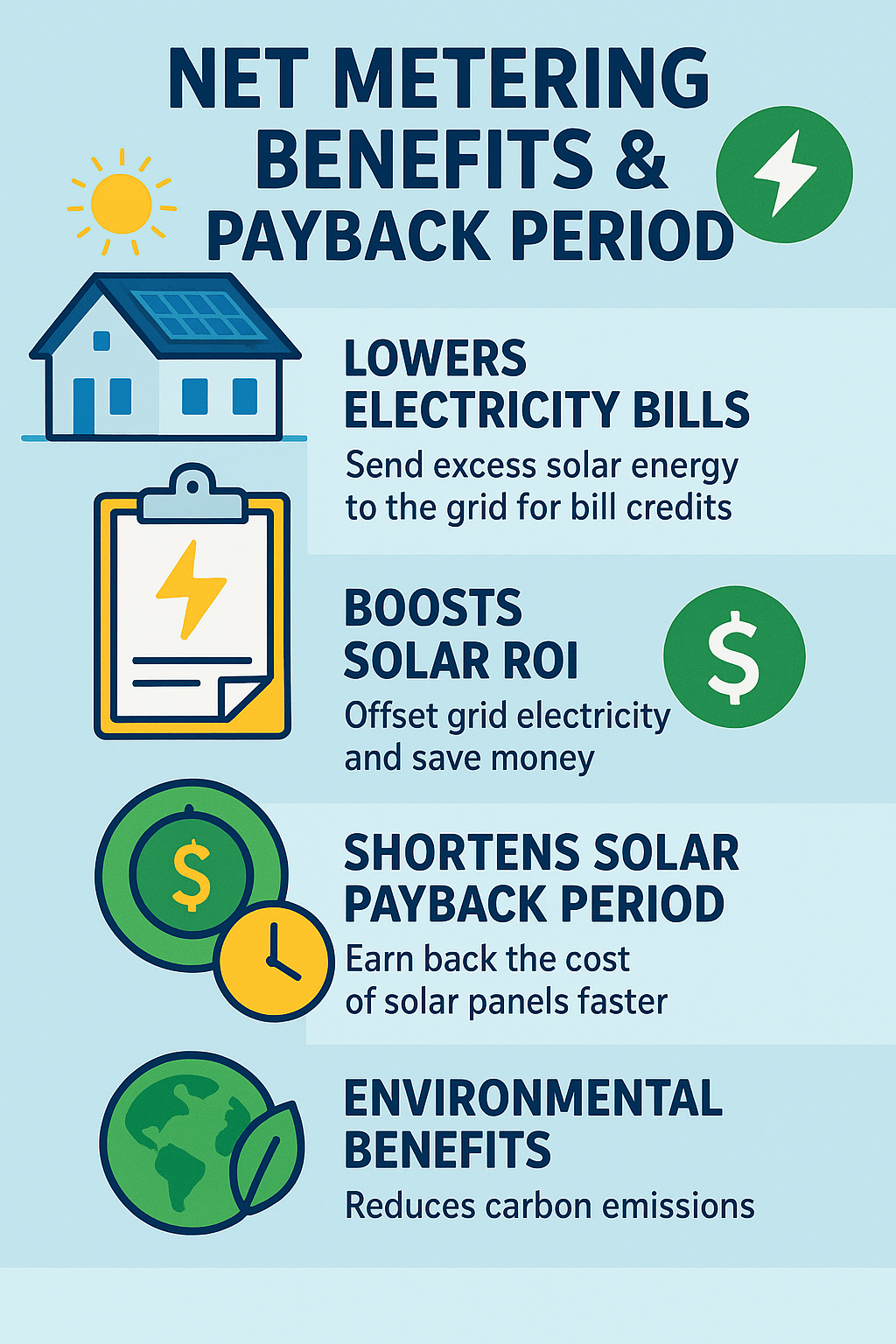
Net Metering Benefits & Payback Period | Save on Electricity Bills with Solar
Ever wondered: “How long does it take solar panels to pay for themselves?” That’s exactly what net metering helps you figure out—and it’s becoming a game-changer for homeowners and businesses in the IESCO region.
Net metering is a smart system that lets you send surplus energy from your solar panels back to the grid—and earn credits in return. It essentially tracks your electricity consumption, compares it to what your panels generate, and ensures you only pay for your net usage. Thanks to this, renewable energy becomes both an eco-friendly choice and a smart financial move.
Why does understanding net metering—and especially the solar payback period—matter so much for your wallet? Installing solar power requires a solid upfront investment. But with net metering, you start saving right away by offsetting your utility bills and potentially earning credits from utility companies like IESCO. It’s a win-win—you’re reducing your carbon footprint and trimming down your bills every month.
✅ Check IESCO Bill Online and download a copy instantly
Whether you’re a homeowner tired of rising electricity costs or a business aiming for energy efficiency, this guide will help you understand how net metering can reduce your burden—and how quickly your solar setup can pay for itself.
What Is Net Metering?
Imagine your solar panels are busy capturing sunlight and generating electricity. Any time they produce more than you need, that extra electricity flows back into the power grid, and your meter runs in reverse—crediting you instead of charging you. At the end of the month, you’re billed only for the difference in kilowatt-hours (kWh) between what you consumed and what you sent back. It’s like sending energy to the grid as a “deposit,” which you can use later when your panels aren’t producing as much. This billing magic is called net metering.
In essence, “Exported solar electricity credits offset your utility bill.” Those excess units you send back become credits. You can bank them and use them when your solar system isn’t producing—say, at night or during cloudy stretches.
Net Metering vs. Feed-In Tariff
You might be wondering: how does net metering compare to a feed-in tariff? Although both reward solar makers, they’re quite different:
-
Net Metering gives you credits at the retail electricity rate, effectively letting you “pay yourself” for the energy your panels produce.
-
Meanwhile, a feed-in tariff pays you a fixed amount per kWh—often higher than retail—but treats your solar output as a commodity sold to the grid.
So for most homeowners, net metering is simpler and often more beneficial—because it directly offsets your utility usage with your own clean energy.
➡️ Use IESCO Bill Calculator to manage your electricity budget
Why It’s a Game-Changer for You
-
No more paying for the full meter: You only pay for your net consumption.
-
Banking kWh credits: Gone cloudy? No problem—credit covers you.
-
Maximized savings: Your surplus production saves money today and tomorrow.
This approach empowers homeowners and businesses to reduce electricity bills and run cleaner, greener operations with renewable energy—all through a straightforward, user-friendly system.
Financial Benefits of Net Metering
Think of net metering as your solar panels not just producing clean energy, but also making your wallet happier. Here’s how this smart system delivers real, tangible benefits—month after month.
Slash Your Electricity Bill & See Monthly Savings
Every time your solar panels generate more power than you’re using, that extra energy flows back into the grid—earning you electricity credits. These credits are automatically applied to your next bill, effectively offsetting your utility bill with the clean energy you’ve sent back. This results in lower monthly out-of-pocket costs, and peak production months, you may even set your bill to zero.
Many homeowners enjoy consistent bill reductions, thanks to this seamless setup. For instance, users across Pakistan report “zero electricity bill—or even negative bills” during high generation periods.
➡️ Check detailed IESCO billing history for reconciliation
Faster Return on Investment (ROI)
Installing solar isn’t just an eco move—it’s a financial one. The savings from reduced utility bills and electricity credits mean your initial investment starts paying for itself, often faster than you’d expect. With rising energy prices, these savings become even more impactful, bringing the return on investment (ROI) timeline closer.
To estimate your potential, try a solar savings calculator—you’ll see how quickly your solar system can pay for itself. The solar payback period depends on local electricity rates, how much sunlight your panels receive, and whether you benefit from solar incentives or government rebates.
Lock in Long-Term Cost Savings
Beyond immediate bill reductions and ROI, net metering delivers consistent savings over time. As electricity prices climb, your home remains protected—offsetting rising costs with your clean energy production. Over decades, what started as a solar investment has become a stable source of affordable (or nearly free) electricity.
Quick Snapshot: Your Solar Benefits
| Benefit | Why It Matters |
|---|---|
| Utility Bill Offset | Your excess solar energy directly cuts down what you owe. |
| Faster ROI | Savings and credits pay back your investment sooner. |
| Long-Term Savings | Insulate yourself from rising grid prices with your own solar power. |
| Incentives & Rebates | Extras like net-metering policies further accelerate payback. |
Environmental & Energy Independence Benefits
When you choose net metering, you’re not just saving money—you’re helping the planet and creating energy freedom for yourself.
➡️ See how much solar panels reduce your IESCO bill
Lowering Carbon Emissions Through Net Metering
Every unit of clean electricity your solar panels produce replaces a unit that would have otherwise been generated by burning fossil fuels. That means fewer greenhouse gases, cleaner air, and a healthier environment for everyone.
In fact, “Lowering carbon emissions through net metering” is one of the biggest reasons why governments encourage solar adoption worldwide. By tapping into the sun’s power, you’re contributing directly to sustainability and protecting future generations from climate risks.
Renewable Energy Credits = A Greener Future
With net metering, your exported electricity doesn’t go to waste—it creates renewable energy credits that balance out your grid usage. These credits don’t just reduce your electricity bill; they also symbolize your personal contribution to the clean energy movement. The more households and businesses that join in, the stronger Pakistan’s clean energy future becomes.
Energy Independence at Home
Another major benefit? Freedom. Net metering reduces your dependence on utility companies and shields you from the constant rise in electricity costs. Instead of being fully reliant on fossil fuel–based power plants, you become your own mini power producer.
During sunny days, your home may run entirely on solar, and when you generate more than you use, your credits cover you at night or in low-sun seasons. This energy independence gives homeowners peace of mind while cutting ties with the unpredictability of traditional energy markets.
Why It Matters for Pakistan
Pakistan faces rising carbon emissions, growing demand for energy, and costly fuel imports. By embracing net metering, households contribute to reducing the national energy burden, lowering the carbon footprint, and moving the country toward sustainability. It’s a small step for one household, but a giant leap when millions join in.
Understanding the Payback Period
One of the most common questions people ask when considering solar is: “When will my solar panels pay for themselves?” The answer lies in what we call the solar payback period—also known as the break-even point.
What Is the Solar Payback Period?
The payback period is simply the time it takes for your solar rooftop system to generate enough savings on your electricity bills to cover the cost of installation. Once you hit this break-even point, every unit of energy your panels produce is essentially free, and the money you save goes directly back into your pocket.
For most homeowners, the solar payback time frame ranges anywhere from 4 to 8 years, depending on various factors. After that, your system continues producing clean, low-cost electricity for 15–20+ years—true long-term savings.
✅ Understand how peak hour rates impact your monthly bill
Factors That Influence the Payback Period
Several elements affect how quickly you’ll see your investment pay off:
-
Installation Cost: A higher upfront investment means a slightly longer payback time, while affordable systems help you recover costs faster.
-
Electricity Rates: If grid electricity prices are high (as we often see in Pakistan), your savings grow quicker.
-
Incentives & Rebates: “Return on solar investment depends on incentives and rebates.” Programs like government rebates, net metering credits, and solar incentives significantly shorten your break-even time.
-
Energy Efficiency: The more energy-efficient your home is, the less you consume, and the faster your solar system offsets costs.
Why It Matters
Understanding your solar payback period helps you see solar energy as more than just an expense—it’s an investment. Unlike traditional electricity bills, which never stop, solar offers a clear path to financial freedom and energy efficiency. By knowing your break-even point, you can calculate when your system starts generating pure profit in the form of reduced bills and clean energy independence.
Factors That Affect Solar Payback Calculation
When it comes to solar, one size doesn’t fit all. While net metering ensures you save money, the actual solar payback period varies by location and electricity rates. That’s why some households see returns in just a few years, while others may take a little longer. Let’s break down the main factors that influence your payback timeline:
1. Location & Sunlight Hours
The amount of sunshine your panels receive directly impacts how quickly they pay for themselves. Homes in sunnier regions of Pakistan, such as Sindh and Balochistan, often experience faster returns compared to areas with more cloud cover. Simply put, more sunlight = more solar energy = quicker payback.
2. Electricity Prices & Utility Policies
High electricity rates are frustrating when you’re fully dependent on the grid—but they actually speed up your solar payback period. If your local utility company (like IESCO) charges higher per-unit rates, every kWh you offset with solar gives you bigger savings. Additionally, supportive net metering policies that let you export extra power and earn credits make the journey to break-even much smoother.
3. Size of Your Solar System
The size of your solar panel investment matters. A larger system generates more power and offsets a bigger chunk of your electricity usage. However, it also comes with higher upfront costs. Choosing the right system size is about balance—matching your household’s consumption without overinvesting in unused capacity.
4. Available Tax Credits & Rebates
Government incentives can significantly reduce the time it takes to recover your investment. In Pakistan, initiatives around renewable energy are growing, and programs offering rebates, financing options, or duty reductions on equipment make a real difference. Remember, “Return on solar investment depends on incentives and rebates”—so always check what’s available before finalizing your system.
5. Financing Options
If you opt for solar financing instead of paying up front, your payback calculation changes slightly. While financing spreads out the cost, it allows you to start saving from day one, since your monthly solar payments are often lower than your old electricity bills.
✅ In short, the payback period isn’t the same for everyone. It depends on where you live, how much electricity costs, the size of your system, and the incentives you can access. Understanding these factors helps you make a smart, customized solar decision for your home.
➡️ Determine how much power backup capacity you need
Real-Life Example: How Solar Pays for Itself
Sometimes numbers explain things better than theory. Let’s look at a simple example of how a solar rooftop system can save money for a typical household in Pakistan.
The Setup
-
System size: 5 kW solar panel system
-
Installation cost: PKR 750,000 (average market rate)
-
Monthly electricity usage: Around 600 units (kWh)
-
Electricity price: PKR 45 per unit (average tariff)
Without Solar
If this household stays fully dependent on the grid, their monthly bill would be:
600 kWh × PKR 45 = PKR 27,000 per month
That’s over PKR 324,000 per year—and prices are only increasing.
With Solar + Net Metering
The 5 kW system generates roughly the same 600 units per month (depending on sunlight hours). This means the household offsets almost all its electricity usage. Thanks to net metering, any extra units are exported back to the power grid and turned into credits for cloudy days or nighttime consumption.
Result: Their effective monthly bill drops close to zero. Even if we assume small charges remain, their bill may only be PKR 2,000–3,000.
This shows that net metering reduces monthly utility bills significantly over time—a savings of nearly PKR 24,000 every month.
When Do They Break Even?
-
Annual savings: About PKR 288,000
-
System cost: PKR 750,000
-
Solar payback period: Around 2.5 to 3 years
After this break-even point, every year’s savings go directly into the homeowner’s pocket. Considering solar panels last 20–25 years, the total lifetime savings can cross millions of rupees.
Challenges & Limitations of Net Metering
While net metering brings incredible savings and supports clean energy, it’s not without its hurdles. Homeowners should understand these challenges before making a solar panel investment.
Policy Differences by Region
One important point to remember is: “Not all states offer the same net metering benefits.” Policies vary across regions, and in Pakistan, approvals and regulations often depend on local distribution companies like IESCO or other DISCOs. Some areas have clear net metering policies, while others may take longer to process applications or limit the size of systems you can connect to the power grid.
Utility Company Restrictions
Utility companies sometimes set their own rules on how much energy you can export or the rate at which credits are applied. For example, while net metering credits usually offset your bill at retail electricity rates, certain utilities may limit this or introduce extra charges. These restrictions can slightly affect your solar payback time frame.
Net Metering vs. Feed-in Tariff Policies
It’s also worth understanding the difference between feed-in tariff vs net metering policies. In a feed-in tariff system, you’re paid a fixed rate for every kWh you export—sometimes higher than the retail price. In net metering, however, you’re credited based on your electricity usage and offset against your monthly bill. Depending on the policy in place, one option might be more favorable than the other.
Administrative Delays
Another challenge for homeowners is paperwork and approval timelines. Getting net metering installed often requires inspections, approvals, and compliance checks with government regulations. While it’s usually a one-time hassle, delays can push back when you actually start seeing savings.
FAQs
Q1. What is net metering in simple words?
Net metering is a billing system where your solar panels send extra electricity to the power grid. In return, you earn electricity credits that reduce your future bills.
Q2. How long does it take solar panels to pay for themselves?
The solar payback period depends on factors like installation cost, electricity rates, and government incentives. On average in Pakistan, homeowners reach the break-even point in about 3 to 5 years. After that, your solar energy is practically free.
Q3. Does net metering really reduce monthly bills?
Yes! “Net metering reduces monthly utility bills significantly over time.” By exporting extra solar energy, you offset your usage and can even bring your bill close to zero in peak months.
Q4. What is the difference between feed-in tariff vs net metering policies?
-
Net metering: Credits your bill at retail electricity rates.
-
Feed-in tariff: Pays you a fixed rate for each kWh you export.
Both support solar adoption, but net metering usually makes more sense for homeowners.
Q5. Are there government incentives for solar in Pakistan?
Yes. The government supports renewable energy through net metering approvals, solar incentives, and occasional rebates. These incentives shorten your payback time and make solar more affordable.
Q6. What factors affect the solar payback period?
-
Location & sunlight hours
-
Electricity prices & utility company policies
-
Size of the solar rooftop system
-
Incentives, rebates, and financing options
Simply put, the solar payback period varies by location and electricity rates.
Q7. Is net metering worth it for homeowners?
Absolutely. Net metering not only lowers electricity bills but also boosts energy independence, reduces carbon emissions, and increases property value. It’s both a financial and environmental win.
Conclusion
Switching to solar with net metering is more than just a financial decision—it’s an investment in your future savings and energy independence. From lowering electricity bills and achieving a solid ROI on solar panels to reducing carbon emissions and promoting sustainability, the benefits are long-term and undeniable.
Remember, the break-even point for residential solar installation is closer than you think. With the right solar rooftop system, government incentives, and favorable net metering policies, most homeowners recover their investment within just a few years—and then enjoy decades of nearly free energy.
If you’re curious about your exact savings potential, we recommend using a solar payback calculator or consulting with local experts for a personalized estimate. This small step can help you understand how soon you’ll start reaping the rewards of your investment.