NEPRA Regulations Affecting IESCO Consumers – Tariffs, Rights & Benefits
When it comes to electricity in Pakistan, one name you’ll often hear is NEPRA – the National Electric Power Regulatory Authority. This organization plays a central role in setting the rules for how electricity is priced, distributed, and monitored across the country. Simply put, NEPRA is the body that decides the electricity tariff, checks the performance of power companies, and ensures that consumers like you are protected under fair regulations.
On the other hand, for residents of Islamabad and surrounding areas, IESCO (Islamabad Electric Supply Company) is the main provider delivering electricity to homes and businesses. From your monthly IESCO billing system to service reliability, almost everything is influenced by NEPRA’s decisions. That’s why understanding NEPRA regulations isn’t just technical—it directly affects your monthly bills, the quality of service you receive, and even your consumer rights under NEPRA regulations.
Whether it’s the adjustment of electricity rates, addressing overbilling issues, or ensuring that households get a timely power supply, NEPRA’s policies shape the day-to-day experience of every IESCO consumer. By knowing how these regulations work, you can better manage your energy usage, file complaints when necessary, and even explore opportunities like net metering for solar energy savings.
✅ Electricity bill check online Pakistan for IESCO users
Table of Contents
ToggleOverview of NEPRA and IESCO
When you switch on the lights in your home or office, there’s a complex web behind the simple flip of a switch—and at the center of it lies NEPRA, the National Electric Power Regulatory Authority. Established by the NEPRA Act of 1997, NEPRA is the cornerstone of Pakistan’s electricity governance.
It serves as a watchdog—and a guide—making sure that electricity tariffs are fair, power supply standards are maintained, and that electricity companies play by the rules set out by the Government of Pakistan and the Power Division.
Now, let’s talk about IESCO, or the Islamabad Electric Supply Company. As the main distribution company (DISCO) for Islamabad and its surrounding areas, IESCO is the last mile connecting NEPRA’s policies to your light switch. Whether it’s delivering your monthly electricity supply or sending the bill through the IESCO billing system, IESCO is the face you interact with every single time.
So, what’s the relationship between the two? Think of it this way: NEPRA sets the rules, and IESCO plays by them to serve you. NEPRA decides tariff structures and ensures electricity standards are met, while IESCO implements those rules, delivers electricity, and addresses local-level performance. If there’s a billing concern, a service disruption, or confusion about your tariff slab, NEPRA is the governing authority, and IESCO is your on-ground partner.
In short:
-
NEPRA, under the NEPRA Act 1997, gives direction and regulatory oversight—ensuring your rights and electricity quality are protected.
-
IESCO, as a DISCO, works locally to turn NEPRA’s regulations into real electricity service in your neighborhood.
-
Together, they form the regulatory-service duo that powers your home effectively, safely, and transparently.
Understanding how NEPRA and IESCO fit into the broader electricity picture helps you know who sets your tariff, who ensures reliability, and who you should reach out to when things don’t go as planned. It’s all part of being an empowered and informed consumer.
➡️ Easily see estimated taxes and surcharges on your IESCO bill
NEPRA Tariff Determination and Its Effect on IESCO Consumers
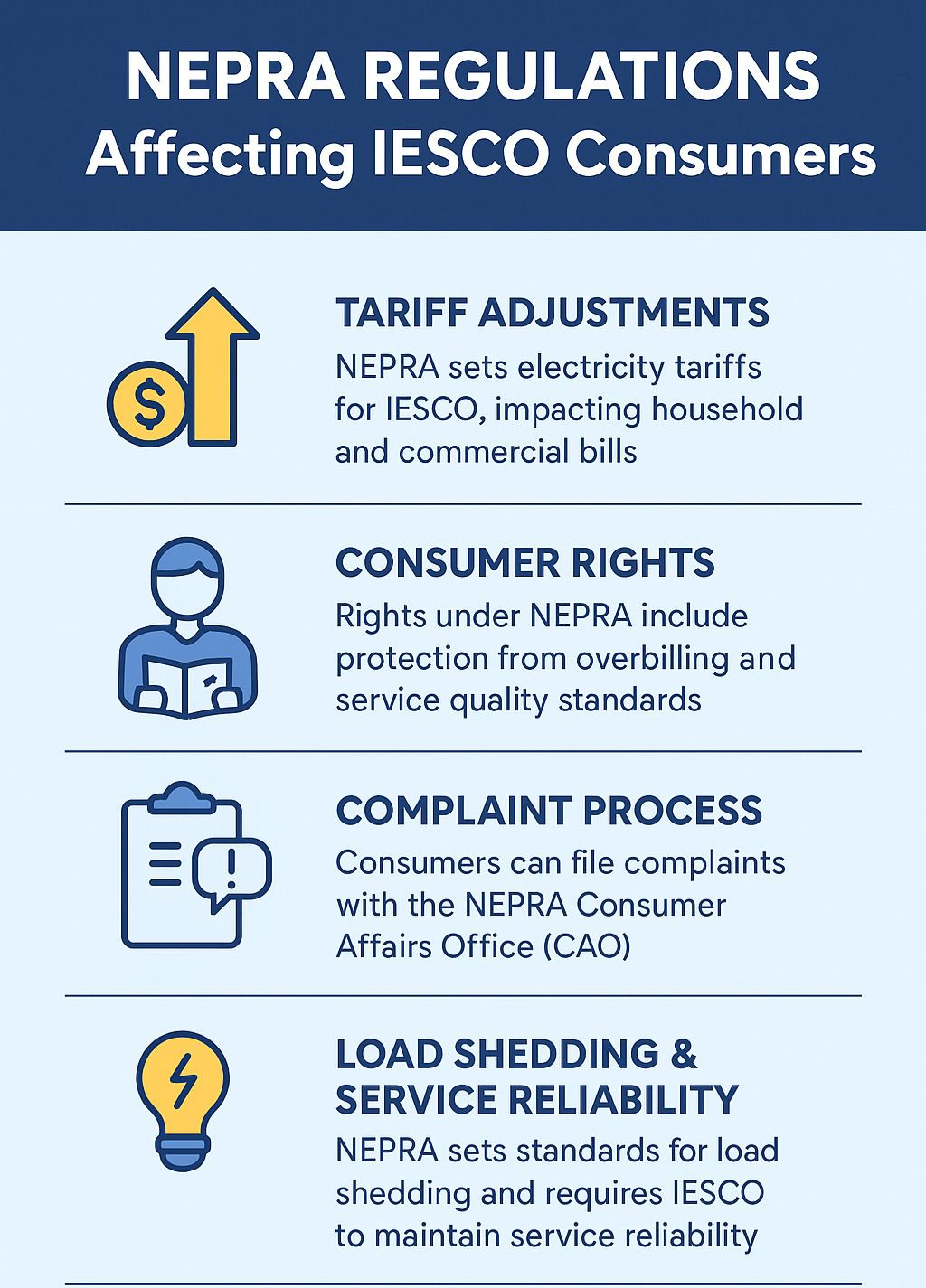
When you receive your monthly bill from IESCO, the number staring back at you isn’t random—it’s the result of a careful process driven by NEPRA tariff adjustments. Here’s how it works, in simple terms.
How Does NEPRA Set Electricity Tariffs?
It all starts when distribution companies like IESCO submit detailed petitions to NEPRA. These documents include breakdowns of energy costs, operational expenses, and forecasts. NEPRA reviews them, invites public feedback, and may even hold hearings before finalizing any changes—making the process both transparent and accountable.
Each year, NEPRA issues a consumer-end tariff—often revised quarterly through adjustments—to reflect updated generation costs, seasonal changes, or legal requirements.
What Are IESCO Tariff Slabs?
IESCO’s rates are structured into tariff slabs, meaning the cost per unit increases as you use more electricity. These slabs are based on usage categories—such as “protected” and “non-protected” consumers:
-
Protected domestic consumers using up to 100 units pay the lowest rates, with slightly higher charges for 101–200 units.
-
Non-protected users face higher rates—starting with low units and rising significantly as consumption increases.
For all DISCOs, including IESCO, NEPRA applies a uniform tariff policy. This ensures fairness across regions so consumers pay standardized rates, avoiding large regional differences.
Peak vs. Off-Peak Impact on Your Bill
If you have a larger connection—usually above 5 kW—you may fall under a time-of-use (TOU) tariff. That means electricity costs more during peak hours and less during off-peak times. This system encourages consumers to shift electricity usage to cheaper hours, helping both the grid and your pocket.
How Do Subsidy and Cross-Subsidy Policies Help Households?
NEPRA also includes subsidy and cross-subsidy mechanisms in tariff structures. This means lower-income or “protected” users receive relief in the form of cheaper electricity. On the other hand, high-consumption or commercial users often pay slightly more to balance the system. This ensures that vulnerable households are shielded from high electricity costs while keeping the sector financially stable.
✅ Use this link to view your IESCO old bill history
What This Means for You, the Consumer
-
Smarter Billing Awareness – Understanding how NEPRA sets tariffs helps you read and analyze your IESCO bill more confidently.
-
Budget Better – By knowing tariff slabs and peak/off-peak rates, you can manage usage and reduce monthly expenses.
-
Know Your Rights – As a consumer, you benefit from NEPRA’s transparent process and policies designed to protect households.
Consumer Rights under NEPRA Regulations
Electricity is not just a service—it’s a necessity. That’s why NEPRA has put in place clear consumer protection rules to make sure people don’t face unfair practices, hidden costs, or poor service. For every IESCO consumer, these rights are essential to understand.
Protection Against Overbilling and Faulty Meter Readings
One of the most common problems faced by electricity consumers is overbilling or errors in meter readings. NEPRA has strict guidelines to stop this. If your bill is higher than expected without a valid reason, or if your meter reading looks suspicious, you have the right to challenge it. These protections ensure that every unit you pay for is accurate, and no extra charges are added unfairly.
Complaint Filing Process with NEPRA Consumer Affairs Office (CAO)
If you ever feel your concern hasn’t been resolved by IESCO, you don’t have to stop there. NEPRA has established the Consumer Affairs Office (CAO) to handle such complaints. The process is straightforward:
-
First, file your complaint directly with IESCO.
-
If it remains unresolved, you can escalate it to the NEPRA Consumer Affairs Office, which is dedicated to addressing consumer grievances fairly.
This system ensures your voice is heard, and your rights as a customer are protected.
➡️ Compare electricity costs before and after solar setup online
Service Quality and Performance Standards
NEPRA doesn’t just regulate prices—it also monitors the service quality provided by companies like IESCO. From reducing unnecessary load shedding to ensuring timely connections and fair billing, NEPRA sets performance standards that every distribution company must follow. If IESCO fails to meet these standards, it can face penalties, which keep the system accountable to consumers.
NEPRA Guidelines on Load Shedding and Service Reliability
Few things frustrate consumers more than unexpected power outages or extended periods of load shedding. To protect consumers, NEPRA has issued performance standards that every electricity distribution company, including IESCO, must follow. These rules are designed to ensure that consumers get reliable electricity, with outages kept to a minimum and managed fairly and transparently.
NEPRA Performance Standards for Power Outages
According to NEPRA, distribution companies must:
-
Provide timely information about planned load shedding schedules.
-
Reduce the duration and frequency of unplanned outages.
-
Maintain service reliability standards so the electricity supply meets consumer expectations.
These standards act as a benchmark, making sure companies like IESCO don’t compromise on the quality of service while delivering electricity.
How These Rules Apply to IESCO Operations
For IESCO consumers, this means that load shedding should be carried out in a structured manner, not randomly. NEPRA requires IESCO to manage load shedding schedules transparently and communicate them to the public. In case of faults or breakdowns, IESCO must respond quickly, ensuring power is restored in the shortest possible time.
Additionally, IESCO is encouraged to adopt energy efficiency regulations, such as reducing line losses and improving system upgrades, so that the burden of load shedding on consumers decreases in the long run.
Penalties for Non-Compliance
If IESCO fails to meet these NEPRA performance standards, the consequences are serious. NEPRA has the authority to impose penalties and fines on distribution companies that do not comply with regulations. This ensures accountability and motivates companies like IESCO to keep improving their service quality.
Renewable Energy and Net Metering Regulations
Across Pakistan, electricity demand is rising—but so is the cost of traditional power. To tackle this challenge, NEPRA has been actively promoting renewable energy integration, especially solar power, to give consumers cleaner, cheaper, and more sustainable options.
NEPRA’s Role in Promoting Solar and Renewable Energy
NEPRA sets the regulatory framework that makes it possible for households and businesses to generate their own electricity through solar panels and feed extra power back into the national grid. By encouraging renewable energy integration, NEPRA is not only helping reduce reliance on costly imported fuels but also giving consumers the chance to lower their bills and support a greener future.
➡️ Check how peak hour activity raises your total bill
Net Metering Policies for IESCO Consumers
One of the most practical initiatives for Islamabad residents is net metering under NEPRA rules. Here’s how it works:
-
You install a solar power system at your home or business.
-
Whatever electricity you generate and use lowers your IESCO bill.
-
Any extra units you produce are exported to the grid, and IESCO credits you for them.
This means that instead of paying heavy bills every month, you could even see your meter run “backwards,” with savings or credits reducing your costs. For consumers who face high electricity expenses, net metering offers real financial relief.
Long-Term Benefits of Renewable Integration
The advantages of renewable energy aren’t just short-term. For IESCO consumers, solar adoption leads to:
-
Lower Bills Over Time – Cut down monthly costs and protect yourself from future tariff hikes.
-
Energy Efficiency – Reduce wastage by producing and using clean power efficiently.
-
Environmental Impact – Contribute to cleaner air and reduced dependence on fossil fuels.
By embracing net metering under NEPRA rules, consumers can turn their rooftops into mini power plants—helping themselves while also contributing to Pakistan’s overall energy stability.
Legal and Regulatory Measures
Behind every electricity bill and every unit of power you use lies a strong legal framework that keeps the system running fairly. For IESCO consumers, these laws and regulations are not just paperwork—they directly affect how electricity is supplied, billed, and protected.
NEPRA Act 1997 and Its Amendments
The foundation of electricity regulation in Pakistan is the NEPRA Act of 1997. This law created NEPRA as the central authority to regulate the generation, transmission, and distribution of electricity. Over time, amendments have been made to strengthen consumer protection, improve transparency, and introduce reforms in tariff adjustments, performance standards, and complaint handling. Simply put, this Act ensures that companies like IESCO follow the rules while consumers get their rights safeguarded.
Regulations Against Electricity Theft and Penalties
Electricity theft is one of the biggest challenges in Pakistan’s power sector. From illegal connections to meter tampering, such practices cause huge financial losses and lead to higher bills for honest consumers. To tackle this, NEPRA regulations for energy theft clearly define penalties and strict actions against violators. Distribution companies like IESCO are required to monitor theft, report cases, and ensure that legal action is taken. This protects not only the system but also law-abiding consumers who end up paying the price for others’ misuse.
IESCO’s Compliance with Government Electricity Policies
As a licensed distribution company (DISCO), IESCO must align with both NEPRA regulations and broader government electricity policies. These policies cover everything from tariff reforms and subsidy allocation to renewable energy adoption and energy efficiency targets. By complying with these regulations, IESCO ensures that consumers in Islamabad and surrounding areas receive electricity under fair, transparent, and lawful terms.
➡️ Check load requirements to balance load across phases
Common Consumer Issues and NEPRA’s Role
No one likes surprises when the bill arrives—especially when the amount seems inexplicably high. Unfortunately, many IESCO consumers face such headaches due to issues like overbilling, service delays, and a lack of awareness about their rights. Let’s unpack the most common problems and understand how NEPRA steps in to help protect you.
Overbilling Complaints & NEPRA’s Intervention
Overbilling—or being charged for more than what you’ve consumed—is one of the most frequent complaints from electricity users in Pakistan. In many cases, consumers report inflated bills after their meter readings are delayed, estimated, or simply incorrect.
In Islamabad, many customers have voiced frustration about IESCO’s advanced meter installations, with some blaming improperly trained technicians and faulty wiring for wrong charges. Such complaints have prompted NEPRA to take action, summoning DISCO CEOs to address systemic issues.
NEPRA plays a critical role in controlling electricity overbilling by investigating such reports, conducting public hearings, and issuing directives to fix errors. In major cases, overbilling investigations have led to regulatory consequences and even mandated refunds for affected consumers.
Service Delays, Outages & Communication Gaps
Another common pain point is unpredictable load shedding or delayed restoration of power during outages. Residents frequently experience disrupted supply—often with little to no advance notice. For instance, angry consumers in parts of Islamabad have protested extended blackouts that range from 8 to 10 hours, especially in extreme weather.
When it comes to resolution or clarity, responses are often slow or lacking entirely, leaving many consumers without reliable support or real-time updates.
Lack of Consumer Awareness
A problem that compounds the above issues is the simple fact that many consumers don’t fully understand their rights or the complaint-filing process. Some may unknowingly pay inflated bills or fail to escalate genuine grievances because they don’t know where to turn. The impact of NEPRA decisions on electricity bills, such as tariff corrections or billing cycle rules, remains hidden from many users.
As one IESCO consumer shared on Reddit, the rules can feel unforgiving:
“We have been very careful about keeping our electricity consumption under 200 units to avoid the doubled/tripled rate. However, last month we consumed 201 units… Even by one unit, then you are out of the protected category for 6 MONTHS!”
Stories like these illustrate how a simple oversight can snowball, especially when consumers aren’t aware of how tariff slabs or subsidy eligibility work.
✅ Experience quick IESCO bill payment through online portals
How Consumers Can Benefit from NEPRA Regulations
When it comes to electricity, most of us only think about paying bills and dealing with power cuts. But here’s the good news: NEPRA regulations aren’t just about rules and restrictions—they also give you opportunities to save money, improve efficiency, and protect your consumer electricity rights. If you know how to use them, these regulations can work in your favor.
Reduce Your Electricity Bills with NEPRA-Approved Tariffs
One of the simplest ways to benefit is by understanding the tariff slabs approved by NEPRA. For example, consumers who keep their monthly consumption within certain limits fall under protected categories and pay significantly lower per-unit charges. By monitoring your usage and practicing energy efficiency—like switching to LED lights, using energy-efficient appliances, and avoiding unnecessary standby power—you can stay within a favorable tariff bracket. This directly translates into financial benefits on your electricity bills.
Filing Complaints Against IESCO Billing Issues
If you’ve ever faced overbilling, faulty meter readings, or unfair disconnections, you don’t have to suffer in silence. NEPRA has established a Consumer Affairs Office (CAO) specifically to safeguard consumer electricity rights. By filing a formal complaint, you can get your issue investigated and resolved. Many consumers have successfully received refunds or adjustments after NEPRA’s intervention. Remember, every complaint not only helps you but also pushes IESCO to improve its service quality.
Opportunities for Renewable Energy & Long-Term Savings
NEPRA is also leading Pakistan’s transition toward renewable energy integration, especially solar. Through net metering regulations, households can install solar panels, generate their electricity, and even sell excess power back to the grid. This isn’t just about reducing your dependency on IESCO—it’s about long-term energy efficiency and financial savings. Over time, this can drastically cut your monthly bills while supporting a cleaner, greener future.
FAQs
1. What is NEPRA, and why is it important for IESCO consumers?
NEPRA (National Electric Power Regulatory Authority) is the main regulator of Pakistan’s power sector. It sets electricity tariffs, monitors service quality, and ensures consumer protection. For IESCO consumers, NEPRA decisions directly impact electricity bills, load shedding schedules, and complaint redressal.
2. How does NEPRA decide electricity tariffs?
NEPRA calculates tariffs based on fuel prices, generation costs, and government policies. It also considers subsidies and uniform tariff policies so that residential, commercial, and industrial consumers are billed fairly under IESCO.
3. Can I file a complaint against IESCO through NEPRA?
Yes. If you face overbilling, faulty meter readings, or poor service, you can approach the NEPRA Consumer Affairs Office (CAO). They handle complaints and ensure that consumers’ rights are protected.
4. What are my rights as an IESCO consumer under NEPRA regulations?
Your key rights include protection from overbilling, transparent tariff application, fair load shedding schedules, and access to renewable energy options such as net metering.
5. How does net metering benefit IESCO consumers?
NEPRA’s net metering regulations allow you to connect solar panels to the grid and sell excess electricity back to IESCO. This reduces monthly bills and promotes renewable energy adoption.
6. What happens if IESCO doesn’t follow NEPRA regulations?
NEPRA has the authority to penalize IESCO for non-compliance, whether it’s unfair load shedding, poor customer service, or billing irregularities. These penalties push DISCOs like IESCO to improve their performance.
7. How can I stay updated about NEPRA policies and IESCO billing changes?
You can stay informed by regularly checking your IESCO online bill, following NEPRA’s official notifications, and keeping track of tariff adjustments and load shedding updates.
✅ Access the IESCO Reference No Retrieval Tool anytime online
Conclusion
When it comes to electricity, it’s not just about paying the bill at the end of the month. NEPRA regulations directly shape the electricity experience of IESCO consumers—from how tariffs are calculated to how load shedding is managed, and even how renewable energy opportunities are introduced. These policies are designed to protect you, guide fair billing, and push for a more reliable and efficient power sector in Pakistan.
But the real benefit comes when you, as a consumer, stay informed and aware. By keeping an eye on NEPRA tariff adjustments, checking your IESCO online bills regularly, and understanding your consumer rights, you can avoid surprises and even reduce your electricity costs. Similarly, keeping track of load shedding schedules and exploring renewable energy options like net metering can help you plan better and save in the long run.
Stay Empowered as a Consumer
The power sector is evolving, and with it, new policies and regulations are being introduced. Don’t let yourself fall behind. Make it a habit to stay informed about NEPRA policies, check official updates, and spread awareness among your community. Remember, consumer awareness in the power sector is the key to accountability and improved services.
By taking small steps—monitoring your bills, reporting issues, and exploring solar adoption—you can make sure you’re not just paying for electricity, but also getting the full benefits of the regulations meant to protect and empower you.