Renewable Energy Initiatives under IESCO | Solar Net Metering & Green Power
Pakistan is steadily moving toward a cleaner and greener energy future, and renewable energy is at the heart of this transition. Rising electricity costs, growing demand, and the urgent need to reduce carbon emissions have pushed the country to explore sustainable power sources like solar energy, wind energy, and hybrid systems.
Among the key players driving this transformation is the Islamabad Electric Supply Company (IESCO), which has been actively introducing programs that encourage households and businesses to adopt renewable energy solutions.
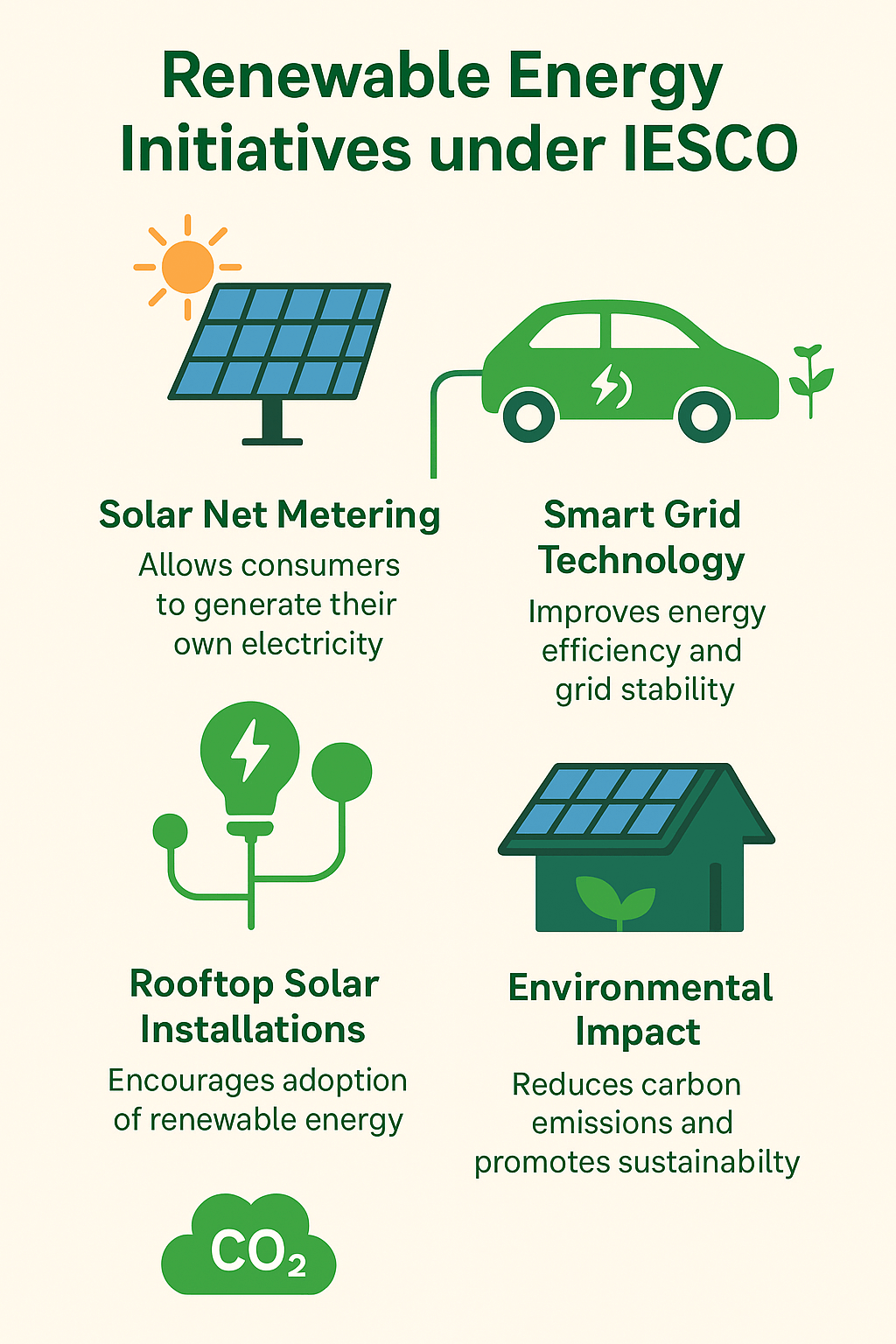
Through initiatives such as solar net metering, rooftop solar installations, and smart grid integration, IESCO is not only supporting government energy policies but also empowering consumers to lower their electricity bills and contribute to a sustainable electricity generation system.
These efforts reflect Pakistan’s broader clean energy transition, where organizations like IESCO are taking the lead in making renewable power more accessible, efficient, and future-ready.
➡️ Calculate next month’s IESCO bill in just a few clicks
Understanding IESCO’s Role in Renewable Energy
Who is IESCO (Islamabad Electric Supply Company)?
Let’s start with the basics: IESCO, or the Islamabad Electric Supply Company, is your trusted electricity provider for Islamabad and nearby regions. Born in 1998 from the old Islamabad Area Electricity Board under WAPDA, IESCO has grown into a key government-owned energy utility serving more than 3 million consumers directly and impacting the lives of over 25 million people across areas from Attock to Jhelum and the Indus to Neelum rivers in Kashmir.
How IESCO Fits into Pakistan’s Power Sector Reforms
Pakistan’s power sector has undergone significant structural reforms, including the breakup of WAPDA into regional distribution companies (DISCOs) like IESCO. These reforms aim to promote transparency, efficiency, and better service delivery within the energy sector.
In a landmark move in April 2023, IESCO became the first DISCO to be granted a separate ‘Supplier of Last Resort’ license by NEPRA. This step marks a shift toward deregulation and competitive power markets — paving the way for a more flexible and sustainable energy system.
Alignment with Government Renewable Policies & NEPRA Regulations
IESCO isn’t just playing defense — it’s actively aligning with the country’s renewable energy drive. Pakistan’s goal is to boost the share of green power in its energy mix to 20% by 2025 and 30% by 2030. While hydropower continues to lead, the emphasis is now squarely on solar energy, wind power, and hybrid systems as part of national policy.
Under these national objectives, IESCO’s role is to enable distributed solar energy systems, promote net metering, and support the clean energy transition within its coverage area. By adhering to NEPRA regulations and responding to policies set by the Ministry of Energy and the Alternative Energy Development Board (AEDB), IESCO is helping to bring renewable energy closer to everyday consumers.
Solar Energy Initiatives under IESCO
Rooftop Solar & Green Meter Programs
Imagine turning your rooftop—or even your balcony—into a mini power plant. That’s the beauty of IESCO’s rooftop solar installations paired with Green Meters. These are bidirectional meters that not only monitor your energy consumption but also track surplus energy you feed back into the grid. In essence, they enable seamless two-way energy flow—and that’s net metering in action.
Net Metering System in Islamabad & Rawalpindi
If you’re based in Islamabad or Rawalpindi, you’re in for a perk: IESCO’s net metering program, backed by NEPRA regulations, allows residential, commercial, and even industrial consumers to generate renewable energy from solar (or wind) systems between 1 kW and 1 MW.
The excess energy you generate gets exported to the grid, and in return, you receive credit on your electricity bill. The current net metering tariff is around Rs. 19.32/kWh—an attractive incentive for solar adoption.
➡️ Check financial benefits of solar with Solar Savings Calculator
Why This Matters to You
-
Slash your electricity bills: By offsetting grid consumption with self-generated solar energy, your bill goes down—sometimes dramatically. Some users report reductions of up to 70% or more.
-
Earn while saving: Any extra electricity you produce gets credited—or even paid out under certain conditions—acting like a passive income.
-
Energy independence: Solar installations, especially when paired with net metering, help ease reliance on the grid—ideal during loadshedding or outages.
The Power of PV Solar Panels & Hybrid Systems
IESCO’s net metering isn’t limited to traditional, grid-tied setups—many households now use hybrid systems (solar + battery storage). These setups let you store solar energy to use at night or during outages—and can reduce dependency on net metering alone to shave down your electricity bills even further.
Real-Life Momentum: How Big Has the Adoption Been?
-
From 2016 to early 2023, IESCO installed approximately 8,700 net metering connections with a combined capacity of 106 MW. Of these, 7,781 were actively importing and exporting units, cumulatively contributing over 133 million units exported and 167 million units imported.
-
The scale of rooftop solar in Pakistan is staggering—solar now contributes over 25% of the nation’s electricity generation (as of 2025), making solar the fastest-growing energy source in the country.
➡️ Check wattage and current requirements using this tool
Voice of the People
On local forums, solar adopters share compelling stories:
“Since February bills are in negative ₹3000 … using a 5 kW net metering system.
One practical tip from a user on net metering systems:
“With a hybrid system, solar runs your home, charges your batteries, and only excess exports to WAPDA.
These personal notes highlight not just the cost savings but also the control homeowners gain over their energy usage.
Summary: What Makes IESCO’s Solar Programs Stand Out
| Feature | Why It Matters to You |
|---|---|
| Rooftop Solar + Green Meters | Turn your home into a power plant and track both ways |
| Net Metering (1 kW–1 MW systems) | Offset electricity use, earn credits, or receive payouts |
| PV & Hybrid Systems | Store excess energy, reduce reliance on net metering |
| Rapid Adoption | Solar now powers over 25% of the national energy |
In short: Whether you’re looking to reduce your IESCO electricity bill, become more energy-independent, or contribute to a cleaner future, installing a PV solar system and opting into IESCO’s net metering program is one of the most rewarding steps you can take.
➡️ Plan household activities around lower electricity rates
Net Metering & Consumer Empowerment
Step-by-Step: Applying for Net Metering with IESCO
Here’s a simple, human-friendly breakdown of how you can get started with IESCO’s solar net metering:
-
Install a solar PV system—make sure it’s an on-grid or hybrid setup with a valid three-phase connection.
-
Contact an AEDB-registered solar installer. NEPRA doesn’t allow consumers to apply directly—only through accredited companies.
-
Your installer prepares and submits your application to IESCO, including necessary documents like your CNIC, property ownership proof, and technical specs.
-
IESCO inspects your setup to ensure safety and technical standards are met.
-
Once approved, you sign an agreement with IESCO and pay the installation fee.
-
A green (bidirectional) meter is installed—it tracks both the energy you import and the energy you export to the grid.
-
Your net metering is now active! Any surplus energy you generate will earn you credits or, in some cases, payments.
How Solar + Net Metering Slashes Your Electricity Bills
-
Lower utility bills instantly: Solar power offsets grid usage. The more you net, the less you pay—or you could even end up with credits.
-
Maximize savings with Green Meters: These give you real-time energy usage insights and help identify opportunities to cut waste.
-
Carry-over credits: Any excess energy sent to the grid becomes a credit. If you use more than you generate, it deducts from what you owe. After a few months, if surplus energy remains, you may get paid.
Real user voices echo these benefits:
“If you have the budget, go for an 8 or 10 kW system” delay in application process depends on your installer’s links, “it might take 2–3 months.”
Financial & Environmental Incentives at a Glance
| Incentive Type | What It Means for You |
|---|---|
| Financial | Save on bills right away; potential to get paid for surplus |
| Environmental | Reduce carbon footprint, promote clean energy use in Pakistan |
| Technical | Smart metering and efficient energy usage with green meters |
NEPRA’s Role: Why Their Rules Matter to You
-
NEPRA laid the foundation with the Net Metering Regulations of 2015—enabling solar consumers to connect and contribute excess power to the grid.
-
NEPRA sets the net metering tariffs—currently around Rs. 19.32 per kWh for excess energy.
-
Policies are evolving. New changes include reducing buyback rates to Rs. 10 per unit and limiting net metering agreements to five years, with NEPRA authorized to adjust rates periodically.
Smart Grid & Energy Efficiency Measures
Introduction of Smart Meters by IESCO
Gone are the days when electricity bills were just numbers on a piece of paper. With the launch of smart meters under IESCO, consumers now have access to real-time energy usage data. These advanced digital meters do more than just record your consumption—they measure both the energy you import from the grid and the energy you export through systems like solar net metering.
For households and businesses across Islamabad, Rawalpindi, and surrounding areas, these meters bring a new level of transparency and accuracy to billing while supporting Pakistan’s broader power sector reforms.
Improving Energy Efficiency through Digital Monitoring
One of the biggest challenges in Pakistan’s electricity sector has been energy waste and inaccurate consumption tracking. IESCO’s smart grid program is changing that. With digital monitoring, consumers can:
-
Track how much electricity is being used at different times of the day.
-
Identify appliances or usage patterns that consume the most power.
-
Adjust habits to save on electricity bills and improve energy efficiency.
This makes it easier for families and businesses to actively manage their consumption and avoid unpleasant surprises at the end of the month.
✅ Easily recover your bill reference ID with the retrieval tool
How Smart Grid Technology Supports Renewable Energy Integration
Smart grids are not just about better billing—they’re a key part of the clean energy transition in Pakistan. Here’s how they make renewable energy adoption easier:
-
Two-way communication: Smart grids can handle electricity flowing both ways—perfect for households with solar PV systems feeding extra energy back to IESCO’s network.
-
Stability in supply: By balancing renewable inputs like solar and wind power, the grid reduces fluctuations and ensures smoother electricity delivery.
-
Future-ready system: As more people adopt rooftop solar and hybrid systems, smart grid technology ensures Pakistan’s infrastructure can keep up with the shift toward sustainable electricity generation.
Why This Matters for You
For the average consumer, IESCO’s investment in smart grid technology means:
-
More accurate bills with no hidden surprises.
-
The ability to cut electricity costs by monitoring usage in real time.
-
A greener role in supporting renewable energy adoption across Pakistan.
In short, IESCO’s smart meters and smart grid upgrades are more than just tech—they’re tools to empower you, the consumer, to take control of your energy future.
➡️ Access forgotten IESCO reference numbers anytime online
Collaboration with National & International Bodies
Partnerships with AEDB, Ministry of Energy, and NEPRA
Renewable energy development isn’t a solo effort—and IESCO knows this well. To bring more solar, wind, and hybrid systems into the mainstream, IESCO works hand in hand with key national bodies like the Alternative Energy Development Board (AEDB), the Ministry of Energy (Power Division), and the National Electric Power Regulatory Authority (NEPRA).
-
AEDB plays a central role in approving certified solar installers for net metering, ensuring consumers get safe and reliable systems.
-
Ministry of Energy sets national renewable energy targets, like reaching 30% clean energy by 2030, and IESCO aligns its local programs with these goals.
-
NEPRA regulates tariffs, issues net metering licenses, and ensures fair integration of renewable power into the grid.
Together, these partnerships ensure that IESCO’s renewable energy projects are backed by a strong policy framework and transparent regulatory guidelines.
Funding and Support from World Bank & ADB
To scale renewable energy faster, IESCO also benefits from international funding and technical support. Global organizations like the World Bank and the Asian Development Bank (ADB) have been instrumental in financing solar power projects, smart grid upgrades, and energy efficiency measures in Pakistan.
Such international collaborations not only bring much-needed investment but also introduce global best practices in project design, implementation, and monitoring. This ensures that IESCO’s clean energy efforts aren’t just local experiments—they’re globally aligned initiatives with proven sustainability.
Global Benchmarks and IESCO’s Alignment
The world is rapidly shifting toward sustainable electricity generation, and IESCO’s programs mirror this trend. From rooftop solar adoption to smart grid technology, IESCO is aligning itself with global benchmarks set by countries that have successfully integrated renewable energy into their mainstream power supply.
For consumers, this means:
-
Access to internationally recognized renewable solutions.
-
The chance to participate in a system that meets climate change goals and reduces carbon emissions.
-
Assurance that IESCO’s renewable energy initiatives are future-ready and globally competitive.
Impact on Sustainability & Environment
Reducing Carbon Emissions through Renewable Energy
Every unit of solar electricity generated under IESCO’s net metering program replaces a unit of power that would otherwise come from fossil fuels. That means fewer carbon emissions entering our atmosphere. Thousands of households and businesses in Islamabad, Rawalpindi, Attock, and Jhelum are now producing clean energy right from their rooftops—collectively helping to reduce Pakistan’s dependence on oil, gas, and coal.
By scaling up solar PV systems and hybrid setups, IESCO is making a real impact in lowering greenhouse gases and setting an example for other distribution companies in the country.
Renewable Energy’s Role in Combating Climate Change
Climate change is no longer a distant threat—it’s already affecting Pakistan with extreme heatwaves, floods, and changing weather patterns. The shift towards renewable energy sources like solar and wind power is one of the most effective ways to fight back.
With the introduction of smart meters, green meters, and net metering, IESCO is empowering consumers to be part of the solution. Instead of relying solely on conventional energy, citizens can now contribute clean electricity to the grid, reducing the strain on non-renewable resources. This decentralized energy generation helps stabilize supply while cutting down harmful emissions that accelerate climate change.
Pakistan’s Sustainable Electricity Generation Goals
Pakistan has set ambitious goals to transform its energy mix:
-
20% renewable energy by 2025
-
30% renewable energy by 2030
IESCO’s renewable energy initiatives are directly aligned with these national targets. By enabling distributed solar energy systems, supporting NEPRA’s net metering regulations, and partnering with global organizations, IESCO is helping Pakistan progress toward a sustainable electricity generation system that’s cleaner, more efficient, and future-ready.
Challenges & Future Outlook
Current Hurdles in Renewable Energy Adoption
While IESCO has taken major steps toward promoting renewable energy, there are still challenges slowing down widespread adoption. One of the biggest hurdles is the high cost of solar panel installation. Even though prices have dropped over the years, many households and small businesses in Islamabad and Rawalpindi still find the upfront investment difficult without financing support.
Another challenge is the awareness gap. Many consumers are still unaware of the net metering process, the benefits of rooftop solar, or the government incentives available. Technical issues—such as grid stability, lack of skilled technicians, and maintenance barriers—also remain concerns for smooth integration of renewable energy systems.
Need for Policy Reforms & Stronger Government Incentives
To accelerate the shift toward clean power, Pakistan needs stronger renewable energy policies and financial incentives. For example, tax rebates on solar equipment, easier loan schemes, and subsidies could make it much more affordable for families to install solar panels.
IESCO, in alignment with NEPRA regulations and the Ministry of Energy, can play a key role by simplifying procedures, creating awareness campaigns, and ensuring consumer-friendly net metering policies. If policy reforms are implemented effectively, renewable energy adoption will become easier, faster, and more widespread.
Vision for Pakistan’s Clean Energy Future with IESCO
Looking ahead, IESCO’s vision goes beyond just powering homes—it’s about building a sustainable electricity future for Pakistan. By expanding solar and hybrid solutions, introducing smart grid technology, and strengthening partnerships with international organizations like the World Bank and ADB, IESCO aims to lead the way in renewable energy transformation.
The dream is clear:
-
More homes and businesses powered by solar PV systems ☀️
-
A greener, more reliable power grid
-
Reduced reliance on fossil fuels ⛽
-
A sustainable future where energy is both affordable and eco-friendly
With continued investment, policy reforms, and public participation, IESCO is set to become a key player in Pakistan’s clean energy revolution.
FAQs
Q1: How can I apply for IESCO net metering?
Applying for IESCO net metering is a straightforward process. You need to submit an application to IESCO along with your solar system design and installer details. Once approved, IESCO installs a bi-directional meter that records both imported and exported electricity. This allows you to sell excess solar energy back to the grid, reducing your monthly bills.
Q2: What documents are required for solar panel installation?
To install solar panels and apply for IESCO’s net metering program, you will typically need:
-
A copy of your CNIC (Computerized National Identity Card)
-
Latest electricity bill of the premises
-
Property ownership or rental agreement
-
Solar system design & technical specifications
-
Certification from a licensed solar installer approved by AEDB
These documents ensure the system is compliant with NEPRA and IESCO regulations.
Q3: Does IESCO provide subsidies for renewable energy?
Currently, IESCO itself does not directly provide subsidies for solar or renewable energy systems. However, the Government of Pakistan and international organizations (like World Bank & ADB) often introduce financing schemes, solar loans, or tax benefits to make renewable energy more affordable. Keep an eye on government announcements and IESCO updates for new incentives.
Q4: How much can I save on bills with rooftop solar?
Your bill savings with rooftop solar depend on your system size and electricity consumption. On average, households in Islamabad and Rawalpindi can cut their bills by 40% to 70% through net metering. If your system generates more electricity than you consume, you even get credits that reduce future bills—making solar one of the most cost-effective long-term investments.
Q5: Is net metering available for both residential and commercial users?
Yes ✅. IESCO net metering is available for residential, commercial, and industrial consumers. Whether you’re a homeowner, shop owner, or running a factory, you can apply for net metering as long as your solar system is compliant with AEDB and NEPRA standards. Larger commercial setups can save even more due to higher electricity usage and bigger solar installations.
✅ Pay IESCO electricity bills online with just one click
Conclusion
Pakistan’s energy landscape is changing, and IESCO’s renewable energy initiatives are playing a vital role in shaping that future. From solar net metering in Islamabad and Rawalpindi to smart grid technology and energy efficiency measures, IESCO is helping consumers save money, reduce dependency on fossil fuels, and actively contribute to a greener tomorrow.
If you’re a homeowner or business owner, now is the perfect time to explore solar panel installation, rooftop PV systems, and hybrid solutions. With IESCO net metering policies approved by NEPRA, you can not only cut down your electricity bills but also become a part of Pakistan’s sustainable energy transition.
For the latest updates, application details, and renewable energy guidelines, make sure to check the IESCO official portal and NEPRA regulations. And if you want simplified guides, bill checks, and consumer-friendly resources, you can always visit iesco-online-bill.pk.