
How to Read Your Electricity Meter | Easy Guide to Save on Bills
Electricity is something we all rely on every single day, but when it comes to understanding our bills, many of us feel confused. One of the simplest ways to take control of your energy consumption is by learning how to read your electricity meter.
Whether you have an analog dial meter, a digital display, or a smart meter, knowing how to track your usage in kilowatt-hours (kWh) can help you manage costs and avoid unexpected surprises on your electricity bill.
✅ Click here to check your IESCO bill now
Why It’s Important to Know How to Read Your Electricity Meter
Reading your electricity meter isn’t just about numbers—it’s about taking control. By regularly checking your meter:
-
You can track your household energy usage and spot patterns in consumption.
-
You’ll have a better idea of how much your next electricity bill might be.
-
It helps you avoid overbilling or errors from the utility company.
-
You can monitor which appliances are consuming the most power and find ways to reduce electricity usage.
Simply put, your meter reading is like a window into your home’s energy habits. Understanding it empowers you to make smarter choices, save money, and even live more energy-efficiently.
What is an Electricity Meter?
An electricity meter is a simple but essential device installed in every home and business to measure how much electrical energy you use. Think of it as a tracker that records the amount of energy consumption over time, so your utility company knows how much to bill you.
The readings on your meter are measured in kilowatt-hours (kWh). This is the standard unit that tells you how much electricity you’ve consumed. For example, if you run a 1,000-watt appliance for one hour, that equals 1 kWh of usage. The more appliances you use, and the longer they stay on, the higher your kWh reading will be.
In simple words, your electricity meter is like a “fuel gauge” for your home’s power supply. It doesn’t just help your provider calculate your electric bill—it also helps you understand your household power usage. By learning how to read it, you gain the ability to monitor your consumption, manage costs, and even adopt smarter energy-saving habits.
✅ Use the online IESCO calculator to check your billing period
Different Types of Electricity Meters
Not all homes and businesses have the same kind of electricity meter. Depending on your area and the system your utility company uses, you might see one of three main types: analog meters, digital meters, or smart meters. Each works a little differently, but the purpose remains the same—to measure your energy consumption in kilowatt-hours (kWh).
Analog (Dial) Meters
These are the traditional meters with small circular dials. Each dial rotates as electricity flows into your home. To get your reading, you note down the numbers from left to right. While they may look old-fashioned, they are still accurate and widely used in many areas.
Digital Meters
A digital meter has an LCD screen that directly shows your electricity reading in numbers, making it much easier to understand compared to dial meters. You simply read the numbers displayed—no guessing or manual interpretation required.
Smart Meters
The latest technology in energy monitoring, smart meters, automatically record and send your readings directly to your utility provider. Many smart meters also allow you to check your real-time usage through a mobile app or in-home display. This makes it easier to track your consumption, avoid surprises on your bill, and adopt smarter energy-saving habits.
In short, whether you have an analog, digital, or smart meter, each serves the same purpose: giving you insights into your household electricity usage so you can stay in control of your bills.
How to Read an Analog (Dial) Electricity Meter
If you have an older-style analog meter at home, reading it can feel tricky at first—but once you understand the method, it’s quite simple. These meters use rotating dials to record your energy consumption in kilowatt-hours (kWh). Here’s how you can do it step by step.
Step 1: Read from Left to Right
Look at the row of dials on your electricity meter. Always read them from left to right. Each dial represents a different number in your meter reading.
Step 2: Note the Lower Number
When the pointer is between two numbers, always record the lower number. For example, if the dial is between 6 and 7, write down 6.
Step 3: Skip the Decimals
Some analog meters also have a small dial that shows fractions or decimals. You don’t need this for your bill, so just skip it.
Step 4: Write Down the Full Reading
Combine all the numbers you’ve recorded from left to right. This gives you the total meter reading in kWh.
Example: Calculating Your Usage
Let’s say your previous reading was 54218 and your current reading is 54736.
54736 – 54218 = 518 kWh used
If your utility company charges, for example, Rs. 20 per kWh, then:
518 × 20 = Rs. 10,360 (estimated bill)
This simple calculation shows how your electric bill is based directly on your meter reading. By practicing this regularly, you can avoid surprises and better manage your household electricity usage.
✅ View archived IESCO bills for comparisons
How to Read a Digital Electricity Meter
If your home has a digital electricity meter, reading it is much easier compared to the old dial version. A digital meter usually comes with an LCD screen that displays your electricity usage in kilowatt-hours (kWh). With just a glance, you can see how much power you’ve consumed.
Step 1: Check the LCD Display
Most digital meters automatically show the current reading on the screen. The numbers you see (for example, 004576) represent your total energy consumption in kWh.
Step 2: Use the Buttons (If Available)
Some digital meters come with buttons that allow you to scroll through different displays. By pressing these buttons, you can see more details like:
-
Total – the total electricity you’ve consumed.
-
Rate – the tariff or unit rate applied by your utility company.
-
Peak/Off-Peak – if you are on a time-of-use tariff plan, the meter may show readings for high-demand and low-demand hours separately.
Step 3: Record Your Reading
Write down the numbers exactly as they appear on the screen. Like with an analog meter, ignore any decimal points or numbers after the dot.
Example:
If your previous reading was 4576 kWh and your current reading shows 4820 kWh, then:
4820 – 4576 = 244 kWh used
Multiply this by your tariff rate (for example, Rs. 20 per kWh):
244 × 20 = Rs. 4,880 (estimated bill)
With a digital meter, there’s no confusion about dials or pointer positions. Everything is shown in plain numbers, making it easier for you to track your usage and manage your electricity bill.
➡️ Calculate IESCO load needs to prevent breaker trips and fuse overloads
How to Read a Smart Electricity Meter
If you have a smart meter installed at your home, you’re already one step ahead in managing your electricity consumption. Unlike analog or digital meters, a smart meter automatically records your energy usage and sends the data directly to your utility company. This means no more manual meter readings and no risk of billing errors.
Step 1: Use the In-Home Display (IHD)
Most smart meters come with a small device called an in-home display. This shows you real-time information about how much electricity you’re using, usually in kilowatt-hours (kWh). It often also displays your estimated cost, making it easy to monitor your billing cycle.
Step 2: Check the Mobile App (If Available)
Many smart meters are linked with mobile apps. By logging in, you can track your daily, weekly, or monthly energy consumption trends. This is especially helpful to see which times of day your household uses the most electricity.
Step 3: Understand the Benefits
-
Accuracy: Since data is sent automatically, your bills are based on actual usage, not estimates.
-
Convenience: No need to write down readings or submit them manually.
-
Energy Usage Monitoring: Real-time updates help you make smarter choices to reduce waste and save money.
In short, a smart meter gives you more control and transparency. By checking your usage on the in-home display or app, you can easily stay informed about your electricity consumption and manage your household budget more effectively.
Understanding Your Meter Reading in kWh
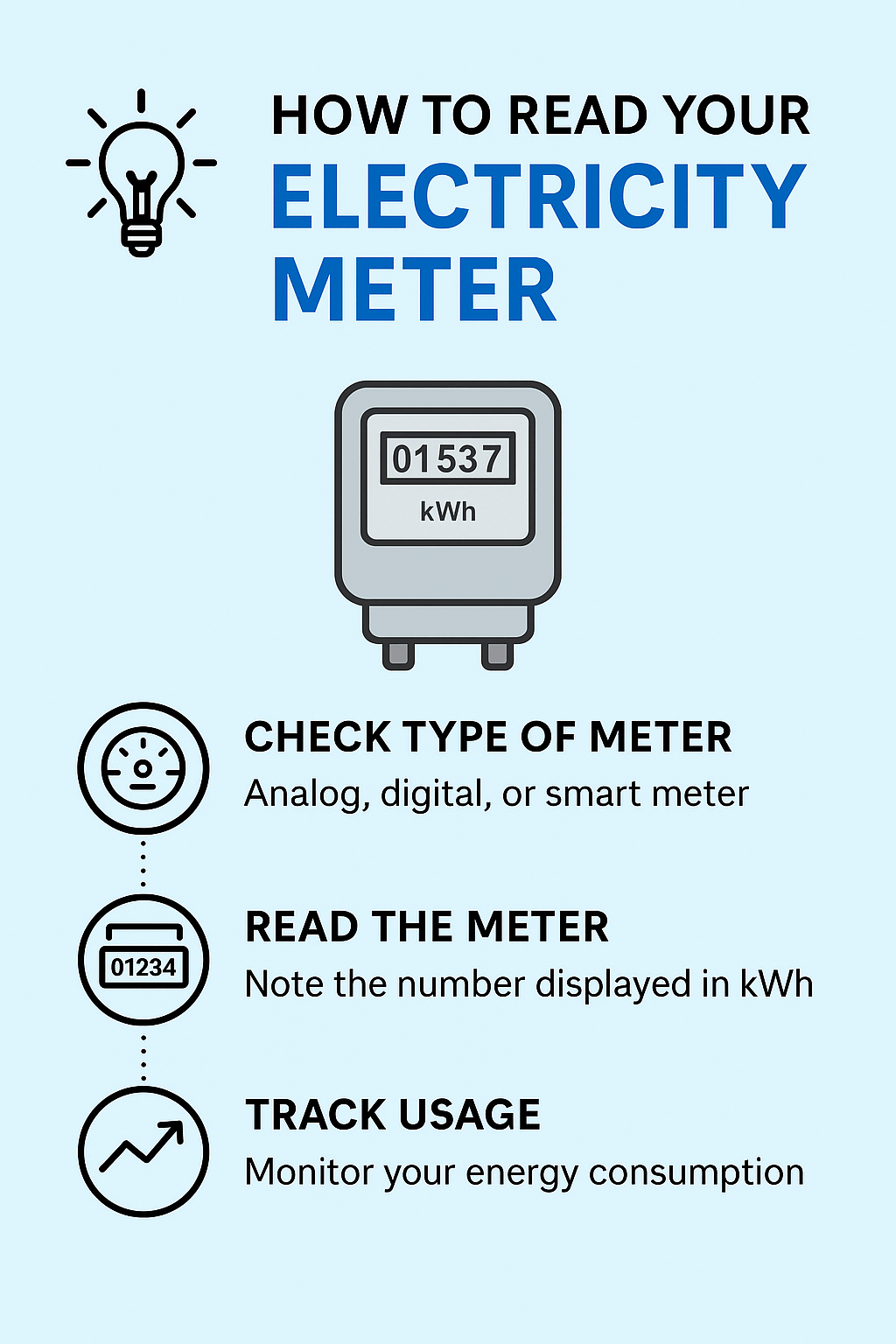
When you look at your electricity meter, the numbers you see are recorded in kilowatt-hours (kWh). But what does that mean? A kilowatt-hour is the standard unit of measurement for energy consumption. Simply put, it tells you how much electricity your household appliances have used over time.
For example, if you run a 1,000-watt (1 kW) appliance, like an electric iron, for one hour, it will consume 1 kWh. If you run the same appliance for 5 hours, that’s 5 kWh. The more appliances you use and the longer they run, the higher your kWh reading will be.
How Utility Companies Use kWh for Billing
Your utility company takes the meter readings—both the previous and the current—and calculates the difference. That difference is the total kWh you’ve used during the billing cycle. Once they have the units consumed, they multiply it by your electricity tariff rate to determine your electricity bill.
Example:
-
Previous reading: 12,450 kWh
-
Current reading: 12,900 kWh
-
Units consumed: 450 kWh
If your rate is Rs. 20 per kWh:
450 × 20 = Rs. 9,000
This is how your raw meter readings are converted into your monthly cost.
Understanding kWh in electricity bills helps you see how your daily habits affect your expenses. By keeping an eye on your readings, you can spot high consumption periods and find ways to cut back—leading to lower bills and more efficient energy usage.
How to Calculate Your Electricity Bill from Meter Reading
One of the most practical benefits of learning to read your meter is that you can easily calculate your electric bill. This gives you a clear idea of what to expect in your upcoming bill and helps you track your energy usage during each billing cycle.
Step 1: Find Your Current and Previous Reading
Check your meter reading today and note it down. Then look at your last electricity bill or record to see the previous reading.
Step 2: Apply the Formula
Subtract the previous reading from the current reading:
Current Reading – Previous Reading = Units Consumed (kWh)
These units represent your total electricity usage in kilowatt-hours for the billing cycle.
Step 3: Apply the Tariff / Rate Plan
Every utility company has a tariff rate plan—the price you pay per kWh. Multiply the total units consumed by your tariff rate to estimate your monthly cost.
Example:
-
Previous Reading: 9,850 kWh
-
Current Reading: 10,200 kWh
-
Units Consumed: 350 kWh
If the tariff rate is Rs. 20 per kWh:
350 × 20 = Rs. 7,000
This means your estimated electricity bill will be around Rs. 7,000 for this billing cycle.
By following this simple method, you can easily monitor your household energy consumption, predict your electricity costs, and manage your budget more effectively.
Why Checking Your Meter Reading Regularly is Important
Most people only look at their electricity bill once it arrives, but by then, it’s often too late to control the costs. Regularly checking your meter reading is a simple habit that can save you money, prevent mistakes, and give you better control over your energy consumption.
1. Avoid Overbilling and Errors
Sometimes, utility companies may rely on estimated readings instead of actual ones, which can lead to overbilling. By keeping track of your readings, you can compare them with your bill and quickly spot any discrepancies.
2. Detect High Energy Consumption Early
When you regularly check your meter, you’ll notice sudden spikes in household power usage. This could indicate that certain appliances are consuming more electricity than expected or that you’re using more power during peak hours. Identifying these patterns early helps you adjust your usage before the bill gets too high.
3. Monitor Appliance Impact
Every appliance in your home—from air conditioners to water heaters—adds up to your monthly kWh consumption. By watching your readings closely, you can see how different devices impact your overall electricity usage and take steps to reduce unnecessary consumption.
4. Identify Faulty Meters or Appliances
If your bill doesn’t match your actual lifestyle or you notice unusual jumps in usage, it could be due to a faulty meter or even a malfunctioning appliance. Regular monitoring helps you catch such issues quickly and report them before they cost you extra.
In short, checking your electricity meter reading regularly is one of the easiest ways to stay in control of your budget, avoid billing surprises, and make smarter choices about your energy use.
Tips for Energy Efficiency & Lower Bills
Managing your electricity doesn’t just stop at reading your meter—it’s also about using smart habits to lower your costs. With a few simple energy efficiency tips, you can reduce waste, cut down on unnecessary usage, and enjoy smaller bills every month.
1. Use Energy-Saving Appliances
Modern appliances are designed to consume less electricity while giving you the same performance. Switching to LED bulbs, inverter air conditioners, and energy-efficient refrigerators can make a noticeable difference in your electricity bill.
2. Reduce Peak-Hour Usage
Electricity is often more expensive during peak hours when demand is high. By shifting heavy appliance use—like washing machines, irons, or water heaters—to off-peak times, you can save money and ease the load on your household power usage.
3. Monitor Trends with Smart Meters
If you have a smart meter, make use of its real-time tracking features. These devices let you see exactly when your consumption spikes. By tracking power consumption, you can identify wasteful habits and make adjustments before the next billing cycle.
4. Practice Daily Energy-Saving Habits
Simple steps like turning off lights when not in use, unplugging chargers, and maintaining appliances regularly can go a long way in reducing electricity usage.
By combining regular meter reading with smart energy practices, you not only stay in control of your bills but also contribute to a more efficient and sustainable use of electricity.
Common Problems and When to Contact Your Utility Provider
While regularly checking your electricity meter reading helps you stay in control, there are times when issues can still arise. Knowing when to contact your utility company is important to avoid paying extra or dealing with incorrect bills. Here are some common problems to watch out for:
1. Signs of a Faulty Meter
If your meter is stuck, showing unreadable numbers, or running unusually fast without reason, it may be a faulty meter. Since meters are responsible for recording your energy consumption, even a small fault can lead to incorrect billing.
2. Unexpectedly High Readings
Sometimes, you may notice a sudden spike in your usage that doesn’t match your actual lifestyle. If your electricity habits haven’t changed but the meter shows a huge increase in household power usage, it’s worth double-checking with your provider. This could point to an error in recording or a technical fault.
3. Overbilling Issues
If the amount on your electricity bill is far higher than what your meter reading shows, it could be a case of overbilling. Comparing your readings with the numbers on your bill is the easiest way to spot this problem.
4. When to Report Issues
Always contact your utility company if:
-
Your meter looks damaged or faulty.
-
You notice continuous incorrect readings.
-
Your bill doesn’t match your actual consumption.
By reporting a faulty meter or billing error promptly, you protect yourself from paying extra charges and ensure accurate tracking of your energy usage.
FAQs
How do I know if my electricity meter is faulty?
A faulty meter may show unusual signs such as the display not moving, digits running too fast, or unreadable numbers. If your meter reading does not match your actual energy consumption or your electricity bill is unexpectedly high despite normal household usage, it’s best to contact your utility company and request a meter inspection.
How can I check my electricity bill from meter reading?
To calculate your bill, note your current electricity meter reading and subtract the previous reading. The result shows your units consumed in kilowatt-hours (kWh). Multiply these units by your applicable tariff or rate plan to get an estimate of your monthly bill. This electric bill calculation helps you stay in control of your expenses.
What’s the difference between a smart meter and a digital meter?
A digital meter shows readings on an LCD screen that you must check manually. A smart meter, however, automatically transmits your energy usage data to the utility provider and often comes with a mobile app or in-home display for real-time monitoring. Smart meters are more accurate and convenient than digital meters, making it easier to track your billing cycle.
How do I reduce high electricity consumption at home?
You can lower your household power usage with a few simple energy efficiency tips:
-
Use LED bulbs and energy-saving appliances.
-
Reduce heavy appliance usage during peak hours.
-
Unplug devices when not in use.
-
Monitor consumption trends using a smart meter.
By applying these steps, you can reduce electricity usage, lower your monthly bills, and enjoy long-term savings.
Conclusion
Learning how to read your electricity meter is more than just a technical skill—it’s a way to stay in control of your energy consumption and monthly expenses. Whether you have an analog, digital, or smart meter, regularly checking your readings helps you detect errors, avoid overbilling, and better understand your household’s power usage.
By keeping track of your meter readings, you gain valuable insights into your daily habits and the impact of your appliances on your electricity bill. When paired with simple energy efficiency practices, such as using smart devices and reducing peak-hour usage, you can effectively lower costs and save money in the long run.
So, make it a routine: self-check your meter, stay informed about your billing cycle, and adopt energy-saving habits. The more you monitor, the smarter your energy choices become. Remember, every unit of electricity saved is money saved—and a step towards smarter, more sustainable living.