
How Power Factor Affects Your Electricity Bill | Save on IESCO Charges
Have you ever wondered why your electricity bill sometimes feels higher than expected, even when your usage seems normal? One hidden factor behind this is something called power factor — a technical term that can actually have a real impact on your electricity costs.
In simple terms, power factor measures how efficiently the electrical power you use is being converted into useful work. Think of it like this: it’s the difference between the electricity flowing into your home or business and how much of that energy is actually being used effectively. A low power factor means energy is being wasted, which can lead to higher bills without you even noticing.
Most people don’t realize that power factor doesn’t just matter for big industries; it can affect domestic homes too. Whether you’re running heavy machinery in a factory or just using everyday appliances, an inefficient power factor can increase your energy costs. Understanding power factor is a smart step toward better managing your electricity usage and saving money on your IESCO bill.
➡️ Find your IESCO bill amount using the reference number
What is Power Factor?
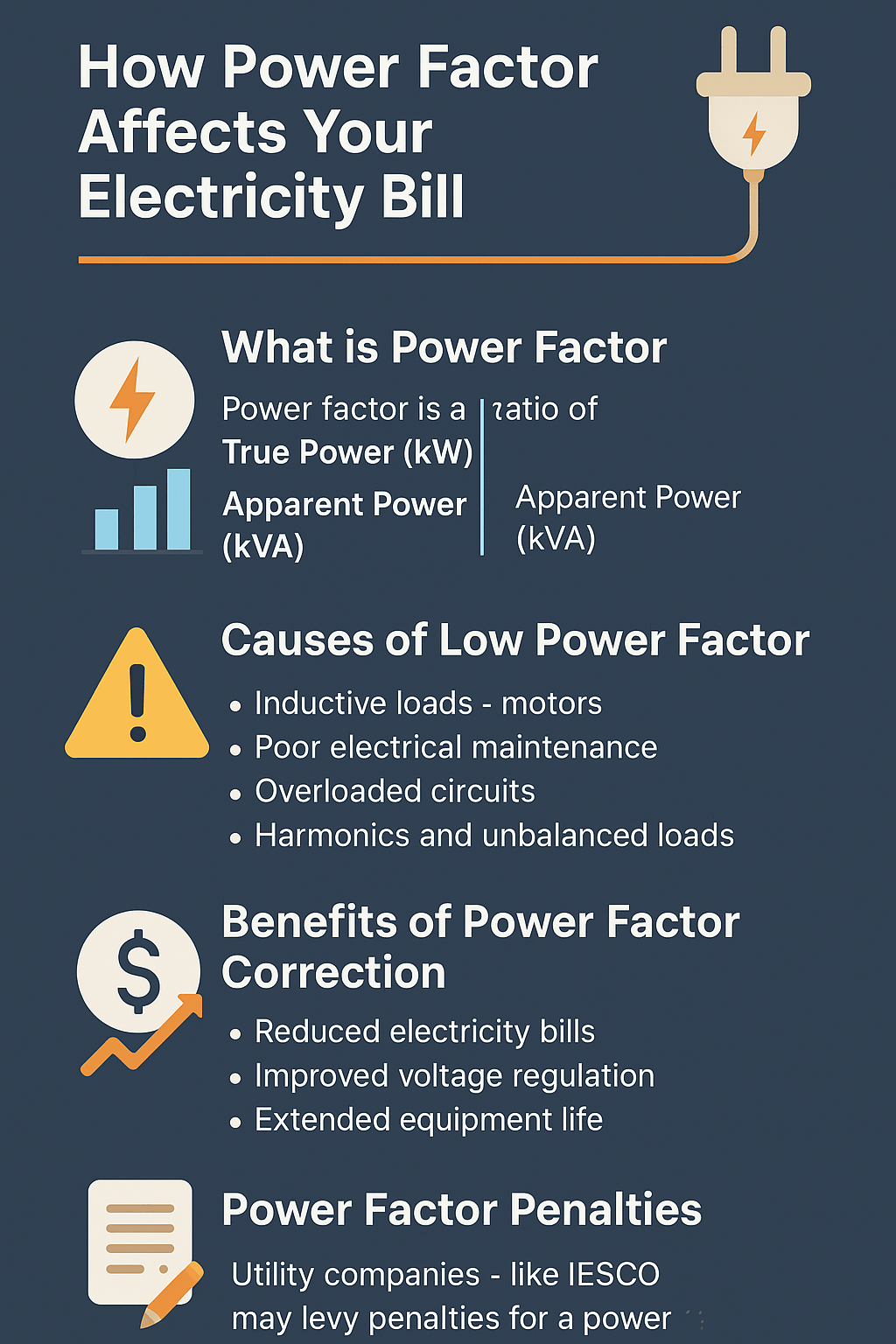
Power factor is a key term in understanding how electricity works in your home or business. Simply put, it’s a measure of how effectively the electrical power you consume is being used to do actual work. In electrical systems, power factor is the ratio between true power (measured in kilowatts, kW) and apparent power (measured in kilovolt-amperes, kVA).
To break it down further, electrical power has three main components:
-
True Power (kW): The real power that actually powers your lights, appliances, and machines.
-
Reactive Power (kVAR): The power that flows back and forth due to magnetic fields in devices like motors and transformers — it doesn’t do any useful work but is necessary for some equipment.
-
Apparent Power (kVA): The combination of true power and reactive power — basically, the total power your electrical system handles.
The power factor is calculated using this simple formula:
Power Factor = True Power (kW) ÷ Apparent Power (kVA)
A power factor value close to 1 means most of the electricity is being used efficiently, while a lower number means more energy is wasted as reactive power.
To visualize this, imagine you’re carrying water in a bucket (true power). If the bucket has holes leaking water (reactive power), you need to carry more water overall (apparent power) to get the same amount delivered. Fixing the holes means less wasted effort, just like improving power factor means less wasted electricity and lower bills.
Understanding power factor helps you see why it’s important to keep your electrical system efficient—not only to save on your IESCO electricity bill but also to reduce strain on the power grid.
➡️ Calculate expected charges for domestic and commercial IESCO accounts
How Power Factor Works in Your Electricity Bill
When you receive your electricity bill from IESCO, you usually focus on how many units (kilowatt-hours) you’ve consumed. But there’s more happening behind the scenes — especially when it comes to power factor.
Utility companies like IESCO monitor not only how much energy you use but also how efficiently you use it. If your power factor is low, it means your electrical system is pulling more current than necessary. This higher current causes extra power losses in the transmission lines and equipment, which makes the electricity delivery less efficient.
Think of it this way: when your power factor is low, your electrical appliances and machines draw more current to do the same amount of work. This increased current creates additional heat and energy loss in the wires — which the utility has to compensate for. As a result, your electricity bill can include extra charges or penalties for poor power factor because it costs the utility more to supply that wasted energy.
Real-world example: Imagine two businesses both use 100 kW of true power. Business A has a high power factor of 0.95, while Business B’s power factor is only 0.7. To deliver the same 100 kW, Business B draws much more apparent power (kVA), increasing losses and costs.
-
Business A’s apparent power = 100 kW ÷ 0.95 ≈ 105 kVA
-
Business B’s apparent power = 100 kW ÷ 0.7 ≈ 143 kVA
Because Business B requires more current, their electricity bill could be significantly higher, even though both use the same actual power. This is why improving power factor can directly help reduce your electricity costs and avoid penalties on your IESCO bill.
By understanding how power factor works in your electricity bill, you can take smart steps to optimize your energy usage and save money.
Causes of Low Power Factor
Low power factor can sneak into your electricity setup for several common reasons — and knowing these causes is the first step to fixing the problem and saving on your IESCO electricity bill.
One of the main culprits behind a low power factor is inductive loads. These are electrical devices like motors, fans, pumps, and transformers that create magnetic fields to operate. While they’re essential for many machines, they also cause a lag between voltage and current, which lowers the power factor.
Another cause is poor electrical system maintenance. Over time, worn-out wiring, loose connections, or aging equipment can affect how efficiently electricity flows, leading to wasted energy and a drop in power factor.
Overloaded circuits and voltage drops also play a role. When your electrical system is pushed beyond its capacity, voltage can dip, causing appliances to draw more current to keep running — which further reduces power factor and raises energy losses.
Lastly, harmonics and unbalanced loads in your electrical system can cause distortion in the current waveform. This interference affects the smooth flow of power, resulting in inefficiencies and a lower power factor.
By identifying these causes, whether it’s heavy machinery with inductive loads or electrical maintenance issues, you can take the right steps to improve your power factor, reduce energy waste, and keep your IESCO electricity bill in check.
➡️ Old IESCO billing history available at a glance
The Financial Impact – Why Low Power Factor Costs You More
Did you know that a low power factor can directly hit your wallet? Many people don’t realize that inefficient use of electricity doesn’t just waste energy — it can also lead to extra charges on your IESCO electricity bill.
Utility companies often impose penalties or surcharges if your power factor falls below a certain level. These penalties are designed to encourage consumers to use electricity more efficiently and reduce the strain on the electrical grid. When your power factor is low, it means your system is drawing more current than necessary, increasing the demand on the utility’s infrastructure.
This results in higher demand charges because utilities have to provide and maintain equipment capable of handling these larger loads, even if the actual useful power consumption is lower. Simply put, you pay more for the wasted energy that your equipment isn’t using effectively.
Let’s look at an example to make it clearer:
Imagine your business uses 100 kW of true power with a power factor of 0.85, but the minimum acceptable power factor set by IESCO is 0.9. If your power factor drops below that threshold, you may be charged a surcharge calculated on the extra apparent power (kVA) you’re consuming.
-
At 0.85 PF, your apparent power = 100 ÷ 0.85 ≈ 118 kVA
-
At 0.9 PF, your apparent power should be = 100 ÷ 0.9 ≈ 111 kVA
The difference means you’re paying for around 7 kVA of unnecessary load, which can quickly add up in surcharges.
By improving your power factor, you not only avoid these penalties but also boost your energy efficiency, reduce wasted electricity, and ultimately save money. Understanding this financial impact is crucial for both households and businesses looking to lower their electricity bills and optimize their power usage.
Power Factor Penalties and Utility Tariffs
If you’re a customer of IESCO, WAPDA, or LESCO, it’s important to understand how your power factor can affect your electricity bill through utility tariffs and penalties.
In Pakistan, electricity providers include power factor considerations in their tariff schedules to encourage efficient energy use. Generally, when your power factor falls below a certain threshold — often around 0.9 — penalties may apply. These penalties are charged because a low power factor means you’re using more apparent power (kVA), which puts extra load on the power distribution system.
For industrial and commercial users, these penalties can be quite significant. Industries typically operate large motors, pumps, and heavy machinery, which can lower power factor if not managed properly. If your power factor drops below the set limit, your electricity bill will reflect additional charges designed to cover the cost of the extra strain on the grid.
On the other hand, domestic users usually have fewer inductive loads and lower overall consumption, so power factor penalties are less common or less strict. However, if you use several high-power appliances like air conditioners, refrigerators, or welding equipment, it’s still a good idea to monitor and maintain a healthy power factor to avoid unexpected charges.
By understanding how WAPDA, IESCO, and LESCO tariffs address power factor, you can better manage your energy consumption. Keeping your power factor above the minimum required level helps you avoid penalties, reduce wasted energy, and keep your electricity bills affordable.
➡️ Use our calculator to compare solar costs vs unit billing
How to Improve Your Power Factor
Improving your power factor is one of the smartest ways to reduce your electricity bill and make your electrical system more efficient. Luckily, there are several practical steps you can take to boost your power factor and avoid unnecessary charges on your IESCO bill.
One of the most common solutions is installing capacitor banks. These devices help compensate for the reactive power caused by inductive loads like motors and pumps, effectively “balancing out” your power usage and bringing your power factor closer to 1. Capacitor banks can be tailored to the size and type of your electrical system for maximum efficiency.
Another great method is using power factor correction capacitors directly on motors. Since motors are often the main cause of low power factor, adding correction capacitors helps reduce the lag between voltage and current right at the source, improving overall system performance.
Load balancing also plays a key role. By evenly distributing electrical loads across different phases, you can prevent unbalanced currents that reduce power factor and cause energy losses. Regularly reviewing and adjusting your load distribution can make a big difference.
Don’t forget the importance of scheduled equipment maintenance. Worn-out or poorly maintained machines often run inefficiently, lowering your power factor. Keeping your electrical devices clean and in good condition helps them operate smoothly and efficiently.
Finally, investing in smart monitoring systems that track your power factor in real-time can give you valuable insights. These systems alert you to drops in power factor early, allowing you to take action before penalties or high bills kick in.
By combining these strategies—capacitor banks, motor correction, load balancing, maintenance, and smart monitoring—you can significantly improve your power factor, reduce energy waste, and enjoy lower electricity bills from IESCO.
✅ Learn how scheduling appliances off-peak saves IESCO charges
Benefits of Power Factor Correction
Making the effort to improve your power factor brings a range of valuable benefits—not just for your electricity bill but for your entire electrical system.
First and foremost, power factor correction helps reduce your electricity bills. By improving how efficiently you use electrical power, you lower the amount of wasted energy and avoid costly penalties from IESCO or other utility providers. This means real savings every month.
Better power factor also leads to improved voltage regulation. When your system operates efficiently, voltage levels stay more stable, which helps your appliances and machinery perform optimally without flickering lights or unexpected shutdowns.
Another big advantage is extended equipment life. When your electrical devices run at a healthy power factor, they experience less overheating and stress. This reduces wear and tear, helping your motors, pumps, and other equipment last longer and need fewer repairs.
Lastly, improving power factor reduces strain on transformers and generators. With less reactive power flowing through your system, these critical components work more smoothly and efficiently, lowering maintenance costs and reducing the risk of outages.
In short, power factor correction is a smart investment that boosts energy efficiency, protects your equipment, and helps keep your IESCO electricity bill in check—all while supporting a more reliable power supply.
Common Myths about Power Factor and Billing
Power factor can seem confusing, and over time, a few myths have developed—especially around how it affects your electricity bill. Let’s clear up some of the most common misunderstandings.
Myth 1: “Power factor doesn’t matter for homes.”
Many people believe that power factor is only an industrial issue and that it doesn’t impact residential consumers. While it’s true that power factor penalties are more common in commercial settings, having a poor power factor at home can still lead to inefficiencies and higher electricity costs—especially if you run heavy appliances like air conditioners, water pumps, or welding machines. So, power factor does matter for households that want to optimize their energy use and avoid unnecessary waste.
Myth 2: “You only need to fix power factor problems in factories.”
It’s partially true that industries with large motors and heavy equipment are more likely to experience low power factor issues. However, this doesn’t mean homes and small businesses should ignore it. With the increasing use of electronics, inverters, and motor-driven devices, maintaining a good power factor is becoming more important for everyone.
Myth 3: “Capacitors always fix the power factor problem.”
While installing capacitors is one of the most effective ways to improve power factor, it’s not a one-size-fits-all solution. If your electrical system has issues like unbalanced loads, harmonics, or faulty equipment, simply adding capacitors won’t fix everything. Proper assessment and targeted solutions, such as load balancing or equipment maintenance, may be needed to fully improve power factor.
Understanding the facts about power factor helps you avoid costly mistakes and ensures you get the best value from your electricity usage. Whether you’re a homeowner or a business owner, keeping an eye on power factor can save you money on your IESCO bill and improve your overall energy efficiency.
➡️ Get your forgotten bill reference back through our online system
Frequently Asked Questions
Q1: What exactly is power factor?
Power factor is a measure of how efficiently your electrical system uses the power supplied. It’s the ratio of true power (used to run devices) to apparent power (total power drawn from the grid).
Q2: Why does a low power factor increase my electricity bill?
A low power factor means your system draws more current than necessary, causing energy losses and extra strain on the grid. Utilities like IESCO may charge penalties or higher demand fees because of this inefficiency.
Q3: Can power factor affect residential electricity bills?
Yes! While penalties are more common for industrial users, homes with heavy inductive loads like motors and pumps can also experience inefficiencies and higher bills if their power factor is low.
Q4: How can I improve my power factor at home or business?
Common methods include installing capacitor banks, using power factor correction capacitors on motors, balancing electrical loads, maintaining equipment regularly, and using smart monitoring systems to track power factor.
Q5: Will adding capacitors always fix my power factor problem?
Not always. Capacitors are effective for correcting inductive loads, but if your system has other issues like harmonics or unbalanced loads, additional solutions may be needed.
Q6: At what power factor level does IESCO start applying penalties?
Typically, if your power factor drops below 0.9, you may face surcharges. It’s best to check your tariff details or consult with IESCO for specific thresholds.
Q7: How can I monitor my power factor?
You can monitor power factor through your electricity bill if provided, or install smart energy meters and monitoring devices that track real-time power usage and power factor.
Conclusion
Keeping a good power factor isn’t just a technical detail—it’s a simple, effective way to make your electricity usage more efficient and save money on your IESCO bill. By maintaining a healthy power factor, you reduce wasted energy, avoid unnecessary penalties, and help your electrical equipment run smoother and last longer.
Take a moment to check your latest electricity bills and look for power factor readings—many utility bills now include this information. If you notice a low power factor or unexpected surcharges, it’s a sign to act.
The best next step? Contact a qualified electrician or energy expert who can assess your electrical system and recommend the right power factor correction methods, whether that’s installing capacitor banks, balancing your loads, or upgrading equipment.
Don’t wait for your electricity bill to climb—reduce your electricity costs by starting to monitor your power factor today. Small changes can lead to big savings, so take control of your energy usage now and keep your power bills in check.