IESCO Approved Load Limits & Safety Guidelines – Avoid Overloading & Stay Safe
When it comes to safe and reliable electricity in Islamabad and surrounding areas, the Islamabad Electric Supply Company (IESCO) plays a central role. From powering your home appliances to keeping commercial setups running smoothly, IESCO ensures that electricity reaches you efficiently and safely.
However, safe electricity supply is a shared responsibility. One key part of this is staying within your approved load limit—the maximum electrical capacity sanctioned for your connection. This limit isn’t just a technical formality; it’s set to protect you, your appliances, and your community from the risks of electrical overloading, such as sudden voltage fluctuations, damaged wiring, or even electrical fires.
Ignoring these limits can lead to more than just inconvenience. Overloading can trip your breakers, burn out costly appliances, cause transformer failures in your area, and even lead to IESCO penalties or disconnection of your connection. By understanding and following IESCO’s load capacity guidelines, you not only stay compliant but also contribute to a safer, more stable power distribution network for everyone.
In this guide, we’ll break down the IESCO-approved load limits, explain how to check or increase your sanctioned load, and share practical electrical safety tips to help you manage your electricity usage smartly—without crossing the red line.
✅ Get your IESCO bill details by reference number now
Table of Contents
ToggleUnderstanding Approved Load Limits
When we talk about staying safe and compliant under your IESCO connection, one key term you’ll hear is “sanctioned load capacity.” Think of it as your electrical allowance—the maximum power load IESCO authorizes for your home or business. This limit is critical to ensure your wiring handles the demand and keeps everything running smoothly without stressing the system.
Domestic, Commercial, and Industrial Load Limits
Load limits differ based on what kind of connection you have:
-
Domestic connections typically receive a sanctioned load in the range of 5 kW for small homes, around 7.5 kW for medium-sized properties, and up to 10–15 kW for larger residences like 1 kanal homes.
-
Commercial and industrial consumers naturally have higher capacity, depending on their specific electricity demands. While IESCO defines these limits per category, the general principle is the same: more power needs a higher sanctioned load.
Who Sets These Load Rules?
This is where NEPRA and PEPCO come in:
-
NEPRA (National Electric Power Regulatory Authority) is the top regulatory body overseeing electricity in Pakistan. It issues licences, sets safety and technical standards, and approves tariffs and load regulations for distribution companies like IESCO.
-
PEPCO (Pakistan Electric Power Company) is the umbrella entity for all electricity distribution companies, including IESCO. Think of it as the parent organization coordinating policies among many regional power utilities.
What About IESCO’s Specific Connection Requirements?
IESCO enforces the sanctioned load limits based on NEPRA-approved standards. These limits are tied directly to your tariff category—residential, commercial, or industrial—and are used for both billing and safety assessments. Whether you’re looking to verify your current load or considering a load upgrade, IESCO’s procedures are governed by these NEPRA-sanctioned rules.
✅ Find estimated monthly IESCO electricity charges with ease
IESCO Load Categories & Limits
Not all electricity users are the same—your power needs depend on whether you’re running a small home, a bustling shop, or a heavy-duty manufacturing unit. That’s why IESCO divides its approved load limits into different categories, each with its own safe capacity range.
Domestic Consumer Load Range
For homes, IESCO allocates a sanctioned load based on the size of the house and the number of appliances.
-
Small households: Usually between 3 kW and 5 kW, perfect for basic needs like fans, lights, a fridge, and a TV.
-
Medium to large houses: Around 7.5 kW to 10 kW, enough to run multiple air conditioners, kitchen appliances, and extra electronics.
-
Luxury residences: Can go beyond 15 kW, but only with proper approval and upgraded wiring to prevent circuit overloads.
Staying within these limits helps avoid voltage drops, appliance damage, and unnecessary tripping of breakers.
Commercial Load Range
Shops, restaurants, and small offices need a higher sanctioned load compared to homes.
-
Small shops might require 5 kW to 7 kW, while restaurants, salons, or medical clinics could need 10 kW or more.
-
Exceeding your commercial load limit can result in IESCO penalties and even service disconnection, so load planning is crucial.
Industrial Load Capacity
Factories and manufacturing units fall into the industrial category, where loads can exceed 25 kW and go into hundreds of kilowatts depending on the machinery.
-
These setups often require three-phase supply, specialized circuit breakers, and heavy-duty distribution boards.
-
Overloading in industrial environments can cause transformer failures—impacting not just the factory but surrounding consumers too.
✅ Fetch previous IESCO billing records with one click
Transformer Capacity Considerations
Your area’s transformer capacity plays a big role in determining your approved load. If too many consumers exceed their sanctioned loads, the transformer can overheat, trip, or even burn out—leading to power outages for the whole neighborhood. That’s why IESCO carefully balances load distribution across its network.
How Circuit Breaker and Fuse Ratings Are Linked to Load Limits
Every circuit breaker and fuse in your system is rated to handle a certain load. If your sanctioned load is 10 kW, your breaker will be chosen accordingly.
-
Using appliances beyond that limit can trip the breaker repeatedly or, worse, cause wiring damage and fire hazards.
-
Correct breaker and fuse sizing is part of IESCO’s safety guidelines, ensuring your electrical system can handle the approved capacity without risk.
Procedure to Check or Increase Approved Load
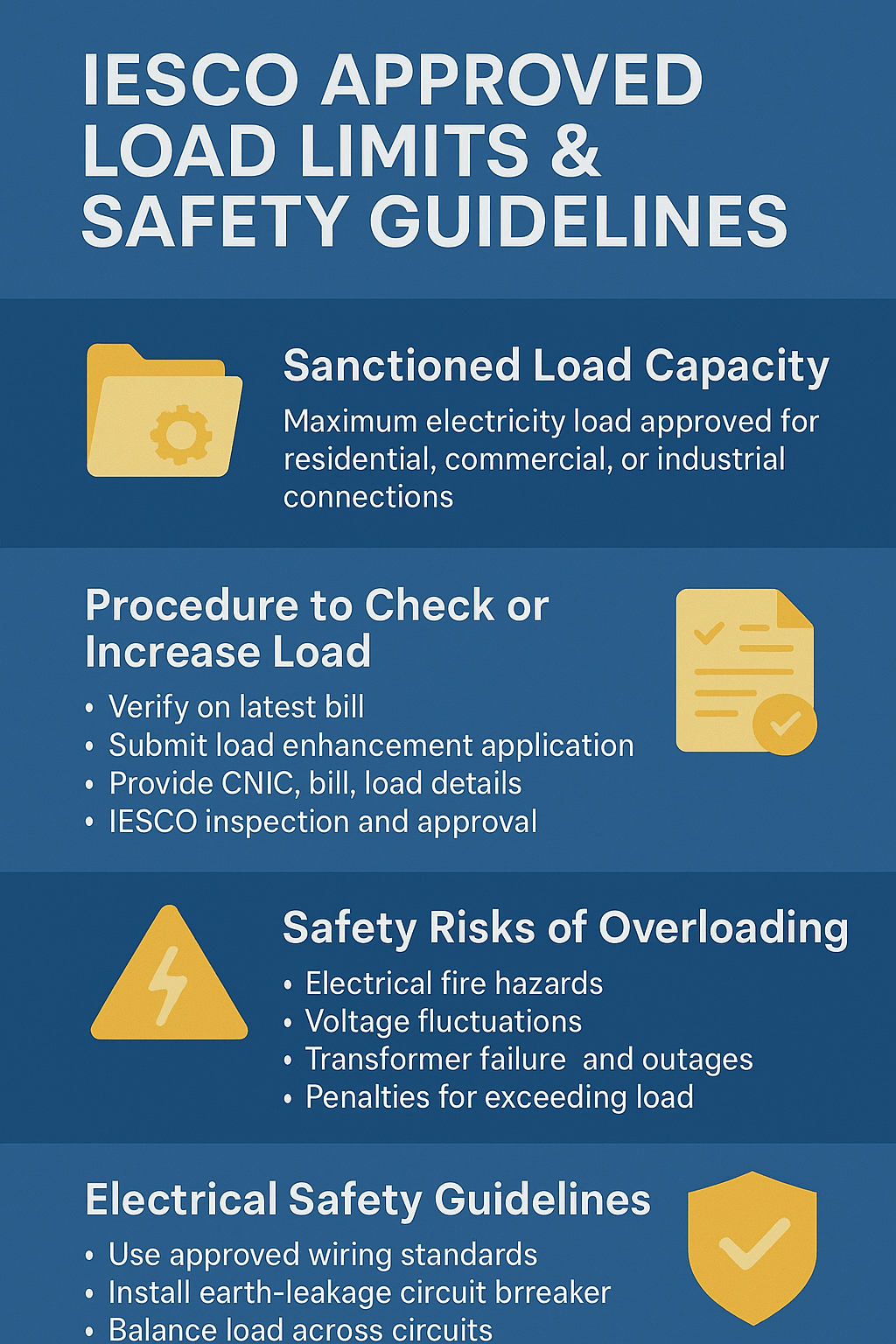
Whether you’ve recently added new appliances, expanded your home, or upgraded your business equipment, it’s important to ensure your sanctioned load matches your actual electricity usage. Staying within your IESCO-approved load limit helps prevent overloading, penalties, and potential service disconnection.
How to Verify Your Current Sanctioned Load
Checking your approved load is simple:
-
Look at your latest IESCO electricity bill – Your sanctioned load (in kilowatts or kW) is usually printed in the billing details section.
-
Visit the IESCO online bill portal – Enter your reference number to download your bill and see your current load limit.
-
Call the IESCO helpline – For quick confirmation, you can contact IESCO’s customer service and provide your connection details.
Step-by-Step Process to Apply for Load Enhancement
If your electricity needs have grown, here’s how you can apply for a higher sanctioned load:
-
Visit your nearest IESCO Customer Care Center or Sub-Division Office.
-
Fill out the Load Enhancement Application Form – Available at the office or downloadable from IESCO’s official website.
-
Submit your application along with required documents (see below).
-
Pay the load enhancement fee – Charges depend on the additional load requested.
-
Schedule an inspection – IESCO will arrange a visit to assess your wiring and safety readiness.
-
Get official approval – Once everything meets safety and technical standards, your sanctioned load will be updated.
Required Documents
When applying for load enhancement, make sure you have:
-
Copy of your CNIC (Computerized National Identity Card)
-
Latest paid electricity bill (to verify connection ownership and standing)
-
Load calculation form (showing the total expected demand in kW)
-
Proof of premises (property ownership or tenancy documents, if required)
IESCO Inspection and Approval Process
After receiving your application:
-
An IESCO inspection team will visit your premises to check wiring, breaker capacity, and overall load safety compliance.
-
They will also ensure your main distribution board (MDB), circuit breakers, and service line can handle the new load without risk.
-
If approved, the load update will be reflected in your bill from the next billing cycle.
Tip: Always consult a licensed electrician before applying for load enhancement to ensure your internal wiring meets IESCO safety standards. This will speed up the approval process and reduce the chances of rejection.
Safety Risks of Overloading
Exceeding your IESCO-approved load limit might seem harmless—until the consequences hit. Overloading your connection can harm your appliances, endanger lives, and even cause power issues for your whole neighborhood. Let’s break down the major risks so you understand why staying within your sanctioned load capacity is non-negotiable.
1. Electrical Fire Hazards
When your wiring is forced to carry more electricity than it’s designed for, it heats up. Prolonged overheating can melt insulation, spark flames, and cause electrical fires. Many incidents in Pakistan’s urban and rural areas trace back to unsafe load practices.
-
Poor-quality wiring, outdated circuit breakers, and ignoring IESCO safety guidelines only increase the danger.
-
Residential fires caused by overloaded circuits can destroy property and cost lives.
2. Voltage Fluctuation and Appliance Damage
Overloading puts unnecessary stress on the electrical network, causing voltage drops and sudden fluctuations.
-
Sensitive electronics like TVs, refrigerators, and air conditioners are especially vulnerable.
-
Even a short voltage surge can burn out compressors, motors, and circuit boards—leading to expensive repairs or replacements.
3. Transformer Failure and Power Outages
Your local distribution transformer is designed for a specific load capacity.
-
When too many consumers in the area exceed their sanctioned limits, the transformer overheats.
-
This can cause temporary outages, permanent transformer damage, and costly replacements.
-
In many Pakistani localities, summer transformer burnouts are directly linked to illegal load increases during peak cooling hours.
4. Legal Penalties for Exceeding Sanctioned Load
IESCO, under NEPRA regulations, has the authority to penalize consumers who use more than their approved capacity.
-
Penalties may include fines, service disconnection, or even legal action in severe cases.
-
Repeat violations can result in mandatory load reduction or refusal of future load enhancement requests.
5. Real-World Case Examples from Pakistan
-
In Rawalpindi, a commercial plaza faced a major transformer fire after tenants collectively drew double the approved load. The result? A week-long blackout and massive business losses.
-
In Islamabad, a housing society experienced repeated power outages every summer due to residents exceeding their domestic load limits with multiple unapproved air conditioners.
Bottom line: Overloading is not just an inconvenience—it’s a serious safety hazard that can cause fires, destroy appliances, trigger long power outages, and bring hefty legal penalties. By respecting your IESCO load capacity, you’re protecting your home, your appliances, and your community’s electricity supply.
✅ Check solar energy ROI in terms of IESCO bill savings
IESCO Electrical Safety Guidelines
Electricity is one of the most essential services in our lives—but it can also be one of the most dangerous if not handled correctly. That’s why IESCO enforces strict electrical safety guidelines for all consumers. Following these rules not only keeps you safe but also ensures your home or business stays compliant with NEPRA-approved standards.
Approved Wiring Standards and Safe Wiring Practices
Your wiring is the backbone of your electrical system. Poor-quality cables or unprofessional installation can lead to overheating, short circuits, and even electrical fires.
-
Always use Pakistan Standards and Quality Control Authority (PSQCA)-approved wires and fittings.
-
Hire only licensed electricians who understand IESCO wiring guidelines.
-
Avoid makeshift joints and loose connections, as these are common fire hazards.
Importance of Earth Leakage Circuit Breaker (ELCB)
An Earth Leakage Circuit Breaker (ELCB) is your first line of defense against electric shocks.
-
It detects small leakages of current to earth and instantly shuts off the power before it can harm anyone.
-
IESCO strongly recommends installing ELCBs in all new connections, whether domestic, commercial, or industrial.
-
In many cases, the installation of an ELCB is a requirement before load approval or enhancement.
Load Balancing Across Circuits
Overloading a single circuit is one of the fastest ways to trip breakers or cause voltage fluctuations.
-
Distribute high-consumption appliances like air conditioners, heaters, and microwaves across different circuits.
-
Use separate wiring for heavy appliances to avoid overburdening the main supply line.
-
Load balancing is especially important in three-phase supply systems to keep all phases evenly loaded.
Role of Main Distribution Board (MDB) in Safety
The Main Distribution Board (MDB) acts as the control center of your electrical system.
-
It houses your main breaker, fuses, and safety devices.
-
A well-maintained MDB ensures that in case of a fault, only the affected circuit trips—keeping the rest of your house or business powered safely.
-
IESCO inspections often check the MDB to confirm it meets safety and load capacity standards.
Consumer Responsibilities for Safe Electricity Usage
Electrical safety isn’t just IESCO’s responsibility—it’s yours too.
-
Never exceed your sanctioned load capacity without formal approval.
-
Report damaged poles, exposed wires, or sparks near your property to IESCO immediately.
-
Schedule regular inspections to ensure your wiring, breakers, and earthing systems are in good condition.
-
Avoid illegal connections or tampering with the meter—it’s not only dangerous but also a punishable offense.
Remember: A few simple steps—like using approved wiring, installing an ELCB, and balancing your load—can prevent costly damages, protect lives, and ensure uninterrupted electricity for you and your community.
✅ Use our tool to estimate electricity charges during high-demand periods
Load Management Best Practices
Managing your electricity usage isn’t just about saving money—it’s about protecting your appliances, avoiding overloading, and ensuring your IESCO-approved load limit is never crossed. With a few smart strategies, you can create a load management plan that works for both homes and businesses.
1. Create a Load Management Plan for Homes and Businesses
A proper load management plan helps you decide when and how to use your electrical appliances without stressing your system.
-
List all major appliances (air conditioners, heaters, microwaves, water pumps, etc.) and note their wattage.
-
Schedule high-power appliances so they’re not all running at the same time.
-
For businesses, stagger the operation of heavy machinery to avoid peak load spikes.
2. Use Energy-Efficient Appliances to Stay Within Limits
Energy-efficient appliances use less electricity without compromising performance.
-
Look for devices with Energy Star ratings or efficient inverter technology.
-
Replace old tube lights with LED bulbs—they consume up to 80% less electricity.
-
For cooling, opt for inverter ACs instead of conventional models.
These small upgrades can significantly reduce your total consumption, helping you stay well below your sanctioned load capacity.
3. Avoid Peak-Hour Overloading
IESCO peak hours are when electricity demand is at its highest—usually in the evenings and summer afternoons.
-
Running all heavy appliances during these hours not only risks overloading your connection but also contributes to voltage fluctuations in your area.
-
Shift non-essential usage like washing machines, irons, and water motors to off-peak times.
4. Schedule Regular Maintenance and Inspection
Faulty wiring, worn-out breakers, or loose connections can reduce your electrical system’s capacity and increase the risk of overload.
-
Have a licensed electrician inspect your wiring and main distribution board (MDB) every 6–12 months.
-
Ensure all breakers and fuses are working properly and match your load requirements.
-
For businesses, conduct load assessments annually to adjust usage as equipment changes.
Legal Compliance & Consumer Rights
When it comes to electricity usage, IESCO takes legal compliance very seriously. The goal isn’t just to enforce rules—it’s to ensure safe, fair, and reliable power distribution for all consumers. As a customer, it’s important to know both your responsibilities and your rights under IESCO’s policies and NEPRA regulations.
IESCO’s Policy on Non-Compliance
Every consumer is bound by the terms of their electricity connection agreement, which includes respecting the approved load limit.
-
If you exceed your sanctioned load capacity without proper approval, you are considered non-compliant.
-
Non-compliance also includes unsafe wiring, bypassing meters, and illegal connections.
-
IESCO monitors connections regularly to detect overloading and violations through field inspections and meter readings.
Penalties and Disconnection Rules
Breaking IESCO’s load regulations can result in strict actions:
-
Monetary fines are based on the severity of the violation.
-
Immediate disconnection of your electricity supply in dangerous or repeated cases.
-
Possible legal action for electricity theft or tampering with meters.
-
Additional charges for load restoration after disconnection.
Staying within your load limit and following IESCO safety guidelines is the easiest way to avoid these penalties.
Consumer Rights Under NEPRA Regulations
While IESCO enforces the rules, NEPRA (National Electric Power Regulatory Authority) protects your rights as a consumer.
-
You have the right to transparent billing with your sanctioned load clearly stated.
-
You can apply for load enhancement or reduction at any time.
-
You are entitled to timely restoration of service after approved upgrades or maintenance.
-
You can file a complaint with IESCO or escalate it to NEPRA if you feel your rights have been violated.
Reporting Unsafe Electrical Practices
Electrical safety is a shared responsibility. If you notice:
-
Overloaded poles or transformers
-
Exposed live wires
-
Illegal hook connections (“kundas”)
-
Sparks or burning smells near electrical infrastructure
report it immediately to the IESCO helpline or your local subdivision office. Quick reporting can prevent accidents, protect lives, and maintain a stable power supply for your area.
FAQs
1. How do I find my approved load capacity?
Your approved load capacity is mentioned on your IESCO electricity bill, usually in the “Sanctioned Load” or “Connected Load” section.
-
If you don’t have a recent bill, you can check it through the IESCO online bill portal by entering your reference number.
-
You can also contact the nearest IESCO Customer Care Center to verify it in their records.
2. Can IESCO disconnect my connection without notice for overloading?
Yes – in serious cases.
-
If overloading is causing safety hazards, damaging infrastructure, or violating NEPRA safety regulations, IESCO has the authority to disconnect the supply immediately without prior notice.
-
For minor cases, you’ll usually receive a warning or load regularization notice before disconnection.
3. What is the cost to enhance load capacity?
The cost of load enhancement depends on:
-
The difference between your current sanctioned load and the requested load
-
Any additional infrastructure or wiring upgrades required
-
NEPRA-approved charges for meter replacement or load change
You can get the exact cost estimate from your local IESCO subdivision office after applying for load enhancement.
4. Is load enhancement required for adding new heavy appliances?
Yes – if the appliance increases your total load beyond your approved capacity.
-
-
Adding air conditioners, electric geysers, water pumps, or industrial machines without load enhancement can lead to meter tripping, voltage drops, and safety risks.
-
It’s always safer to apply for a load upgrade before installing high-consumption equipment.
-
Conclusion
Electricity is the heartbeat of every home and business — but with great power comes the responsibility to use it safely. Adhering to your IESCO-approved load limits isn’t just about avoiding fines; it’s about protecting your appliances, ensuring stable voltage, and preventing electrical hazards that can put lives at risk.
Regular electrical inspections are one of the smartest habits you can adopt. By checking your wiring, meter, and overall load consumption, you reduce the chances of sudden outages, short circuits, and costly equipment damage.
If you’re planning to add new heavy appliances or increase your sanctioned load, follow the proper procedure through IESCO’s official channels. You can find detailed safety guidelines, load enhancement application forms, and approved tariff rates on IESCO’s official website.
⚡ Take Action Today:
-
Review your approved load capacity on your latest IESCO bill or through the online portal.
-
Schedule a professional inspection if you haven’t had one in over a year.
-
Visit IESCO’s official safety resource page to learn more about safe electricity usage and load management.
Remember, smart electricity usage means a safer home, lower bills, and a healthier power grid for everyone.