IESCO Load Extension & Load Reduction Process – Complete Guide 2025
Managing your electricity usage effectively starts with understanding your sanctioned load. For IESCO consumers, two important processes help adjust this load as per your needs – Load Extension and Load Reduction.
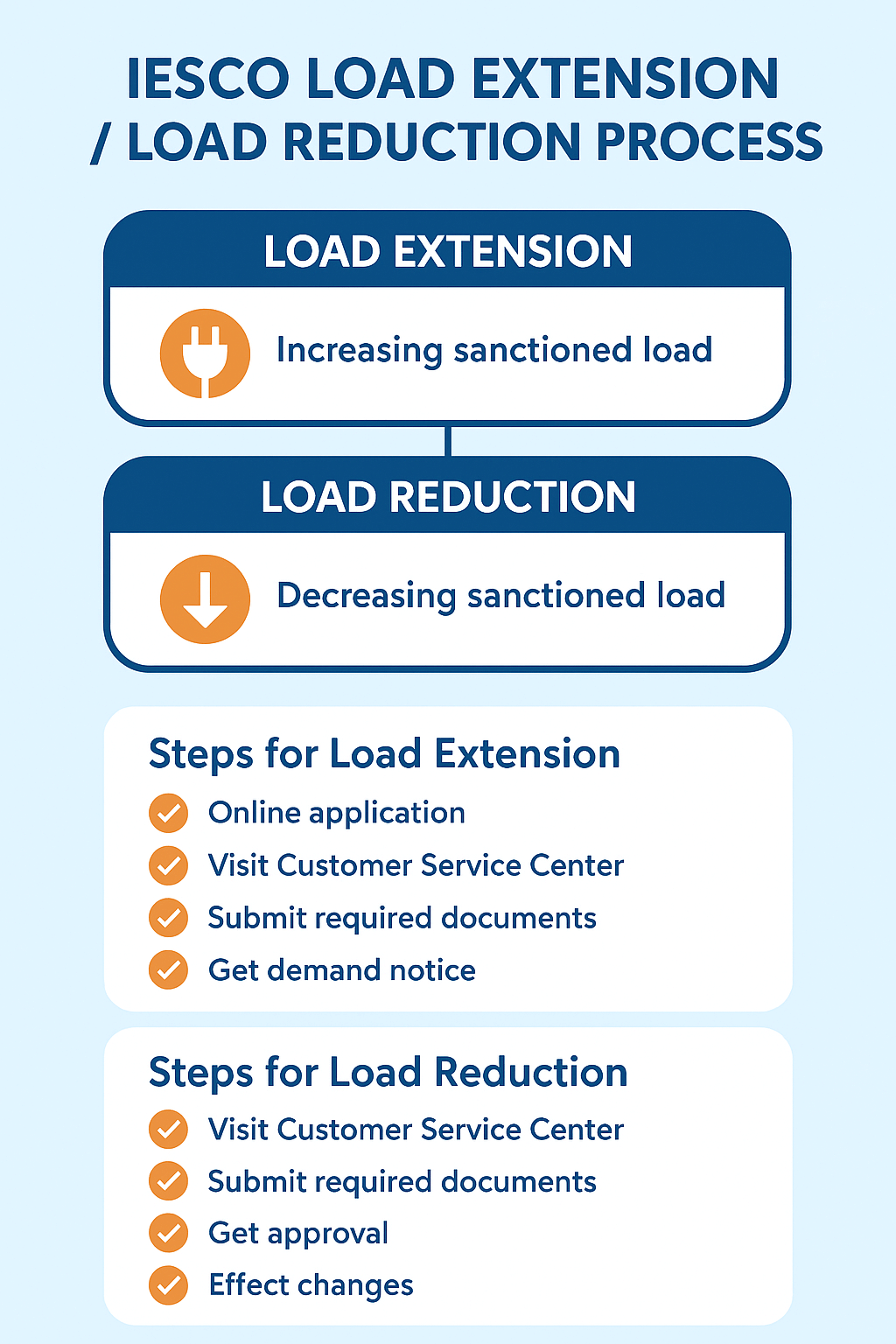
In simple terms, Load Extension means increasing your sanctioned load, while Load Reduction refers to decreasing it. These processes are essential to ensure that your electricity supply matches your actual consumption.
But why would you need to change your load? Here are a few common scenarios:
-
If you’ve recently added heavy appliances like air conditioners, geysers, or motors, you might require additional load approval to avoid overloading your meter.
-
On the other hand, if your electricity usage has decreased – maybe due to energy-efficient appliances or reduced household demand – applying for a load reduction can help lower your billing category and save money.
✅ How to view IESCO electricity bills online step by step
IESCO, under the regulations of NEPRA (National Electric Power Regulatory Authority) and WAPDA, has a well-defined process for these changes. Whether you need extra load for a growing business or want to reduce your sanctioned load for cost efficiency, following the proper procedure is important for safety and compliance.
Adjusting your load correctly ensures accurate billing, prevents overloading, and keeps you aligned with IESCO’s guidelines. In the sections ahead, we’ll guide you through the complete IESCO Load Extension and Load Reduction Process, including the application steps, required documents, charges, and verification process.
What is IESCO Load Extension and Load Reduction?
When you apply for an electricity connection with IESCO, you are assigned a sanctioned load, which represents the maximum power your connection is allowed to draw. Over time, your electricity needs may change. That’s where Load Extension and Load Reduction come into play.
Load Extension
Load Extension means increasing your sanctioned load. This is required when you start using additional heavy appliances or expand your home or business operations. For example, if you install multiple air conditioners, electric water heaters, or industrial machines, your current load limit may not be enough to handle the extra demand. By applying for a load extension, you ensure your system can safely handle this increase without risking meter damage or disconnection.
Load Reduction
On the other hand, refers to decreasing your sanctioned load. This is useful when your energy consumption has dropped. Maybe you’ve replaced old appliances with energy-efficient models, or you no longer use certain equipment. Reducing your load helps you move to a lower category, which can lower your electricity bill and avoid unnecessary fixed charges.
Having the correct sanctioned load is very important. If you exceed your approved load without applying for an extension, it can lead to overloading, meter faults, and even penalties from IESCO. Similarly, keeping a higher load than you need means paying extra charges unnecessarily.
In short, applying for load extension or load reduction keeps your electricity connection safe, compliant, and cost-effective.
✅ Check the effect of unit consumption on your IESCO bill
Reasons for Load Extension or Load Reduction
Your electricity needs aren’t always the same. Sometimes they grow, and other times they shrink. That’s why IESCO offers the option of Load Extension and Load Reduction, so your sanctioned load matches your actual usage.
Why Consumers Request Additional Load Approval
There are several reasons why customers apply for a load extension:
-
New appliances – Adding heavy-duty appliances like refrigerators, electric geysers, or washing machines requires more power.
-
Air Conditioners and Motors – If you’ve installed new AC units or water pumps, your existing sanctioned load might not be sufficient.
-
Increased household or business demand – Expanding your home, starting a small business, or adding new machinery means extra electricity usage, which calls for additional load approval from IESCO.
Why Consumers Request Load Reduction
On the other hand, some consumers find their electricity needs have gone down. In such cases, applying for a load reduction can save money and make your billing more accurate:
-
Energy-efficient appliances – Switching to LED lights, inverter ACs, or other energy-saving devices reduces power demand.
-
Reduced consumption – Maybe your family size decreased, or you closed a business facility, lowering your electricity needs.
Whether you’re applying for an increase in sanctioned load or a decrease, the goal is to keep your connection aligned with your actual usage. This prevents technical issues, avoids penalties, and ensures fair billing.
IESCO Load Extension Process (Step-by-Step Guide)
If your electricity needs have increased, applying for a load extension is the safest and most reliable way to get more power without overloading your system. IESCO has a clear and straightforward process for this. Here’s a detailed guide to help you through each step.
✅ Use the Old Bill History feature to fetch past bills
How to Apply for Load Extension in IESCO
There are two convenient ways to apply for a load extension:
-
Online Application – You can apply through the IESCO official website by filling out the load extension application form online.
-
Visit the Customer Service Center – If you prefer in-person assistance, visit your nearest IESCO Customer Service Center with the required documents.
Required Documents for Load Extension
To start the process, make sure you have these documents ready:
-
Copy of CNIC (National Identity Card).
-
Latest electricity bill of your existing connection.
-
Load extension application form (filled and signed).
Having these documents complete ensures your request moves forward without delays.
IESCO Load Verification Process
Once your application is submitted, IESCO will begin the verification process:
-
Load Verification Team Visit – A team will visit your premises to verify the requested additional load and check your existing meter capacity.
-
Demand Notice Issuance – After verification, IESCO will issue a Demand Notice, which includes the charges for your load extension request.
Payment of Demand Notice
You can pay the demand notice using these methods:
-
Bank Payment – Pay at an authorized bank branch mentioned on the notice.
-
Online Payment – Many consumers prefer the convenience of paying through digital channels.
Timely payment of the demand notice ensures your process continues without any delay.
Meter Upgrade for Additional Load
In some cases, increasing your sanctioned load may require a meter upgrade to handle the extra capacity. IESCO will inform you if your current meter is not suitable and arrange for the necessary replacement.
Applying for load extension in IESCO is a simple process when you follow the proper steps. It ensures your connection remains safe, compliant, and capable of handling your growing electricity needs.
IESCO Load Reduction Process (Step-by-Step Guide)
If your electricity usage has decreased, applying for load reduction is a smart decision. It helps you save on unnecessary fixed charges and keeps your billing category accurate. Here’s a complete guide on how to reduce electricity load in IESCO connection.
Application for Load Reduction
To start the process, you need to submit an application for load reduction. This can be done by visiting your nearest IESCO Customer Service Center. Fill out the load reduction application form carefully, mentioning your current sanctioned load and the desired reduced load.
Required Documents for Load Reduction
Make sure you have the following documents when applying:
-
Copy of CNIC (National Identity Card).
-
Latest electricity bill of your current connection.
-
Filled load reduction application form.
Submitting complete documents ensures smooth processing without unnecessary delays.
Verification and Approval by IESCO
Once you submit your request, IESCO will:
-
Verify your application and ensure that reducing the load won’t affect safety or compliance.
-
Approve the new sanctioned load and update your records.
Changes in Tariff and Billing After Load Reduction
After your load reduction request is approved, your tariff category and fixed charges will be adjusted according to the new sanctioned load. This means you can save money on your monthly bills if your usage is genuinely lower.
IESCO load reduction charges are minimal compared to the long-term savings you’ll enjoy. Plus, it ensures you stay within IESCO regulations, avoiding penalties for incorrect load categorization.
Applying for load reduction in IESCO is an easy way to make your electricity bills fair and aligned with your actual consumption.
➡️ Use this tool before adding heavy appliances to your system
Charges and Timeline for Load Change
Before applying for load extension or load reduction, it’s important to understand the costs involved and the time it takes to complete the process. Knowing these details helps you plan better and avoid surprises.
IESCO Load Extension Charges
The charges for load extension depend on the amount of additional load you request, usually calculated per kilowatt (kW). These charges include:
-
Service charges for processing your application.
-
Cost of additional infrastructure, if required (such as meter upgrade or wiring adjustments).
-
Security deposit for the added load.
The exact cost will be mentioned in the Demand Notice issued by IESCO after the verification process.
IESCO Load Reduction Charges
If you are applying for a load reduction, the charges are generally lower compared to load extension. In most cases, it involves:
-
Meter recalibration or replacement charges, if needed.
Reducing your load can lead to long-term savings on fixed charges and helps avoid paying for unused capacity.
Expected Processing Time for Approval
The processing time for load change depends on the complexity of your request. Typically:
-
Load Extension – May take 15 to 30 working days, including verification and payment of the demand notice.
-
Load Reduction – Usually faster, often within 10 to 15 working days, since it involves fewer technical checks.
To avoid delays, make sure all your documents are complete and the demand notice is paid on time.
Important Rules & Guidelines by NEPRA and IESCO
When applying for load extension or load reduction, it’s essential to follow the official rules and regulations set by NEPRA and implemented by IESCO. These guidelines are designed to ensure safety, fairness, and compliance for all consumers.
NEPRA Regulations on Load Changes
The National Electric Power Regulatory Authority (NEPRA) issues clear regulations on how sanctioned load can be changed. Any modification—whether an increase or decrease—must be processed through IESCO’s official procedure. Unauthorized changes or bypassing the system can lead to penalties and disconnection.
Maximum Permissible Load per Category
Every consumer category—residential, commercial, or industrial—has a maximum permissible load limit. For example:
-
Residential consumers have lower load limits compared to commercial and industrial users.
-
Exceeding the sanctioned load without approval can trigger a load inspection and result in fines.
To avoid issues, always apply for load extension when your electricity demand exceeds the current approved limit.
Penalties for Unauthorized Load Increase
If you increase your electricity usage beyond the sanctioned load without following the official process, IESCO may impose:
-
Heavy fines for illegal load enhancement.
-
Immediate disconnection of supply.
-
Additional charges to regularize the unauthorized load.
Following the NEPRA and IESCO guidelines for load extension and reduction ensures you stay compliant, avoid penalties, and maintain a safe connection.
Common Issues & How to Avoid Delays
Applying for IESCO load extension or load reduction is a straightforward process, but small mistakes can cause unnecessary delays. Here are the most common issues consumers face and how you can avoid them.
Missing Documents
One of the biggest reasons for delays is incomplete documentation. If you forget to attach your CNIC copy, latest electricity bill, or the application form, your request will not be processed.
Solution: Double-check all required documents before submission. Having everything ready ensures a smooth application process.
Incorrect Load Mentioned in Application
Sometimes consumers request a load increase or decrease without proper calculation. Mentioning the wrong load can result in rejection or a longer verification process.
Solution: Assess your electricity needs accurately. If needed, consult with IESCO staff to determine the correct load before applying for a load extension or load reduction.
Late Payment of Demand Notice
After verification, IESCO issues a Demand Notice for load extension charges. If you delay the payment, your application will remain pending.
Solution: Pay your demand notice on time—whether through the bank or online—to keep the process moving without interruptions.
By avoiding these common issues, you can ensure your load change request is completed quickly and without hassle.
➡️ See full lineup of Pakistan’s utility bill portals reviewed
FAQs
Can I apply for load extension online?
Yes! IESCO allows consumers to apply for load extension online through its official web portal. Simply fill out the load extension application form, upload the required documents, and submit your request without visiting the office.
How much time does IESCO take for load extension?
The processing time for IESCO load extension usually ranges between 15 to 30 working days. This includes verification, issuance of the Demand Notice, and final approval after payment. The timeline may vary depending on the additional load requested and any meter upgrade requirements.
Is there any penalty for reducing load?
No, there is no penalty for reducing your sanctioned load if you follow the official process. However, you may need to pay a minimal processing fee and possible meter recalibration charges. Applying for load reduction can help you save money on fixed charges in the long run.
Conclusion
Keeping your sanctioned load accurate is essential for safe, efficient, and cost-effective electricity usage. Whether you need a load extension to accommodate new appliances or a load reduction to match your lower consumption, following the official IESCO process ensures compliance and peace of mind.
By applying through the correct procedure, you avoid penalties, prevent overloading, and make sure your electricity bills reflect your actual usage. Both IESCO and NEPRA have clear guidelines for these changes, so staying within the rules is always the best choice.